en
 Spanish
 Arabic
 Swahili
 French


|
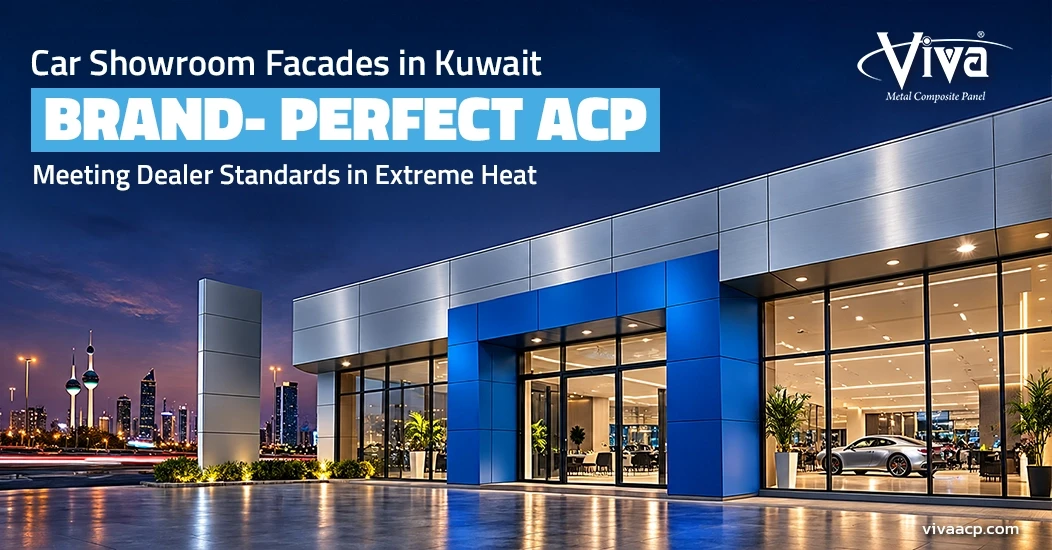
Quick answer Car brands set strict facade standards for their dealers, and ACP is the material most of them specify for fascias, entrance portals, pylons and wall cladding, because it matches brand colours precisely and stays flat over large areas. Solid aluminium is often used for perforated screens and premium details. In Kuwait's extreme heat, use 4 mm fire-rated ACP with a PVDF finish, floating fixings and lighter brand metallics on sun-facing walls. |
Car showrooms are some of the most carefully designed retail buildings in Kuwait. Every major brand has a corporate identity manual that sets the facade down to the millimetre: the colour of the fascia, the height of the portal, the finish of the wall panels and the position of the logo. Dealers who get it wrong can face costly rework.
Aluminium composite panels sit at the heart of most of these brand standards. This guide explains how ACP is used on car showrooms, how to meet brand requirements, what specification works in Kuwait's summer, and how dealer groups keep multiple showrooms consistent.
Why car brands specify ACP
• Exact colour matching: brand silvers, greys, blues and reds can be matched precisely and repeated across sites.
• Perfect flatness: large, flat panels give the clean, high-tech look car brands want.
• Crisp details: folded edges and tight joints match the precision of the cars inside.
• Light weight: large fascias and portals stay light, keeping steelwork simple.
• Durability: PVDF finishes hold their colour and gloss for years with little upkeep.
For most showroom walls and fascias, fire-rated aluminium composite panels are the standard choice. Many premium brands add SolidX solid aluminium panels for perforated screens, curved portals and details where a fully non-combustible metal is preferred.
Where ACP is used on a showroom
|
Element |
Typical treatment |
Brand standard focus |
|
Entrance portal |
A bold frame around the main entrance, often in the signature brand colour |
Exact colour, proportions and logo position |
|
Fascia band |
A continuous band along the top of the glazing |
Height, colour and lighting |
|
Wall cladding |
Large flat panels on solid walls, often silver or grey metallic |
Flatness, joint pattern and gloss level |
|
Brand pylon |
A tall clad totem near the road with the logo |
Height, colour and illumination |
|
Service reception |
Clad canopy and entrance to the workshop |
Consistency with the main showroom |
|
Interior feature walls |
Logo walls and display backdrops |
Finish and lighting |
Meeting brand facade standards
Brand standards are not suggestions. Car makers often inspect new showrooms before approving them, and some tie dealer support to compliance. A few steps make approval much smoother:
• Start with the brand manual: get the latest facade standard from the brand, including colour references, gloss levels and joint layouts.
• Match colours early: ask the panel supplier to produce colour samples against the brand reference and get brand approval before ordering.
• Follow the joint pattern: many brands specify exact panel sizes and joint widths, so plan the layout around them.
• Use approved finishes: some brands list approved coating systems or require specific gloss levels.
• Document everything: keep approved samples, batch numbers and test reports for the brand's inspection.
The right specification for Kuwait
Kuwait has some of the hottest summers on earth, with air temperatures regularly above 45 degrees Celsius and dark panels in full sun much hotter still. Showroom facades also face dust storms and, near the coast, humid salty air.
|
Spec |
Recommendation |
Why |
|
Total thickness |
4 mm |
Stays flat on large showroom walls |
|
Aluminium skin |
0.5 mm |
Better dent resistance and flatness |
|
Core |
Fire-rated (FR or A2) |
Safer choice for public buildings; check local requirements |
|
Coating |
70 percent PVDF |
Holds brand colours and metallic effects in strong sun |
|
Fixing |
Floating fixings with slotted holes |
Panels must move freely with large temperature swings |
|
Panel size |
Moderate sizes, with stiffeners on large panels |
Reduces bowing and oil-canning in the heat |
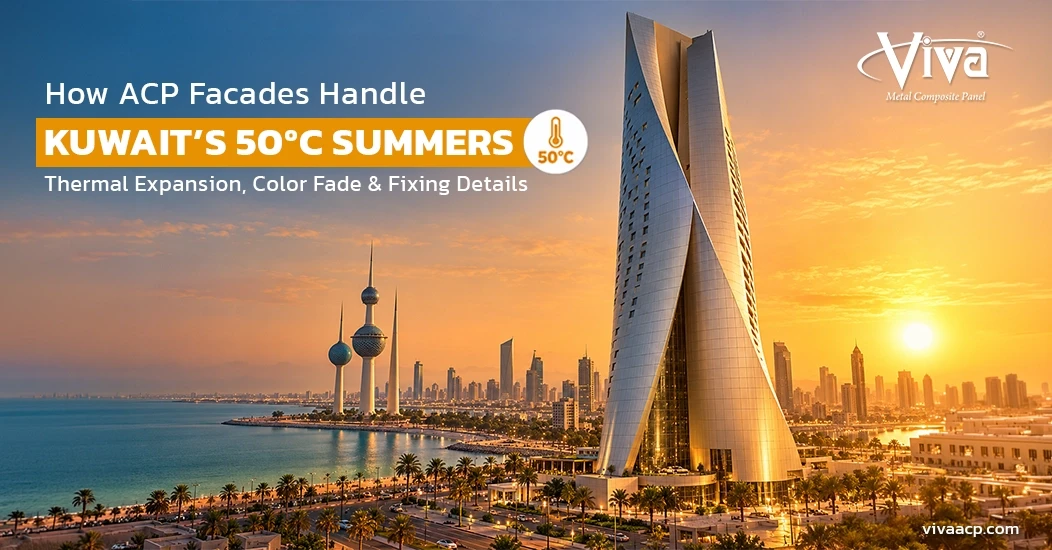
Our earlier guide on how ACP facades handle Kuwait's 50 degree summers covers thermal movement and fixing details in more depth.
Metallic finishes in the heat
Many car brands use silver or grey metallic facades. Metallic finishes look stunning but need extra care.
• Install all panels with the arrows on the protective film pointing the same way. Metallic flakes look different from different angles.
• Order each metallic colour in one batch for each showroom to avoid small shade differences.
• Lighter metallics stay cooler and move less than dark ones on sun-facing walls.
• Use a high-quality PVDF system so the metallic effect does not fade or chalk.
Lighting the showroom facade
Showrooms in Kuwait trade late into the evening, especially in the cooler months. Lighting is part of the brand image.
• Illuminated logos on the portal and pylon.
• LED lines set into fascia grooves for a clean, technical look.
• Soffit downlights over the entrance and display areas.
• Plan cable routes and access panels before the cladding is fixed.
Rolling out across a dealer network
Large dealer groups in Kuwait often represent several brands and run multiple showrooms. Consistency across sites saves time and money.
• Standard details: develop a set of standard drawings for portals, fascias and pylons that can be reused.
• One supplier: order from a manufacturer with the capacity and colour control to supply every site.
• Stock key colours: keep a small stock of each brand colour for repairs and minor works.
• Phased refreshes: when a brand updates its identity, plan the change site by site with matched materials.
Fire safety and approvals in Kuwait
Showrooms are public buildings, so fire safety matters. Fire-rated ACP with an FR or A2 core is the safer choice over standard PE-core sheet, and solid aluminium is non-combustible. Approvals involve Kuwait Municipality and the Kuwait Fire Force. Confirm the current requirements with your consultant and keep the panel test reports ready.
Viva's FR A2 plus aluminium corrugated core panel is certified by Thomas Bell-Wright and suits showrooms that want a high fire margin.
Showroom design trends in Kuwait
• Darker brand identities: several brands are moving to dark grey and black facades with bright logos, which look striking but need careful heat detailing.
• Bigger glass, slimmer frames: more glazing with thin ACP frames and fascias to show off the cars.
• Perforated screens: solid aluminium screens on upper floors to hide service areas and add texture.
• Premium handover areas: dedicated delivery bays with clad canopies and feature lighting.
• Electric vehicle zones: new charging bays and EV displays that use the brand's cladding language.
A typical showroom cladding timeline
|
Stage |
What happens |
Indicative duration |
|
Brand brief and design |
Facade standard received; layouts drawn to brand rules |
2 to 4 weeks |
|
Colour samples and approval |
Samples matched to brand references and approved |
2 to 4 weeks |
|
Shop drawings and approvals |
Detailed drawings, municipality and fire approvals |
3 to 8 weeks |
|
Fabrication |
Panels cut, routed, folded and labelled |
3 to 6 weeks |
|
Installation |
Subframe and panels fixed, lighting integrated |
3 to 8 weeks, depending on size |
|
Brand inspection and handover |
Final checks against the brand standard |
1 to 2 weeks |
These durations are indicative and depend on the brand, the building and approvals. Starting colour approval early is the easiest way to protect the opening date.
Common showroom facade mistakes
• Ordering before brand approval: panels made in an unapproved shade may have to be replaced.
• Using an old brand manual: facade standards change; always check the latest version.
• Locking large dark panels rigidly: they bow in Kuwait's heat and spoil the clean look brands want.
• Mixing metallic batches or directions: the facade looks patchy in sunlight.
• Forgetting service areas: a perfect showroom next to a tired workshop entrance undermines the brand.
• Leaving protective film on: it bakes on in summer and can mark the finish.
Caring for a showroom facade
A car showroom has to look spotless. Wash the facade every one to two months in dusty periods, using water and a mild detergent with soft cloths or sponges. Clean the portal and logo areas more often. Check sealant joints and fixings twice a year, and replace damaged panels quickly from stock so the brand always looks immaculate.
Proven with automotive brands
Viva counts automotive names such as Hyundai, Kia, Volkswagen, Skoda, Mercedes-Benz India, MG and Renault among its clients in India. That experience covers matching brand colours, meeting corporate identity standards and supplying showroom programmes at scale.
With 5 colour coating lines, the first ACP maker in India to run that many, more than 250 in-house quality tests and over 500 shades with custom matching, Viva can hold brand colours steady from one showroom to the next. Its more than 30 global branches support dealer projects across the Gulf.
Frequently asked questions
What cladding do car showrooms use?
Most car showrooms use aluminium composite panels for fascias, entrance portals, pylons and wall cladding, because ACP matches brand colours precisely and stays flat over large areas. Solid aluminium is often used for perforated screens and premium details.
How do dealers meet car brand facade standards?
Start with the brand's latest facade manual, produce colour samples against the brand reference and get approval before ordering, follow the specified panel sizes and joints, use approved finishes and keep samples, batch numbers and test reports for inspection.
Which ACP is best for showrooms in Kuwait?
Use 4 mm fire-rated ACP with 0.5 mm skins and a 70 percent PVDF finish, fixed with floating fixings that allow thermal movement. Keep panel sizes moderate, add stiffeners on large panels and choose lighter metallics for sun-facing walls.
Why do metallic showroom panels look different shades?
Metallic finishes contain flakes that reflect light differently depending on direction. If panels are installed in different directions or come from different batches, they can look like slightly different colours. Install all panels the same way and order each colour in one batch.
Do showroom facades need fire-rated panels?
Showrooms are public buildings, so fire-rated ACP with an FR or A2 core is the safer choice over standard PE-core panels. Requirements depend on the building and local rules, so confirm them with Kuwait Municipality, the Kuwait Fire Force and your consultant.
How long does it take to clad a car showroom?
A typical showroom takes a few months from brand brief to handover, including design, colour approval, shop drawings, approvals, fabrication and installation. The installation itself often takes three to eight weeks, depending on size. Early colour approval protects the opening date.
Can ACP match a car brand colour exactly?
Yes. ACP can be colour-matched to a brand reference such as a RAL, Pantone or brand-specific code. The supplier produces samples for brand approval, then keeps the same coating system and gloss level for every batch, so the colour stays consistent across showrooms.
Building or refreshing a showroom in Kuwait? Share the brand, facade standard and site details through the enquiry form ,and the Viva Gulf team will prepare colour-matched samples for brand approval.
POPULAR POSTS
CATEGORIES
- Aluminium Compsoite panel 2
- ACP Sheet 3
- ACP Facade 3
- Copper Aluminium Sheet 0
- Fire Safety For Buildings 1
- ACP Cladding 2
- Colour Coated Aluminium Coil 0
- Aluminium Corrugated Composite Panel 0
- Facades 2
- Aluminium Honeycomb Panel 1
- Fire Retardant 1
- Zinc Composite Panel 0
- Corten Steel Series 0
- Metal Abstract Series 1
- Wooden ACP Sheet 0
- HPL Sheet 0
- Viva ACP Colour Coating 0
- Wall Cladding 1
- Applications of ACP Panel 0
- Viva ACP 1
- ACP Sheets for Architectural Projects 0
- PVDF vs Polyester 0
- ACP Sheets For Showroom 0
- Viva ACP on International Market 0
- Viva royal club app 0
- ACP Sheets for Branding Corporates 0
- Shades of Santa Fe 0
- Al Zinc Series 0
- ACP Sheet Sizes and Thicknesses 0
- Louvers and Baffles 0
- Sustainable Facades 0
- Aluminium composite material 0
ARCHIVES
Shades in this article

Explore the ranges
Published by VIVA - Asia's Largest Manufacturer of Aluminium Composite Panels. 15M sq.mt capacity | 500+ shades | Thomas Bell-Wright FR A2+ Certified