

 en
en
 Spanish
 Arabic
 Swahili
 French


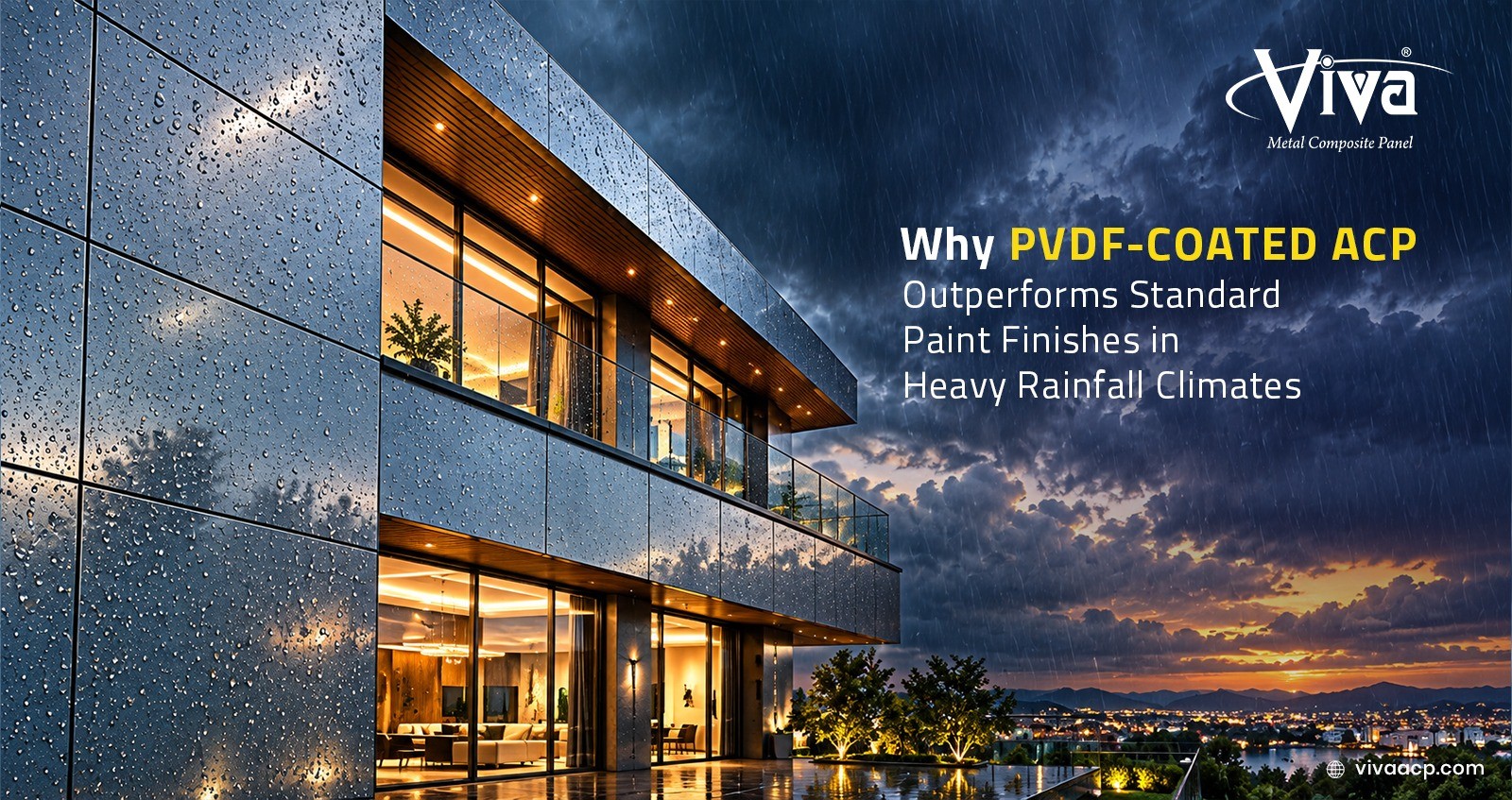
India's monsoon isn't gentle.
Cities like Mumbai see over 3,000mm of rainfall a year, while coastal regions
like Kerala, Chennai, and Mangalore deal with heavy rain plus humidity and salt
exposure for much of the year. Add in the intense pre-monsoon heat and the
sudden temperature swings that follow, and you have one of the toughest climate
combinations any building exterior can face.
For any building exterior,
that's a serious, repeated test — and it's exactly where the difference betweenPVDF-coated ACP and standard paint finishes becomes obvious. This Viva ACP's guide breaks
down what actually happens to these two finishes over time, and why one
consistently outperforms the other in India's wettest regions.
The Problem with Standard Paint Finishes
Traditional painted exteriors —
whether on concrete, wood, or metal — weren't built for this kind of
punishment. Paint is essentially a thin film applied to a surface, and over
time, sun, rain, humidity, and pollution all work against it. In India's monsoon-heavy
regions, that breakdown happens faster than most building owners expect.
Here's what typically happens to
a standard painted exterior over just a few monsoon seasons:
•
Fading and dull, patchy color. UV exposure
breaks down pigment molecules, and repeated rain washes out color unevenly,
leaving a blotchy, aged appearance.
•
Peeling and cracking. Moisture seeps beneath the
paint layer, especially at joints and edges, weakening its bond to the surface
until it starts to lift and flake.
•
Water staining that's difficult to clean off. Monsoon
runoff carries dust and pollutants that streak across painted surfaces, leaving
marks that don't wash away easily.
•
Algae and fungal growth. Constant moisture
combined with India's warm temperatures creates ideal conditions for algae and
mold to take hold on painted exteriors, especially in shaded or poorly
ventilated areas.
•
More frequent repainting — and repainting costs. Most
painted exteriors in high-rainfall regions need touch-ups or full repaints
every 3 to 5 years, sometimes sooner near the coast.
In a country where monsoon
returns every single year without fail, these issues aren't occasional. They're
expected — which is exactly why more architects and developers are moving away
from paint for exterior finishes altogether.
What Makes PVDF Coating Different
PVDF (Polyvinylidene Fluoride)
is a high-performance coating used on ACP panels, typically formulated with a
high concentration of Kynar 500 resin — a fluoropolymer originally developed
for extreme-weather industrial applications. Instead of sitting on the surface
like a layer of paint, PVDF forms a tightly bonded, chemically stable finish
that becomes part of the panel itself during the manufacturing process.
This is a fundamentally
different approach to weather protection, and it shows in how the material
performs over years of exposure rather than months.
Long-Lasting Color Retention
PVDF-coated panels are
engineered to hold their color for 25 years or more, even with constant UV
exposure and repeated wet-dry cycles. The coating's molecular structure resists
the breakdown that causes paint to fade and chalk over time.
Water Doesn't Stick Around
The coated surface has a
naturally low affinity for water, meaning rain sheets off rather than pooling
or soaking in. This significantly reduces staining, streaking, and the kind of
water damage that plagues painted exteriors during monsoon season.
Self-Cleaning Behavior
Because dust and grime don't
bond tightly to the coated surface, monsoon rain actually helps keep
PVDF-coated ACP panels clean, washing away everyday dirt and pollution instead
of trapping it against the surface.
No Swelling, Warping, or Corrosion
Unlike wood, which swells and
warps with repeated moisture exposure, or untreated metal, which can corrode,
ACP with PVDF coating stays dimensionally stable through year after year of
wet-dry cycles. This is especially valuable in coastal cities where salt-laden
air accelerates corrosion on many other materials.
Resistance to Algae and Fungal Growth
The smooth, non-porous nature of
PVDF-coated panels makes it much harder for algae, moss, and fungal growth to
establish themselves compared to the more porous surface of painted concrete or
plaster.
Why This Matters for Indian Buildings Specifically
Every region in India has its
own climate challenge — Mumbai's sheer volume of rainfall, Chennai's
combination of heat and humidity, coastal cities' relentless salt spray, and
the Northeast's near-constant dampness for much of the year. PVDF-coated ACP is
tested and formulated to perform across all of these conditions, which is a big
part of why it has become the standard choice for exterior cladding in India,
rather than an upgrade reserved only for premium projects.
Architects and developers
working across multiple Indian cities also benefit from a single, reliable
specification that performs consistently whether the building sits in Mumbai's
monsoon corridor, Chennai's humid coastline, or Delhi's more seasonal but still
significant rainfall.
Comparing the Real Costs Over Time
On paper, standard paint often
looks like the cheaper option — and at the moment of initial application, it
usually is. But that comparison changes significantly once you factor in the
full lifecycle of the finish.
•
Standard paint: Lower upfront cost, but
repainting every 3–5 years in high-rainfall regions, plus scaffolding, labor,
and building downtime each time.
•
PVDF-coated ACP: Higher upfront cost, but 25+
years of color retention with minimal maintenance beyond routine cleaning.
When you add up the cost of
repeated repainting — materials, labor, equipment, and the disruption to a
building's occupants or business operations — PVDF-coated ACP often works out
to be the more economical choice over the life of a building, not just the more
durable one.
Where PVDF-Coated ACP Makes the Biggest Difference
While every exterior surface
benefits from better weather resistance, some situations make the case for
PVDF-coated ACP even more compelling:
•
High-rise buildings. Repainting tall structures
is expensive and logistically difficult, making a long-lasting finish
especially valuable.
•
Coastal properties. Salt spray accelerates the
breakdown of most conventional finishes, but PVDF-coated ACP is specifically
formulated to resist this kind of environmental stress.
•
Commercial and retail facades. A building's
exterior is often its first impression — fading or peeling paint sends the
wrong message to customers and clients.
•
Public infrastructure. Transport hubs,
hospitals, and institutional buildings need finishes that hold up under
constant use with minimal maintenance windows.
The Bigger Picture: Less Maintenance, Lower Long-Term Cost
While PVDF-coated ACP cost a
little more upfront than standard painted finishes, the savings show up later —
fewer repaints, less facade maintenance, and a building that still looks sharp
a decade or two down the line, even after dozens of monsoon seasons.
For any project in a
monsoon-heavy region, that's not just a design choice. It's a practical,
long-term investment in how a building performs and looks for decades, not just
years.
Understanding How PVDF Coating Is Applied
PVDF coating isn't sprayed on
after the ACP panel is manufactured — it's applied to the aluminum coil itself
through a continuous coil-coating process, before the panel is even formed. The
aluminum coil passes through a series of rollers, cleaning stages, and curing
ovens, where multiple thin layers of PVDF resin are baked onto the surface at
high temperatures.
This process creates a much
stronger, more uniform bond than hand-applied paint could ever achieve, which
is a big part of why the coating performs so differently once it's exposed to
years of monsoon rain and intense sun. The high-temperature curing process is
also what gives PVDF its exceptional resistance to chalking, fading, and
chemical degradation.
How to Identify Genuine PVDF-Coated ACP
As PVDF-coated ACP has grown in
popularity across India, it's become important for architects, contractors, and
building owners to know how to distinguish genuine PVDF coatings from
lower-grade alternatives that are sometimes marketed under similar names.
•
Ask for the resin content. Genuine PVDF coatings
typically use a high concentration of Kynar 500 or similar fluoropolymer resin
— ask your supplier to confirm this percentage.
•
Request test certificates. Reputable
manufacturers can provide weathering and performance test data, often based on
international standards like AAMA 2605.
•
Check the warranty terms. A strong PVDF coating
typically comes with a meaningful color-retention warranty — vague or short
warranties can be a sign of a lower-grade coating.
•
Compare gloss retention claims. Genuine PVDF
coatings are formulated to retain gloss and color far longer than standard
polyester coatings, and manufacturers should be able to back this up with data.
Choosing the Right Panel for Different Parts of a Building
Not every surface on a building
faces the same level of weather exposure, and it's worth thinking through where
PVDF-coated ACP delivers the most value.
•
Street-facing facades. These surfaces take the
brunt of wind-driven rain and pollution, making them the highest priority for
PVDF-coated panels.
•
Rooftop and upper-floor cladding. Higher
sections of a building are more exposed to sun and driving rain, and are also
the most expensive and disruptive to repaint later.
•
Ground-floor and podium levels. While slightly
more sheltered, these areas are still exposed to splash-back from monsoon
runoff and benefit from the same long-term protection.
•
Balconies and sun shades. Horizontal or angled
surfaces tend to collect standing water during heavy rain, making
water-shedding performance especially valuable here.
What Architects and Developers Are Increasingly Choosing
Across major Indian cities,
there's a clear shift underway. Where painted concrete and plaster finishes
were once the default for mid-rise and high-rise buildings, more architects and
developers are now specifying PVDF-coated ACP as the standard exterior material
— not just for premium projects, but increasingly for mainstream commercial and
residential developments as well.
This shift reflects a broader
recognition that in a climate as demanding as India's, the true cost of a
building material has to include what happens to it over 10, 15, or 20 years of
monsoon seasons — not just what it costs to install on day one.
A Practical Checklist Before You Specify Your Facade Finish
If you're weighing PVDF-coated
ACP against standard paint for an upcoming project, a few practical questions
can help clarify the decision:
•
How many monsoon seasons will this building need to
withstand before its next planned renovation? The longer the horizon, the
stronger the case for a coating designed to last decades rather than years.
•
Is the building in a coastal zone or a region with
especially heavy rainfall? These conditions accelerate the breakdown of
standard finishes and make the case for PVDF even stronger.
•
How disruptive would repainting be to occupants or
business operations? For hospitals, offices, hotels, and retail spaces, the
hidden cost of repainting downtime often outweighs the price difference between
materials.
•
What does the building's ownership value more —
lowest upfront cost, or lowest cost over the building's lifetime? This
single question often settles the decision on its own.
For most projects built to last,
the answer becomes clear once the full picture — not just the initial invoice —
is on the table.
Frequently Asked Questions
How is PVDF different from PVC or standard polyester coatings?
PVDF offers significantly better
UV and weather resistance than standard polyester coatings, and is generally
considered the premium standard for exterior-grade ACP, particularly in
demanding climates like India's monsoon regions.
Does PVDF-coated ACP need any maintenance at all?
Routine cleaning with mild
detergent and water is generally all that's needed. Unlike painted surfaces,
there's no need for periodic repainting or touch-ups under normal conditions.
Is PVDF-coated ACP suitable for coastal buildings?
Yes — its resistance to salt
spray and corrosion makes it particularly well-suited for coastal cities, where
standard finishes tend to degrade much faster.
How much more expensive is PVDF-coated ACP compared to standard paint?
Upfront costs are typically
higher than paint, but when factored against 20+ years of reduced maintenance
and repainting, the total cost of ownership is often lower over the building's
lifetime.
Can PVDF-coated ACP be installed on an existing painted building?
Yes. PVDF-coated ACP is commonly
used in re-cladding and renovation projects, mounted onto an engineered
sub-frame over the existing wall. This makes it a practical way to upgrade an
older, paint-finished building's weather resistance without a full structural
overhaul.
POPULAR POSTS
CATEGORIES
- Aluminium Compsoite panel 52
- ACP Sheet 170
- ACP Facade 9
- Copper Aluminium Sheet 1
- Fire Safety For Buildings 3
- ACP Cladding 14
- Colour Coated Aluminium Coil 2
- Aluminium Corrugated Composite Panel 1
- Facades 7
- Aluminium Honeycomb Panel 6
- Fire Retardant 8
- Zinc Composite Panel 4
- Corten Steel Series 1
- Metal Abstract Series 3
- Wooden ACP Sheet 1
- HPL Sheet 3
- Viva ACP Colour Coating 1
- Wall Cladding 2
- Applications of ACP Panel 1
- Viva ACP 14
- ACP Sheets for Architectural Projects 3
- PVDF vs Polyester 3
- ACP Sheets For Showroom 1
- Viva ACP on International Market 1
- Viva royal club app 1
- ACP Sheets for Branding Corporates 1
- Shades of Santa Fe 1
- Al Zinc Series 1
- ACP Sheet Sizes and Thicknesses 1
- Louvers and Baffles 1
- Sustainable Facades 1