en
 Spanish
 Arabic
 Swahili
 French


|
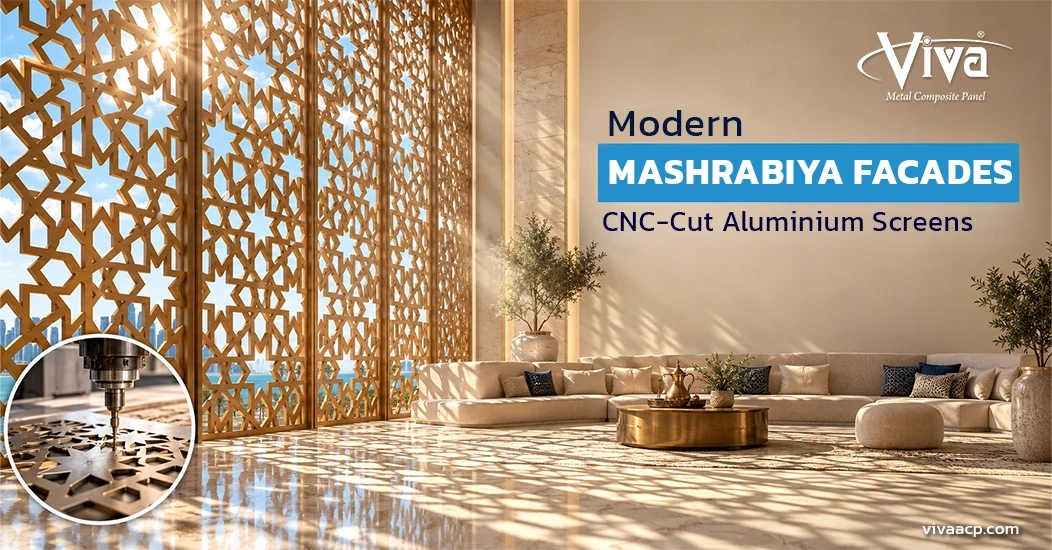
Quick answer A modern mashrabiya facade uses CNC-cut or perforated aluminium panels in place of the traditional timber lattice, giving shade, privacy and airflow with very little upkeep. In Qatar, solid aluminium panels are usually the best choice for perforated screens because they have no core at the cut edges. A2 fire-rated ACP or honeycomb panels suit large, flat cladding around them. |
Walk through Msheireb or look up at Doha Tower in West Bay and you can see how Qatar has reinvented the mashrabiya. The carved timber screens that once shaded old Doha houses have become precise aluminium skins, cut by machine and wrapped around towers, museums and homes.
The idea has not changed: keep out the harsh sun, let air through, protect privacy, and throw beautiful shadows across the floor. What has changed is the material. This guide covers how to design a mashrabiya-inspired facade in Qatar, how pattern density affects light and heat, and which aluminium panel to use where.
The mashrabiya in Qatari architecture today
A traditional mashrabiya is a projecting window screen made of turned or carved wood. It let families look out without being seen, cooled air passing through it, and cut the glare of Gulf sunlight down to a soft dappled light.
Modern Qatari architecture borrows all three of those jobs. Doha Tower, designed by Jean Nouvel, wraps its glass in layers of patterned aluminium screens. Msheireb Downtown Doha uses shaded courtyards, deep reveals and screens drawn from local building traditions. Villas in Al Waab, The Pearl and Lusail now regularly use CNC-cut panels on boundary walls, balconies and stair cores.
Choosing the right panel for a mashrabiya screen
Not every aluminium panel suits a heavily cut pattern. The main issue is the cut edge: once you cut a composite panel into a lattice, every opening exposes the core.
|
Panel |
How it handles CNC cutting |
Fire |
Best use in a mashrabiya design |
|
Solid aluminium panel (2 to 4 mm) |
Excellent; no core exposed, clean edges |
Non-combustible (A1) |
Perforated and CNC-cut screens, balcony and stair screens |
|
A2 fire-rated ACP |
Good for simple cut-outs; edges need sealing |
A2-s1,d0 |
Flat cladding behind or around the screen, large plain areas |
|
FR ACP |
Good for simple cut-outs; edges need sealing |
B-s1,d0 |
Low-rise villas and boundary walls, within approved systems |
|
Aluminium honeycomb panel |
Limited cutting; very stiff and flat |
A1 or A2, depending on build-up |
Large flat panels, soffits and stone-look feature walls |
For most designs, the answer is a mix: a solid aluminium screen for the patterned layer, set in front of A2 fire-rated ACP or honeycomb panels on the main wall. That keeps every cut edge in a non-combustible material and gives the flattest finish on the large surfaces.
Viva has written about the role of perforated solid aluminium panels in climate-responsive buildings , which covers the material in more depth.
Pattern density, shade and light
The most important number in a screen design is the open area: the share of the panel that is cut away. It controls how much sun, light, air and view get through.
|
Open area |
Shade and glare |
Light and view |
Typical use in Qatar |
|
15 to 25% |
Very high shading, strong glare control |
Low; strong privacy |
West-facing walls, bedrooms, majlis privacy screens |
|
30 to 40% |
Balanced shading |
Moderate; filtered views out |
Offices, apartments, stair cores |
|
45 to 60% |
Moderate shading |
High; good views and airflow |
North elevations, car park screens, lobbies |
A useful trick is to vary the density across the elevation: denser where the sun is strongest and privacy matters most, more open at eye level in shared spaces or on north-facing walls. With CNC cutting, that variation costs very little extra.
• Orientation: west and south elevations take the strongest sun in Qatar; give them the densest patterns.
• Depth: a screen set 300 to 600 mm in front of the glass shades far better than one fixed directly to it.
• Airflow: leave the cavity open at the top and bottom so hot air can rise and escape.
• Shadows: test the pattern with a sun study; the shadows on the floor inside are part of the design.
From pattern to fabrication
Most mashrabiya patterns today start as parametric designs in software such as Rhino and Grasshopper. The design team adjusts pattern size and density, then exports cutting files for the CNC router or laser.
• Keep the solid strips between openings at least about two times the panel thickness, so the screen stays stiff.
• Avoid very small, sharp internal corners, which slow cutting and can crack during handling.
• Use a repeating module that fits standard panel sizes to cut waste.
• Plan where the panel joints will fall so they line up with the pattern, not across it.
• Finish cut edges in the same coating as the face where they will be seen up close.
Viva's article on how parametric facade designs get manufactured at scale walks through this process from design file to finished panel.
Finishes that suit Qatar
• Warm metallics: bronze, champagne and gold tones reflect Qatar's tradition of rich detailing.
• Wood-look finishes: give the warmth of a traditional timber mashrabiya without warping or termites.
• Sand and stone tones: sit quietly in desert light and hide dust between cleans.
• PVDF coatings: essential outdoors, where UV and summer heat are intense.
Fire and approvals in Qatar
In Qatar, building fire safety is approved by the Qatar Civil Defence Department (QCDD). A perforated screen is still part of the facade, so it needs to meet the same fire requirements as the rest of the external wall.
This is one more reason solid aluminium works so well for screens: it is non-combustible, so the cut pattern does not create any fire weakness. For the main cladding, specify A2 fire-rated panels on taller buildings and anywhere the consultant requires them, and keep the test reports and certificates ready for QCDD submission.
Living with a mashrabiya facade
Aluminium screens are far easier to live with than timber, but they still need care in Qatar's dust and humidity:
• Wash screens two to four times a year with water and a mild detergent.
• Make sure maintenance access reaches the back of the screen and the glass behind it.
• Check fixings and brackets yearly, especially on coastal sites near The Pearl or Lusail.
• Avoid patterns so fine that birds can nest in them or dust packs into them.
A simple design process for a mashrabiya facade
Projects that go smoothly tend to follow the same order. Skipping steps usually shows up later as patterns that are hard to fabricate or screens that don't shade as intended.
• Start with orientation: map which elevations get the strongest sun and where privacy matters most.
• Choose a pattern family: traditional geometric stars, abstract parametric forms, or calligraphy-inspired motifs.
• Set open-area targets: decide how much light and view each zone needs, then vary the density.
• Check fabrication early: share sample cutting files with the panel supplier before the design is frozen.
• Mock up a full-size panel: look at it on site in morning and afternoon light.
• Confirm fire and approvals: agree the panel types with the fire consultant before tender.
Mashrabiya patterns indoors
The same panels work inside. Hotels, majlis rooms, malls and offices across Doha use CNC-cut aluminium screens as room dividers, ceiling features, lift lobby walls and lighting backdrops. Indoors, ACP with wood, metallic or marble finishes is often the most economical choice, since edges are protected from weather. A backlit screen can turn a plain lobby into a signature space.
Cost and value
A mashrabiya facade costs more than flat cladding, mainly because of CNC machine time, extra subframe and the screen layer itself. A few choices keep it under control:
• Use one or two repeating modules instead of a unique pattern on every panel.
• Keep the screen to the elevations where it does the most work, often west and south.
• Match panel sizes to standard sheet widths to reduce waste.
• Count the savings too: lower cooling loads and less need for blinds or film on the glass.
Screens, GSAS and cooling loads
Qatar's Global Sustainability Assessment System (GSAS) puts weight on energy performance, and in Qatar that mainly means cooling. Summer highs in Doha regularly reach the mid-40s °C, and humidity near the coast makes it feel hotter still.
An external screen is one of the most effective ways to cut solar gain, because it stops the sun before it reaches the glass. Internal blinds only catch the heat once it is already inside. A well-designed mashrabiya facade can therefore help with GSAS energy credits, reduce chiller sizes and make interiors more comfortable near the windows.
Where screens work best
• Residential towers: balcony screens give privacy between neighbours and shade living rooms.
• Villas: boundary walls, upper-floor windows and roof terraces gain privacy without losing airflow.
• Car parks: screens hide parked cars while letting fumes escape naturally.
• Schools and mosques: filtered daylight with less glare suits classrooms and prayer halls.
• Hotels and malls: signature entrances and atria with dramatic shadow patterns.
Viva in Qatar
Viva has already helped shape parts of the skyline, as covered in Viva ACP: Redefining the Skyline of Qatar. Viva was the first in India to offer pre-coated, ready-to-install solid aluminium panels, which suit CNC-cut screens, and its range covers 500+ shades with custom colours and finish warranties of up to 30+ years depending on product.
Frequently asked questions
What is a mashrabiya facade?
A mashrabiya facade is a modern version of the traditional Arabic lattice window screen. It uses perforated or CNC-cut panels, usually aluminium today, to shade the building, filter light, allow airflow and give privacy, while creating patterned shadows inside.
Which material is best for a mashrabiya screen?
Solid aluminium panels are usually best for heavily cut or perforated screens because they have no core at the cut edges, stay non-combustible and keep clean edges. A2 fire-rated ACP or aluminium honeycomb panels suit the flat cladding around the screen.
Can ACP sheets be CNC cut into patterns?
Yes, ACP can be CNC cut into patterns, and it works well for simpler cut-outs on low-rise buildings. Every cut exposes the core, though, so edges should be sealed, and for dense lattice patterns on taller buildings solid aluminium is the better choice.
How much open area should a mashrabiya screen have?
It depends on the job. Around 15 to 25 percent open area gives strong shade and privacy, 30 to 40 percent balances shade and views, and 45 to 60 percent gives more light and airflow. Many designs vary the density across the facade.
Do perforated facade screens need fire approval in Qatar?
Yes. Perforated screens are part of the external wall, so they fall under Qatar Civil Defence Department requirements. Using non-combustible solid aluminium for the screen and A2 fire-rated panels for the main cladding makes approval simpler.
Does a mashrabiya screen reduce cooling costs?
Yes. An external screen blocks sunlight before it reaches the glass, which is far more effective than internal blinds. In Qatar's climate, a well-designed screen with the right open area can noticeably reduce solar heat gain, help with GSAS energy credits and make rooms near windows more comfortable.
Designing a screen facade in Qatar? Send your pattern idea, elevation size and preferred finish through the enquiry form, and Viva's team will advise on panel type, thickness and open area.
POPULAR POSTS
CATEGORIES
- Aluminium Compsoite panel 2
- ACP Sheet 3
- ACP Facade 2
- Copper Aluminium Sheet 0
- Fire Safety For Buildings 1
- ACP Cladding 2
- Colour Coated Aluminium Coil 0
- Aluminium Corrugated Composite Panel 0
- Facades 2
- Aluminium Honeycomb Panel 1
- Fire Retardant 1
- Zinc Composite Panel 0
- Corten Steel Series 0
- Metal Abstract Series 1
- Wooden ACP Sheet 0
- HPL Sheet 0
- Viva ACP Colour Coating 0
- Wall Cladding 1
- Applications of ACP Panel 0
- Viva ACP 1
- ACP Sheets for Architectural Projects 0
- PVDF vs Polyester 0
- ACP Sheets For Showroom 0
- Viva ACP on International Market 0
- Viva royal club app 0
- ACP Sheets for Branding Corporates 0
- Shades of Santa Fe 0
- Al Zinc Series 0
- ACP Sheet Sizes and Thicknesses 0
- Louvers and Baffles 0
- Sustainable Facades 0
ARCHIVES
Published by VIVA - Asia's Largest Manufacturer of Aluminium Composite Panels. 15M sq.mt capacity | 500+ shades | Thomas Bell-Wright FR A2+ Certified