en
 Spanish
 Arabic
 Swahili
 French


|
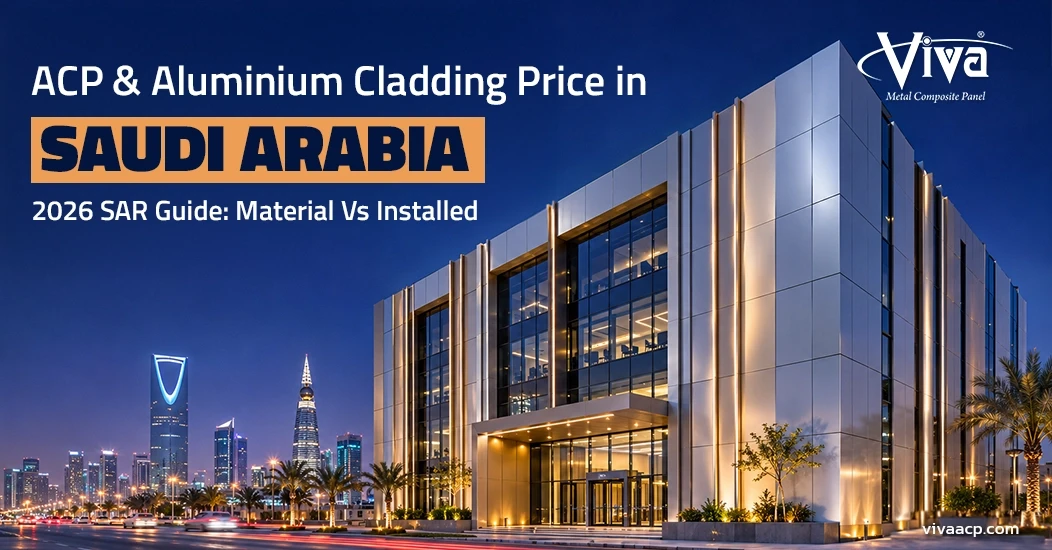
Quick answer In Saudi Arabia, the price of ACP cladding depends mainly on the core (FR or A2), the finish, the installation system and the size and height of the building. Installation, fabrication and framing usually make up the larger share of the final installed cost, often more than the panels themselves. As a rule of thumb, A2 cores cost more than FR cores, specialty finishes cost more than solid colours, and rainscreen and cassette systems cost more than basic sealed systems. |
Ask three contractors in Riyadh what ACP cladding costs and you may get three very different numbers. One is quoting panels only. Another includes fabrication and framing. The third is pricing a fully engineered rainscreen with A2 panels for a tower. All three can be right.
This guide breaks the price into its parts so you can compare quotes fairly. It explains what drives the cost of aluminium composite panels and aluminium cladding in Saudi Arabia, how fire rules affect the budget, and how to get a quote you can plan around.
Material price vs installed price
The first thing to check in any quote is what it includes. There are two very different numbers in the market:
• Material price: the cost of the aluminium composite panels alone, usually quoted per square metre of sheet.
• Installed price: the cost of a finished facade, including panels, fabrication, subframe, fixings, sealants, flashing, labour, access equipment and supervision.
On most commercial projects, the panels are well under half of the installed cost. Labour, fabrication and framing make up the rest. That is why the cheapest panel rarely gives the cheapest facade.
Indicative price ranges in Saudi Arabia (2026)
The table below shows indicative ranges for planning. Real quotes vary with order size, finish, freight, city and project complexity.
|
Panel type (4 mm) |
Material only (SAR per sq m) |
Installed (SAR per sq m) |
Typical use |
|
FR core, PVDF solid colour |
[to be confirmed] |
[to be confirmed] |
Low and mid-rise commercial, retail, villas |
|
A2 core, PVDF solid colour |
[to be confirmed] |
[to be confirmed] |
Towers, hotels, hospitals, malls |
|
FR or A2, metallic or wood finish |
[to be confirmed] |
[to be confirmed] |
Feature areas and branded facades |
|
Solid aluminium (SolidX, 3 mm) |
[to be confirmed] |
[to be confirmed] |
Non-combustible facades, screens, soffits |
Viva's Gulf team can share current prices for your project. The relative guide below holds true in most markets and helps you sense-check any quote.
|
Choice |
Effect on price (relative) |
|
FR core to A2 core |
A2 usually costs noticeably more than FR |
|
Solid colour to metallic, wood or stone finish |
Specialty finishes add a premium |
|
Polyester to PVDF coating |
PVDF costs more but is essential outdoors in Saudi sun |
|
Standard shade to custom colour |
Custom colours may need minimum quantities and longer lead times |
|
Sealed system to rainscreen or cassette |
Engineered systems cost more to fabricate and install |
|
Low-rise to high-rise |
Access, wind design and approvals add cost with height |
What drives the price of ACP cladding
1. Core type and fire rating
This is the biggest material decision. PE cores are not suitable for building facades. FR cores, with a mineral-filled core, are used on many low and mid-rise buildings. A2 cores, with very limited combustibility, are increasingly the default for towers, hotels, hospitals and giga-project buildings, and they cost more.
2. Coating and finish
In Saudi Arabia's intense sun, a 70 percent PVDF coating is not optional on exterior walls. Within PVDF, solid colours are the most economical. Metallics, wood grain, stone textures and custom brand colours add to the price.
3. Installation system
A basic sealed system is the cheapest to install. Dry joint, rainscreen and cassette systems cost more but manage water and heat better and give cleaner lines. On high-profile buildings, the system choice can move the installed price more than the panel choice.
4. Building height and complexity
Taller buildings need more wind engineering, stronger subframes, longer access (mast climbers, BMUs or rope access) and stricter fire documentation. Curves, many panel sizes and complex corners all add fabrication time.
5. Project size and location
Large volumes in a standard shade price better per square metre. Freight costs differ between Riyadh, Jeddah, Dammam and remote giga-project sites, and labour rates vary by city and season.
How fire rules affect your budget
Saudi Arabia's building code, the SBC, is based largely on the International Building Code. Exterior walls must meet flame spread limits, and taller buildings often need wall assemblies tested for fire propagation. Civil Defense reviews fire safety as part of the permit.
In practice, that means many Saudi projects need FR or A2 cores and a tested system, and changing the fire strategy late can be expensive. Settle the core type with your consultant early, and make sure every quote prices the same core.
Why Saudi conditions affect cost
• Heat: panels need floating fixings and correct joint widths, which adds care in fabrication and installation.
• Dust: a self-cleaning finish costs a little more but can reduce facade cleaning costs over the years.
• Coastal sites: in Jeddah and the Eastern Province, stainless fixings and sealed edges add a small premium but prevent costly corrosion repairs.
• Working hours: summer midday work restrictions can stretch installation programmes, which affects labour cost.
Sample budget structure for a mid-rise facade
Here is how the cost of a typical 5,000 sq m facade with FR-core ACP and a dry joint system usually splits. The percentages are typical proportions, not fixed figures.
|
Line item |
Typical share of installed cost |
|
ACP panels (including waste) |
About 20 to 30 percent |
|
Fabrication (routing, folding, extrusions) |
About 15 to 20 percent |
|
Subframe, brackets and fixings |
About 15 to 20 percent |
|
Installation labour |
About 25 to 35 percent |
|
Flashing, sealants and trims |
About 5 to 8 percent |
|
Access equipment, freight and supervision |
About 5 to 10 percent |
If a quote comes in far below this shape, check what is missing. Framing, flashing, access and fire documentation are the usual gaps.
Why prices differ between Saudi cities
|
Location |
What affects the price |
|
Riyadh |
High demand, large projects and strict developer standards; strong competition among contractors |
|
Jeddah and the Red Sea coast |
Coastal specification (stainless fixings, sealed edges) and humid working conditions |
|
Dammam, Al Khobar and the Eastern Province |
Industrial and commercial work, coastal exposure and port access for imports |
|
Giga-project and remote sites |
Long freight routes, site logistics, accommodation for crews and strict documentation |
Hidden costs to look for in a quote
• Access equipment: mast climbers, scaffolding, cranes or BMU time can be a large line item on tall buildings.
• Engineering and shop drawings: structural calculations and detailed drawings are sometimes priced separately.
• Fire documentation: test reports, engineering judgements and approvals support may carry a cost.
• Mock-ups: many consultants ask for a full-size facade mock-up before approval.
• Waste allowance: complex layouts can push sheet waste well above the usual allowance.
• Protection and cleaning: protecting finished panels and cleaning at handover.
Asking every bidder to price the same list of items is the simplest way to compare quotes fairly.
How to get an accurate quote
A quote is only as good as the information behind it. Send these details with your request:
• Facade area in square metres, with elevations or drawings.
• Building height, use and city.
• Required core (FR or A2) and the fire strategy from your consultant.
• Colour or finish, and panel thickness.
• Preferred installation system, if known.
• Target delivery and installation dates.
Lead times and how they affect price
Price and time are linked. Standard shades in common thicknesses are usually available faster and at better prices than custom colours, special finishes or unusual sheet sizes. Large projects in Saudi Arabia often run for years, so many developers agree a supply plan with the manufacturer early, with colour approval, batch planning and delivery phases set out in advance. Rushed orders, late design changes and split deliveries tend to push costs up. Planning panel supply alongside the construction programme is one of the simplest ways to protect both budget and colour consistency.
Ways to control cost without cutting corners
• Design to the sheet: lay out panels around standard sheet widths to cut waste.
• Pick standard shades for large areas and save custom colours for brand features.
• Keep panel sizes consistent to speed up fabrication.
• Lock the fire strategy early to avoid late redesign.
• Order in one batch to avoid colour differences and extra freight.
• Compare installed prices, not panel prices.
Why Viva for Saudi projects
Viva, which describes itself as Asia's largest ACP manufacturer, has more than 15 million sq m of annual capacity and 5 colour coating lines, the first ACP maker in India to run that many. That scale supports large Saudi projects with consistent colour over long programmes. Viva makes FR and A2 cores, SolidX solid aluminium and stone honeycomb panels, with over 500 shades, more than 250 in-house quality tests and product-specific warranties of 30 years and more. See Viva's guide to aluminium cladding for Saudi heat and dust for the technical side of specification.
Frequently asked questions
What affects the price of ACP cladding in Saudi Arabia?
The main factors are the core type (FR or A2), the coating and finish, the installation system, the building height and complexity, the project size and the city. Installation, fabrication and framing usually make up more of the installed cost than the panels themselves.
Is A2 ACP more expensive than FR ACP?
Yes. A2-core ACP usually costs more than FR-core ACP because of its higher mineral content or aluminium core, extra manufacturing and testing. For towers and higher-risk buildings, many consultants and developers now specify A2, so it is worth pricing early.
Why do ACP quotes in Saudi Arabia vary so much?
Quotes vary because they often include different things. Some cover panels only, others include fabrication, framing, labour and access. They may also price different cores, finishes and systems. Always compare quotes on the same specification and scope.
How can I reduce the cost of ACP cladding?
Design panel layouts around standard sheet sizes, use standard shades for large areas, keep panel sizes consistent, settle the fire strategy early and order each colour in one batch. Compare installed prices rather than panel prices alone.
Is PVDF coating necessary in Saudi Arabia?
For exterior facades, yes. Saudi Arabia's strong sun and heat break down polyester coatings quickly, causing fading and chalking. A 70 percent PVDF coating holds its colour far longer and is the standard for exterior ACP in the Gulf.
Does solid aluminium cost more than ACP in Saudi Arabia?
Usually yes. Solid aluminium panels cost more than ACP in both material and fabrication, but the gap is smaller when compared with A2-core ACP. Solid aluminium is chosen where a fully non-combustible facade, heavy perforation or complex shapes are needed.
Planning a facade in Saudi Arabia? Share your drawings, area, building height and city through the enquiry form , and the Viva Gulf team will send current pricing along with the fire test documents your consultant will need.
POPULAR POSTS

CATEGORIES
- Aluminium Compsoite panel 2
- ACP Sheet 3
- ACP Facade 1
- Copper Aluminium Sheet 0
- Fire Safety For Buildings 1
- ACP Cladding 4
- Colour Coated Aluminium Coil 0
- Aluminium Corrugated Composite Panel 0
- Facades 2
- Aluminium Honeycomb Panel 1
- Fire Retardant 1
- Zinc Composite Panel 0
- Corten Steel Series 0
- Metal Abstract Series 1
- Wooden ACP Sheet 0
- HPL Sheet 0
- Viva ACP Colour Coating 0
- Wall Cladding 1
- Applications of ACP Panel 0
- Viva ACP 1
- ACP Sheets for Architectural Projects 0
- PVDF vs Polyester 0
- ACP Sheets For Showroom 0
- Viva ACP on International Market 0
- Viva royal club app 0
- ACP Sheets for Branding Corporates 0
- Shades of Santa Fe 0
- Al Zinc Series 0
- ACP Sheet Sizes and Thicknesses 0
- Louvers and Baffles 0
- Sustainable Facades 0
- Aluminium composite material 0
ARCHIVES
Explore the ranges

Published by VIVA - Asia's Largest Manufacturer of Aluminium Composite Panels. 15M sq.mt capacity | 500+ shades | Thomas Bell-Wright FR A2+ Certified