en
 Spanish
 Arabic
 Swahili
 French


|
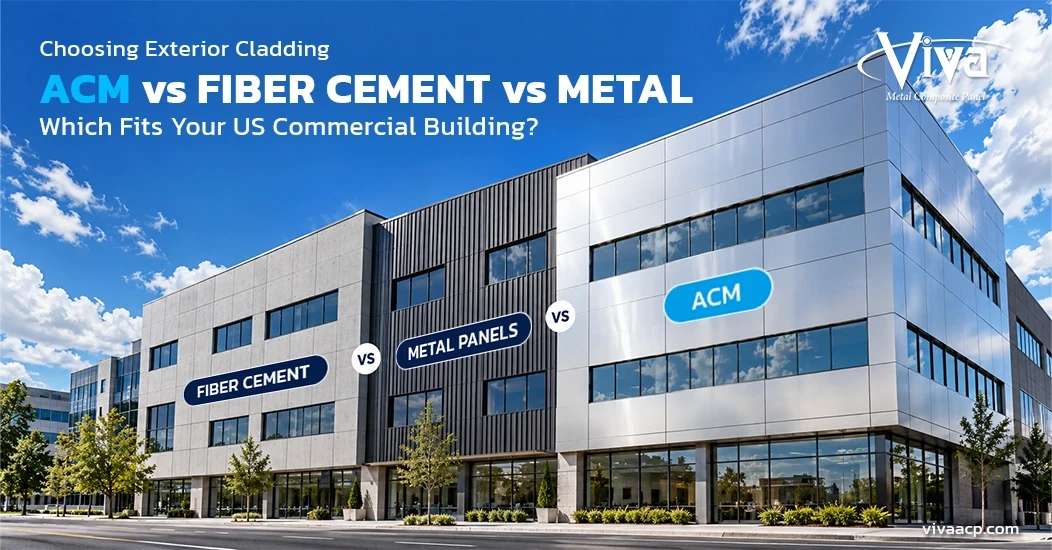
Quick answer ACM panels give the flattest, most design-flexible facade at low weight, and suit retail, offices, healthcare and branded buildings. Fiber cement is the budget-friendly, noncombustible choice for low-rise and multifamily work. Metal wall panels are the most economical for warehouses and industrial sheds, and insulated versions add thermal performance. The right answer depends on building height, fire strategy, climate and how much the facade needs to sell the building. |
Most commercial facades in the US end up being drawn in one of three materials: aluminum composite material (ACM), fiber cement, or a metal wall panel. Each has loyal fans, and each gets blamed when a project goes wrong.
This guide puts the three side by side on the things that matter after the ribbon cutting: how they handle Texas sun and Minnesota winters, how they behave in a fire, how often they need attention, and where each one simply isn't the right tool. If budget is your first question, our cost guide covers prices in detail; this post is about performance.
What each material actually is
ACM (aluminum composite material) is two thin aluminum skins, usually 0.020 in. (0.5 mm), bonded to a polyethylene, fire-retardant or mineral core. Panels are typically 4 mm thick overall and are routed, folded and hung on a subframe. For background, see our guide to aluminum composite material in US construction.
Fiber cement is a cement, sand and cellulose fiber board, sold as lap siding or as large architectural panels around 5/16 in. to 1/2 in. thick. It is fastened through the face or hung on hidden clips.
Metal wall panels cover a broad family: single-skin ribbed or corrugated steel and aluminum, concealed-fastener flat panels, solid aluminum plate, and insulated metal panels (IMPs) with a foam core between two steel skins.
Head-to-head comparison
|
Factor |
ACM panels |
Fiber cement panels |
Metal wall panels |
|
Typical weight |
About 1.1 to 1.6 lb/sq ft (4 mm) |
About 2.5 to 4.5 lb/sq ft |
Single skin 1 to 1.5 lb/sq ft; IMP 2.5 to 4 lb/sq ft |
|
Flatness and finish |
Very flat, crisp folded edges, tight joints |
Flat, but joints and fasteners often visible |
Ribbed profiles visible; flat panels can show oil-canning |
|
Color and texture range |
Widest: solids, metallics, wood, stone, mirror |
Moderate; mostly painted or stained |
Moderate; standard PVDF and SMP color charts |
|
Fire |
Depends on core: PE, FR or A2; tested assemblies needed above 40 ft |
Generally noncombustible |
Skins noncombustible; IMP foam cores need tested assemblies |
|
Curves and shapes |
Excellent: radius bends, cassettes, perforation |
Limited; mostly flat |
Good for corrugated curves; flat panels limited |
|
Impact resistance |
Moderate; can dent at ground level |
Good, but edges can chip |
Good for steel; aluminum can dent |
|
Maintenance |
Wash; PVDF finish holds color for decades |
Repaint or recoat over the building life |
Wash; check fasteners and sealant |
|
Typical service life |
25 to 40+ years |
25 to 50 years with recoating |
30 to 50+ years |
On paper, all three are durable. In practice, the differences show up in the details: how sharp the corners look, how the facade ages in sun, and how much the wall weighs on the structure.
Climate fit across US regions
A material that performs well in Phoenix can struggle in Boston. Here is how the three behave across the country's main climate challenges.
|
Region and challenge |
ACM panels |
Fiber cement |
Metal wall panels |
|
Sun Belt (TX, AZ, NV): intense UV and heat |
Strong with a 70% PVDF finish; allow for thermal movement |
Paint fades faster in full sun |
Strong with PVDF; light colors run cooler |
|
Northeast and Midwest: freeze-thaw |
Unaffected; aluminum does not absorb water |
Needs sealed edges to prevent moisture damage |
Unaffected |
|
Gulf and Atlantic coasts: salt air and hurricanes |
Good with aluminum skins and stainless fixings; check local wind-load and product approvals |
Good; check impact and wind ratings |
Aluminum or coated steel; follow coastal warranty limits |
|
Pacific Northwest: long wet seasons |
Excellent on a rainscreen subframe |
Good on a rainscreen; watch edge sealing |
Excellent |
Whatever the material, a ventilated rainscreen behind the cladding does more for durability in wet climates than any single panel property. Viva's rainscreen system is designed for exactly this job.
Installation and schedule
How a material goes on the wall affects the schedule, the crew you need and how forgiving the system is when the building isn't perfectly square.
|
Factor |
ACM panels |
Fiber cement panels |
Metal wall panels |
|
Common systems |
Wet-seal, dry joint (route-and-return), cassette or hook-on rainscreen |
Exposed fasteners or hidden clips on a rainscreen rail |
Through-fastened, concealed-fastener or IMP clip systems |
|
Fabrication |
Routed and folded in a shop or on site; very precise |
Cut on site; dust control needed for silica |
Roll-formed in a factory to length |
|
Crew skill |
Experienced ACM installers for clean joints |
General siding crews can install |
Metal building crews; fast on large walls |
|
Tolerance for out-of-square walls |
Good; subframe adjusts |
Good |
Moderate; long panels show misalignment |
|
Speed on large plain walls |
Medium |
Medium |
Fastest |
One practical point: fiber cement cutting creates crystalline silica dust, so crews need OSHA-compliant dust controls. ACM and metal panels avoid that issue, which can simplify work on occupied sites such as hospitals and schools.
Fire strategy: where the materials differ most
Fire performance is where people most often compare these materials unfairly.
Fiber cement is generally noncombustible, which makes it a simple choice for many low-rise and multifamily walls. Single-skin metal panels are noncombustible too. ACM depends on its core: a PE core is combustible, an FR core is designed to pass tested assemblies, and an A2 core is close to noncombustible. Insulated metal panels carry foam, so they also rely on tested assemblies such as NFPA 285 and FM 4880.
In other words, a well-specified FR or A2 ACM facade sits comfortably alongside the others on fire safety. A badly specified one doesn't. Our guide to NFPA 285 and ACM panels walks through the code rules in detail.
Design flexibility and brand impact
This is where ACM pulls ahead. Car dealerships, banks, fuel stations and retail chains use ACM because it holds an exact brand color, folds into crisp fascias and canopies, and can be routed into logos and signage. Fiber cement looks clean and architectural but is harder to shape. Metal wall panels look industrial unless you move into premium flat or plate systems.
If you need the look of solid aluminum plate without the weight or cost of thick plate, pre-coated solid aluminum panels are another option, and they are fully noncombustible.
Sustainability and green building credits
• Recyclability: aluminum skins are highly recyclable, and metal panels score well here too.
• Weight: lighter cladding can mean lighter structure, which reduces embodied carbon in the frame.
• EPDs: LEED v4.1 rewards products with Environmental Product Declarations. Ask every supplier for one.
• Longevity: a finish that doesn't need repainting saves materials and labor over decades.
Overcladding and renovation projects
A growing share of US cladding work is refreshing tired 1980s and 1990s buildings rather than building new. Here the comparison shifts. Weight matters more, because the existing structure and anchors were never designed for a heavy new skin. Speed matters more, because tenants are often still in the building.
ACM tends to do well on these jobs. It is light enough to hang on a new subframe over existing masonry or EIFS in many cases, it can be shop-fabricated to reduce noise and time on site, and it can transform a dated strip mall or office block with one material. Fiber cement works for simpler residential-style refreshes, and metal panels suit industrial upgrades where looks are secondary.
When ACM is the wrong choice
Being honest about limits builds better buildings. ACM is probably not your best choice when:
• The building is a plain warehouse where only cost per square foot matters. Ribbed metal panels win.
• The wall sits at ground level in a loading area with constant knocks. Use plate, masonry or a protective base course.
• The design calls for a deep masonry or board-formed concrete look. Fiber cement or real masonry may suit better.
• The insulation strategy needs one product to do everything. IMPs combine cladding and insulation in one panel.
Five questions to settle before you choose
Before the material debate starts in a design meeting, get clear answers to these. They usually decide the outcome on their own.
• How tall is the building, and what construction type? Above 40 feet on Type I to IV construction, you will need a tested assembly for ACM or IMPs.
• What does the facade need to do commercially? A brand-driven frontage justifies ACM; a distribution center doesn't.
• What is the climate exposure? Coastal, high-UV and freeze-thaw sites each favor different finishes and details.
• Who maintains the building, and for how long? A long-term owner usually values a PVDF finish that never needs repainting.
• Can the structure carry the weight? On renovations and overcladding, lighter ACM can avoid structural upgrades.
Quick decision guide
|
Building type |
Usually the best fit |
Why |
|
Retail, dealerships, fuel stations |
ACM |
Brand color, crisp fascias, signage integration |
|
Offices and medical buildings |
ACM or fiber cement |
Clean modern look; ACM for feature areas |
|
Multifamily, 3 to 5 stories |
Fiber cement with ACM accents |
Noncombustible base, budget control, design highlights |
|
Warehouses and industrial |
Metal wall panels or IMPs |
Lowest cost, fast install, thermal performance |
|
High-rise and landmark |
A2 ACM, solid aluminum or plate |
Fire margin and premium finish |
Why Viva ACM for US projects
Viva, which describes itself as Asia's largest ACP manufacturer, runs 15+ production lines with more than 15 million m² of annual capacity, enough to supply national rollouts in a consistent color. It was the first in India to offer pre-coated, ready-to-install solid aluminum panels, and its products carry EPD, IGBC, GRIHA and Green Eco Label certifications that support green building submittals.
Frequently asked questions
Is ACM better than fiber cement?
For a flat, modern, highly branded facade, ACM is usually better: it is lighter, flatter, comes in far more finishes and does not need repainting. Fiber cement is often the better value for low-rise and multifamily walls where a simple, noncombustible finish is enough and the design is mostly flat.
What is the difference between ACM and metal wall panels?
ACM is a composite of two aluminum skins and a core, used for flat, precise architectural facades. Metal wall panels are usually single-skin ribbed or flat steel or aluminum sheets, or insulated panels with a foam core. Metal panels are cheaper and suit industrial buildings; ACM gives a more refined finish.
Which cladding lasts the longest?
All three can last 25 years or more. Metal wall panels and ACM with a 70 percent PVDF finish often go 30 to 40 years with only cleaning. Fiber cement can last 50 years, but the painted surface usually needs recoating during that time.
Is fiber cement fireproof?
Fiber cement is generally classed as noncombustible, which simplifies code compliance on many buildings. No cladding is truly fireproof, and the whole wall assembly, including insulation and weather barrier, still has to meet the code for the building type and height.
What is the most low-maintenance exterior cladding?
ACM and metal wall panels with a PVDF finish are the lowest-maintenance options. They usually need only periodic washing and an inspection of sealants and fasteners. Fiber cement needs similar care plus repainting or recoating over its service life.
Comparing cladding for your next project? Send your building type, height and location through the quote request form, and the Viva team will recommend a core, finish and system and share the supporting test data.
POPULAR POSTS
-
ACM Panels vs Fiber Cement vs Metal Wall Panels: Choosing Exterior Cladding for US Commercial Buildings
2026 Nov 16
-
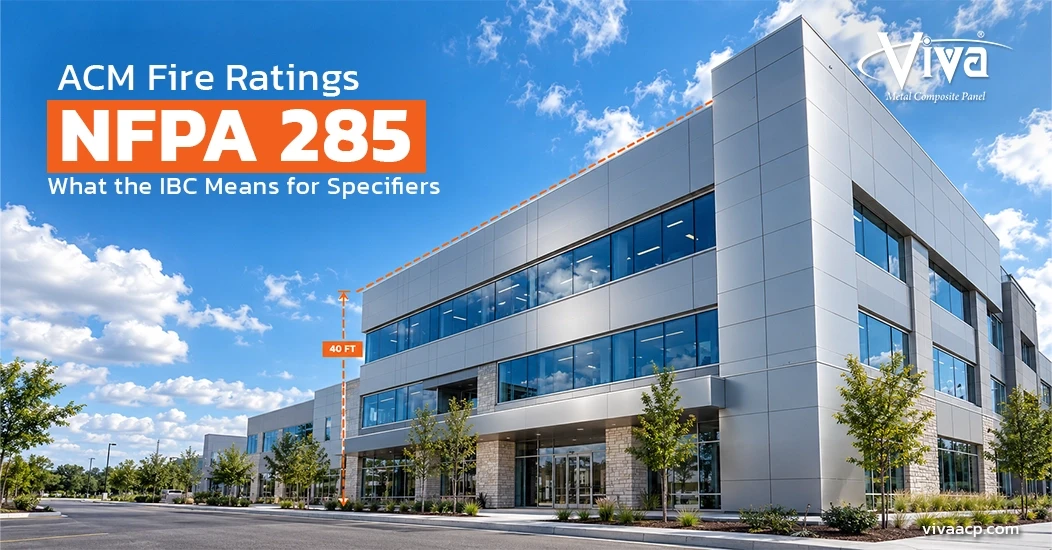 Aluminum Composite Material Fire Ratings: What the IBC and NFPA 285 Mean for Specifiers
2026 Nov 14
-
 Aluminum Composite Material Panels: A Guide to Modern Construction in the USA
2026 Oct 08
CATEGORIES
- Aluminium Compsoite panel 2
- ACP Sheet 0
- ACP Facade 0
- Copper Aluminium Sheet 0
- Fire Safety For Buildings 0
- ACP Cladding 0
- Colour Coated Aluminium Coil 0
- Aluminium Corrugated Composite Panel 0
- Facades 0
- Aluminium Honeycomb Panel 0
- Fire Retardant 1
- Zinc Composite Panel 0
- Corten Steel Series 0
- Metal Abstract Series 0
- Wooden ACP Sheet 0
- HPL Sheet 0
- Viva ACP Colour Coating 0
- Wall Cladding 0
- Applications of ACP Panel 0
- Viva ACP 0
- ACP Sheets for Architectural Projects 0
- PVDF vs Polyester 0
- ACP Sheets For Showroom 0
- Viva ACP on International Market 0
- Viva royal club app 0
- ACP Sheets for Branding Corporates 0
- Shades of Santa Fe 0
- Al Zinc Series 0
- ACP Sheet Sizes and Thicknesses 0
- Louvers and Baffles 0
- Sustainable Facades 0
ARCHIVES
Published by VIVA - Asia's Largest Manufacturer of Aluminium Composite Panels. 15M sq.mt capacity | 500+ shades | Thomas Bell-Wright FR A2+ Certified