en
 Spanish
 Arabic
 Swahili
 French


|
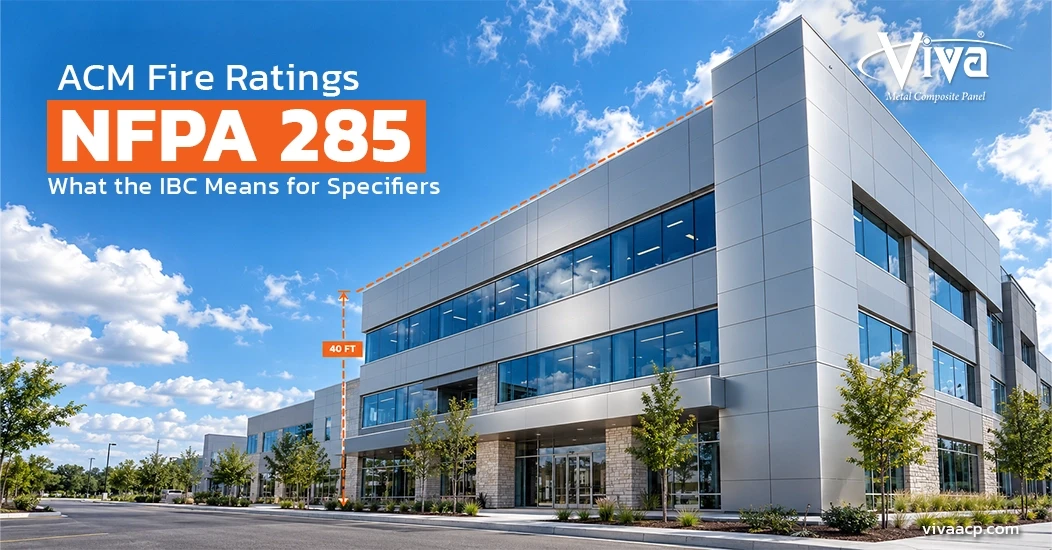
Quick answer Under the 2021 and 2024 International Building Code, aluminum composite material (ACM) on Type I to IV buildings must have a flame spread index of 25 or less, and when it goes more than 40 feet above grade, the wall assembly must pass NFPA 285. NFPA 285 tests the whole wall, not the panel alone. So the core you pick (PE, fire-retardant or noncombustible) and every other layer in the wall have to match a tested assembly. |
If you write specs for commercial facades, you have probably seen it happen: the panel submittal says "NFPA 285 compliant", the insulation gets value-engineered halfway through, and suddenly nobody can say for sure whether the wall still matches a tested design.
This guide pulls apart what US codes actually require of ACM, what an NFPA 285 pass does and does not cover, and the paperwork worth asking for before you approve a submittal. It is written for architects, spec writers and contractors, and it uses the plain language your client will need when you explain why the cheaper core isn't an option.
How the IBC treats aluminum composite material
The IBC does not use the trade term ACM. It groups aluminum, zinc, copper and steel composites under metal composite material (MCM) and covers them in Chapter 14, Exterior Walls. In the 2021 and 2024 editions that is Section 1406; in the 2018 edition the same rules sat in Section 1407. State and city amendments vary, so always check the edition your jurisdiction has adopted.
The requirements stack up in layers. Every MCM installation has to meet a basic surface-burning limit. Buildings of Type I, II, III or IV construction then add stricter rules, and height adds more again.
|
Situation |
Main IBC requirement for MCM |
Test standard |
|
Any building |
Flame spread index 75 or less, smoke-developed index 450 or less |
ASTM E84 or UL 723 |
|
Type I to IV construction, any height |
Flame spread index 25 or less, smoke-developed 450 or less, tested at the maximum thickness used |
ASTM E84 or UL 723 |
|
Type I to IV construction, any height |
Thermal barrier between the MCM and the building interior (1/2 in. gypsum board or equivalent), unless the system passes a room-corner fire test |
NFPA 275, or NFPA 286 / UL 1040 / UL 1715 |
|
Type I to IV construction, more than 40 ft above grade plane |
The exterior wall assembly must pass full-scale fire propagation testing |
NFPA 285 |
|
Type V construction |
MCM permitted, subject to the general surface-burning limit and other Chapter 14 rules |
ASTM E84 |
Older editions allowed some MCM installations up to 75 feet on fully sprinklered buildings to skip NFPA 285. The 2021 IBC removed that route, which is why so many specs written from older templates now need updating.
MCM is not the only trigger. A combustible water-resistive barrier on a Type I to IV wall over 40 feet can also call for NFPA 285, and foam plastic insulation brings in the separate Chapter 26 requirements. In practice, most mid-rise commercial walls end up needing a tested assembly for one reason or another.
NFPA 285 in plain terms
NFPA 285 is a full-scale test of how fire spreads up and across an exterior wall. A two-story test wall is built with the exact layers proposed: framing, sheathing, weather barrier, insulation, attachment system and cladding. A gas burner in the first-floor room simulates a fully developed room fire, and a second burner at the window opening sends flames up the face of the wall for 30 minutes.
To pass, flames must not spread too far vertically or sideways across the face, temperatures inside the wall cavity and insulation must stay within set limits, and fire must not break through into the second-floor room.
• It tests an assembly, not a product. A panel cannot be "NFPA 285 certified" on its own. It can be part of one or more tested assemblies.
• Changes matter. Swapping the insulation brand or type, the weather barrier or the joint design can take the wall outside the tested design.
• Extensions are possible. A qualified fire engineer can issue an engineering judgment, typically following the extension guidance in the standard's Annex B, for small changes. Large changes usually need another test.
Viva has published its own NFPA 285, EN 13501-1 and ASTM D1929 certification results. Read the tested assembly details closely; they are the part that will matter on your project.
ACM core types side by side
The core is the single biggest fire decision on an ACM job. The aluminum skins are the same; what sits between them changes everything.
|
Core type |
What it is |
Typical fire classification |
Where it usually fits in the US |
|
PE (polyethylene) |
Mostly polymer core |
Combustible; fails most full-scale tests on its own |
Signs, interiors, Type V and low-rise uses where code allows |
|
FR (fire-retardant) |
Mineral-filled core, roughly 70% mineral |
Flame spread 25 or less; often part of NFPA 285 tested assemblies; EN 13501-1 B-s1,d0 |
Most commercial facades, including many above 40 ft in a tested assembly |
|
A2 (limited combustibility) |
Core of 90% or more mineral, or an aluminum corrugated or honeycomb core |
EN 13501-1 A2-s1,d0 (limited combustibility) |
High-rise, healthcare, education, and owners or insurers who want the margin |
|
Solid aluminum or A1 honeycomb |
All-metal panel or metal honeycomb |
Noncombustible |
Projects where any combustible content is unwelcome |
European classes are not US code categories, but owners, insurers and international design teams increasingly ask for them. An A2-s1,d0 classification gives a clear signal that the core contributes very little fuel, which can make the NFPA 285 conversation much easier.
Are ACM panels flammable?
It depends entirely on the core. A PE-core panel can burn, and PE-core cladding has been linked to serious high-rise fires overseas. FR and A2 cores are designed to limit that, and all-aluminum panels add no fuel at all. So "are ACM panels flammable?" is the wrong question for a spec. The right one is "which core, in which tested assembly, on which construction type and height?"
The paperwork to request from any ACM supplier
Before you approve a submittal, ask for these documents and check that they describe the same product, thickness and core you are buying:
• ASTM E84 report for the exact core and maximum thickness proposed.
• NFPA 285 test report, plus drawings of the tested assembly showing every layer.
• Engineering judgment letters for any deviation from the tested assembly, signed by a qualified fire engineer.
• Room-corner test data (NFPA 286, UL 1040 or UL 1715) if you plan to omit the thermal barrier.
• Third-party evaluation report (for example an ICC-ES report) where your building official expects one.
• Product labeling details showing manufacturer, product and core, as the IBC labeling rules require.
• ASTM D1929 ignition data and EN 13501-1 classification if the owner or insurer asks for them.
You can download Viva's FR certificates to see how the reports are presented.
Common specification mistakes
• Writing "NFPA 285 compliant panel". Write instead that the exterior wall assembly shall comply with NFPA 285, and name the tested assembly.
• Leaving the core open. "ACM, 4 mm" invites a PE core in the bid. State FR or noncombustible core explicitly.
• Value-engineering the layers behind the panel. Insulation and weather barrier swaps are the most common reason a wall falls outside its tested design.
• Forgetting trim, soffits and canopies. These often use the same material and need the same scrutiny.
• Mixing brands on one elevation. Each manufacturer's test applies to its own product.
Three quick scenarios: which core would you specify?
Code questions are easier to reason about with a real building in mind. These are simplified examples to show how the rules stack up; your code consultant makes the final call.
|
Project |
Construction type and height |
What the code asks of the ACM |
Sensible core choice |
|
Single-story quick-service restaurant |
Type V-B, about 20 ft |
Flame spread 75 or less (ASTM E84) |
FR core for the margin; PE only for signage and small accents where allowed |
|
Three-story medical office |
Type II-B, about 42 ft at the parapet |
Flame spread 25 or less, thermal barrier, and NFPA 285 because the panels run above 40 ft |
FR core within a named NFPA 285 tested assembly |
|
Ten-story residential tower |
Type I-A, about 110 ft |
Same as above, with much closer insurer and owner scrutiny |
A2 (limited combustibility) core, or solid aluminum, in a tested assembly |
Notice the medical office. The building is only three stories, but the parapet takes the cladding past 40 feet. Parapets, roof screens and tower elements are a common reason a "low-rise" job ends up needing NFPA 285.
Questions your building official is likely to ask
Plan reviewers see the same gaps again and again. Having answers ready shortens the review and avoids resubmittals:
• Which tested assembly does this wall match, and where is the report?
• Is the insulation shown on the drawings the same product and thickness as in the test?
• Does the weather barrier match the tested assembly, or is there an engineering judgment covering the change?
• How is the thermal barrier provided, or which room-corner test justifies leaving it out?
• Are the panels labeled so an inspector can confirm the core on site?
A one-page compliance summary that answers these five questions, attached to the panel submittal, saves weeks on most projects.
Why Viva for code-driven US projects
Viva, which describes itself as Asia's largest ACP manufacturer, was the first in India to run dedicated A2 core production lines and the first to offer A1 fire-rated honeycomb panels. Its FR A2+ aluminum corrugated core panel is certified by Thomas Bell-Wright, and every batch goes through 250+ in-house quality tests before it ships.
For specifiers who want to go deeper, Viva also runs an AIA continuing education course on composite panel facades.
Frequently asked questions
Do ACM panels need NFPA 285 testing?
Under the 2021 and 2024 IBC, ACM (classed as metal composite material) installed more than 40 feet above grade plane on Type I to IV construction must be part of an exterior wall assembly that has passed NFPA 285. Below 40 feet, the panel still needs a flame spread index of 25 or less and, in most cases, a thermal barrier.
What is the difference between FR and A2 ACM panels?
An FR (fire-retardant) core is mineral-filled, typically around 70 percent mineral, and usually achieves EN 13501-1 class B-s1,d0. An A2 core has 90 percent or more mineral content, or an aluminum corrugated or honeycomb core, and achieves A2-s1,d0, meaning limited combustibility. A2 gives more margin on taller or higher-risk buildings.
Can a panel be NFPA 285 approved on its own?
No. NFPA 285 tests a complete wall assembly, including framing, sheathing, weather barrier, insulation and cladding. A panel can be included in one or more tested assemblies, and your wall has to match one of them or be covered by a qualified engineering judgment.
Is ACM allowed on Type V buildings?
Yes. The IBC permits metal composite material on Type V construction, subject to the general flame spread limit of 75 and smoke-developed limit of 450 under ASTM E84, along with the other Chapter 14 requirements. Local amendments can be stricter, so confirm with the building official.
What flame spread rating does ACM need?
All MCM needs a flame spread index of 75 or less and a smoke-developed index of 450 or less under ASTM E84 or UL 723. On Type I to IV buildings, the flame spread limit drops to 25 or less, tested at the maximum thickness you plan to install.
Specifying ACM for a code-driven project? Send your building type, height and preferred core through the quote request form and the Viva team will share the matching test reports and tested assembly details.
POPULAR POSTS
CATEGORIES
- Aluminium Compsoite panel 1
- ACP Sheet 0
- ACP Facade 0
- Copper Aluminium Sheet 0
- Fire Safety For Buildings 0
- ACP Cladding 0
- Colour Coated Aluminium Coil 0
- Aluminium Corrugated Composite Panel 0
- Facades 0
- Aluminium Honeycomb Panel 0
- Fire Retardant 1
- Zinc Composite Panel 0
- Corten Steel Series 0
- Metal Abstract Series 0
- Wooden ACP Sheet 0
- HPL Sheet 0
- Viva ACP Colour Coating 0
- Wall Cladding 0
- Applications of ACP Panel 0
- Viva ACP 0
- ACP Sheets for Architectural Projects 0
- PVDF vs Polyester 0
- ACP Sheets For Showroom 0
- Viva ACP on International Market 0
- Viva royal club app 0
- ACP Sheets for Branding Corporates 0
- Shades of Santa Fe 0
- Al Zinc Series 0
- ACP Sheet Sizes and Thicknesses 0
- Louvers and Baffles 0
- Sustainable Facades 0
ARCHIVES
Published by VIVA - Asia's Largest Manufacturer of Aluminium Composite Panels. 15M sq.mt capacity | 500+ shades | Thomas Bell-Wright FR A2+ Certified