en
 Spanish
 Arabic
 Swahili
 French


|
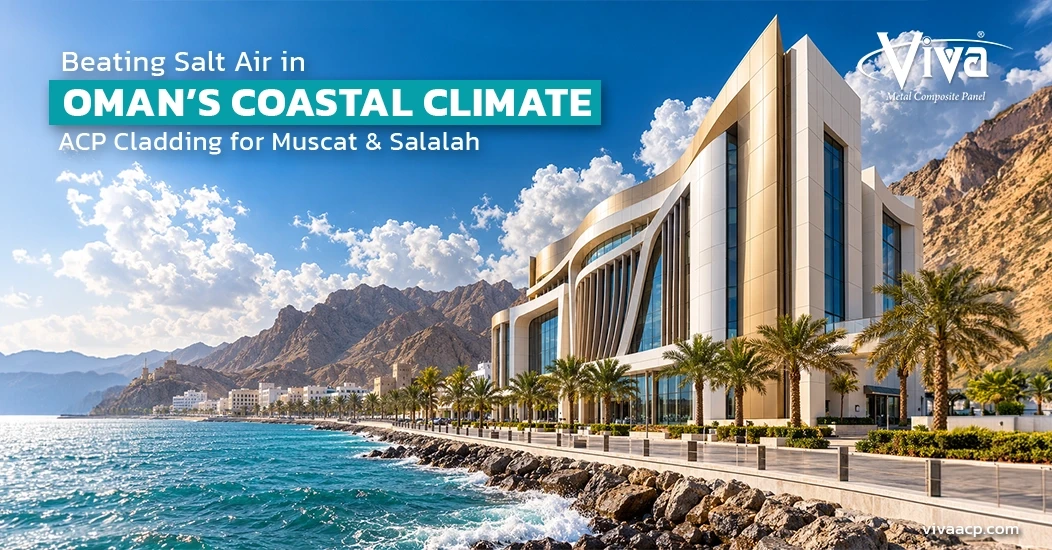
Quick answer On Oman's coast, ACP cladding lasts when it has a PVDF-coated finish, sealed cut edges, stainless steel (A4 / 316) fixings, a ventilated cavity and isolation between aluminium and steel parts. Most coastal facade failures start at edges, fixings and steel subframes, not on the panel face. A fresh-water wash every two to three months keeps salt from building up. |
Oman has one of the most beautiful coastlines in the region, and some of the hardest conditions for a building facade. Along the Batinah coast, around Muscat and down to Duqm and Salalah, buildings sit in warm, humid, salt-laden air for most of the year.
Aluminium handles that air well. The trouble comes from everything around it: cut edges, cheap screws, steel brackets and cavities that trap moisture. This guide explains how salt attacks a facade in Oman, and how to specify and look after ACP cladding so it still looks right after 20 years by the sea.
Oman's climate zones and what they mean for cladding
Oman is not one climate. A spec that is fine in Nizwa may not be enough for a beachfront hotel in Muscat.
|
Zone |
Places |
Conditions |
Facade risk |
|
Northern coast (Batinah and Muscat) |
Muscat, Seeb, Barka, Sohar |
Hot, humid summers; salt air off the Gulf of Oman |
Corrosion at edges and fixings, salt deposits, UV fade |
|
Central and southern coast |
Duqm, Sur, Masirah |
Hot, windy, strong salt spray |
Salt build-up, wind loads, corrosion |
|
Dhofar (khareef zone) |
Salalah, Mirbat |
Khareef monsoon roughly June to September: drizzle, mist, very high humidity |
Moisture in cavities, mould, prolonged wet surfaces |
|
Interior |
Nizwa, Ibri, Bahla |
Very hot and dry, dust |
UV fade, thermal movement, dust |
The khareef in Dhofar deserves a special mention. For three months, facades in Salalah stay damp almost all the time. Good drainage and ventilation behind the panels matter more there than almost anywhere else in the Gulf.
How salt air attacks a facade
Salt doesn't usually attack the painted face of a good ACP panel. It goes for the weak points:
• Cut edges: when a panel is routed or cut, the edge of the aluminium skin is exposed. Without sealing, salt and moisture can creep in under the coating.
• Fixings: carbon steel or zinc-plated screws rust quickly near the sea, staining the panels below.
• Mixed metals: aluminium touching steel in salty, damp air creates galvanic corrosion, which slowly eats the aluminium.
• Steel subframes: poorly galvanised brackets and rails rust behind the cladding, out of sight, until stains appear.
• Trapped moisture: sealed cavities with no airflow stay wet and salty, which speeds up every one of the problems above.
Coatings and panel specification
|
Spec item |
What to choose for coastal Oman |
Why |
|
Coating |
70% PVDF, two or three coats |
Resists UV and salt far better than polyester |
|
Skin thickness |
0.5 mm aluminium skins |
More robust and better able to stay flat |
|
Core |
FR or A2 fire-rated, as the building requires |
Fire safety, and mineral cores do not absorb water |
|
Back coat |
A proper protective back coating |
Protects the inner skin in humid cavities |
|
Test data |
Salt spray test hours (ASTM B117) on the data sheet |
Shows how the coating stands up to salt |
Viva's guide to PVDF vs PE coatings explains why PVDF is the right choice for any exterior facade, and especially by the sea.
Edge sealing and fabrication
• Seal all exposed cut edges with a compatible sealant, or design the panel so edges are folded back and hidden.
• Avoid leaving bare aluminium at routed corners; touch up with the matching coating where edges are visible.
• Fabricate in a clean area and keep offcuts and swarf off the panel face; steel filings rust and stain.
• Remove the protective film soon after installation, before salt gets trapped under it.
Fixings, subframes and mixed metals
This is where coastal projects are most often won or lost.
• Use A4 (316) stainless steel fixings for all exposed screws, rivets and bolts on coastal buildings.
• Prefer aluminium subframes where possible. If steel is used, make sure it is properly hot-dip galvanised.
• Isolate dissimilar metals with isolation pads, washers or tape wherever aluminium meets steel.
• Design for drainage so water never sits in a bracket or channel.
A ventilated rainscreen system, with an open cavity behind the panels, lets moist air escape and helps the whole wall dry out. That is especially valuable in Salalah during the khareef.
One more point for design teams: the stronger winds along the Duqm and Sur coasts mean wind loads should be checked carefully, with panel sizes, fixing spacing and stiffeners designed to the local wind data rather than copied from a Muscat project.
Fire safety and approvals
In Oman, building fire safety approvals sit with the Civil Defence and Ambulance Authority, alongside the local municipality, such as Muscat Municipality. Fire-rated ACP with FR or A2 cores is expected on most commercial and multi-storey buildings. Confirm the requirement for your building type and height with your consultant early, and keep the test reports and certificates ready for submission.
A coastal maintenance plan
The single most effective thing an owner can do on Oman's coast is wash the facade regularly. Salt left on the surface pulls in moisture every humid night and keeps working on edges and fixings.
|
Task |
Seafront (within about 1 km) |
Coastal city |
Interior |
|
Fresh-water rinse and mild detergent wash |
Every 2 to 3 months |
Every 3 to 4 months |
Twice a year |
|
Inspect sealant joints and edges |
Twice a year |
Yearly |
Yearly |
|
Check fixings for rust staining |
Twice a year |
Yearly |
Every 2 years |
|
Check cavity drainage after the khareef (Dhofar) |
Yearly, in October |
Yearly |
Not needed |
Use clean water, a soft brush or sponge and a pH-neutral detergent. Never use abrasive pads, wire brushes or solvents on the coated face.
Colours and finishes for the Omani coast
Oman has a strong architectural identity, with white and sand-coloured buildings and traditional detailing encouraged in many areas. ACP fits well with that:
• White, ivory and sand shades suit local guidelines and reflect heat.
• Stone-look finishes echo traditional Omani stonework at a fraction of the weight.
• Matt finishes hide salt residue between washes better than high gloss.
• Metallic accents in bronze or champagne work well on trims and feature bands.
Warning signs on an existing coastal facade
If you manage a building that is already clad, watch for these early signs. Catching them early is far cheaper than replacing panels later.
|
What you see |
Likely cause |
What to do |
|
Orange or brown streaks below fixings |
Carbon steel or zinc-plated screws rusting |
Replace with A4 stainless fixings; clean the stains |
|
White powder or bubbling at panel edges |
Salt and moisture getting under the coating at unsealed edges |
Clean, treat and seal the edges; check drainage |
|
Chalky, faded surface |
Polyester or low-grade coating breaking down in UV |
Plan replacement with PVDF panels on the worst elevations |
|
Cracked or missing sealant |
UV and movement aging the sealant |
Remove and reseal with a compatible silicone |
|
Panels bowing or loose |
Corroded brackets or rigid fixings |
Survey the subframe; repair or replace brackets |
Hotels, resorts and seafront homes
Oman's tourism push has brought a wave of beachfront hotels and resorts from Muscat to Jebel Sifah, Ras Al Hadd and Salalah. These buildings sit closest to the sea, so they need the most robust specification and the most regular care.
• Specify aluminium subframes and A4 fixings throughout, not just on the most exposed faces.
• Choose finishes that hide salt residue, such as matt sand, stone-look or brushed metallics.
• Build facade washing into the hotel's maintenance contract from day one.
• Keep a stock of spare panels from the same batch for quick repairs.
Questions to ask your supplier for a coastal project
• What salt spray test results (hours to ASTM B117) does this coating have?
• Is the coating 70% PVDF, and how many coats are applied?
• Does the warranty cover coastal sites, and is there a minimum distance from the sea?
• What edge-sealing and fixing details do you recommend for marine exposure?
• Can you supply matching panels later for repairs?
Warranty terms for coastal sites differ between suppliers, so read the fine print before you commit.
Why the right spec pays for itself
A coastal specification costs a little more at the start: stainless fixings, edge sealing, an aluminium subframe and a better coating. Over the life of the building, it is almost always cheaper.
Replacing rusted brackets or stained panels on an occupied building means scaffolding, disruption and a facade that never quite matches again. Spending a few percent more on the right details avoids most of that, and keeps the building looking new for longer, which matters for hotel ratings, rents and resale value.
Why Viva for coastal projects in Oman
Every Viva batch goes through 250+ in-house quality tests, and its 5 colour coating lines, the first in India to run that many, apply consistent PVDF coatings for long outdoor life. Viva's panels carry finish warranties of up to 30+ years depending on product, and its 30+ global branches support Gulf projects with documents and samples. You can see the coating data in Viva's technical data sheets.
Frequently asked questions
Does ACP cladding corrode near the sea?
The PVDF-coated face of a good ACP panel resists salt air well. Corrosion near the sea usually starts at unsealed cut edges, carbon steel fixings, poorly galvanised steel subframes and places where aluminium touches steel. Sealing edges, using A4 stainless fixings and isolating metals prevents most problems.
Which ACP is best for Muscat?
For Muscat's hot, humid, salty air, choose a fire-rated ACP (FR or A2 core) with 0.5 mm aluminium skins, a 70 percent PVDF finish and a good back coating. Pair it with an aluminium or hot-dip galvanised subframe, stainless fixings and a ventilated cavity.
How often should coastal ACP facades be washed?
Seafront buildings in Oman should be rinsed and washed every two to three months, and other coastal buildings every three to four months. Regular washing removes salt deposits that otherwise attract moisture and attack edges and fixings.
How does the khareef affect cladding in Salalah?
During the khareef, from roughly June to September, Salalah has mist, drizzle and very high humidity, so facades stay damp for weeks. A ventilated rainscreen cavity with good drainage, sealed edges and stainless fixings stops moisture and corrosion building up behind the panels.
What fixings should be used for ACP near the sea?
Use A4 (316) grade stainless steel screws, rivets and bolts for coastal ACP facades. Avoid zinc-plated or carbon steel fixings, which rust and stain quickly, and use isolation washers or pads wherever aluminium meets steel.
Is ACP suitable for beachfront hotels in Oman?
Yes, with the right specification. Beachfront hotels need PVDF-coated fire-rated ACP, sealed edges, aluminium subframes, A4 stainless fixings and a ventilated cavity, plus a facade washing plan every two to three months. Check that the coating warranty covers sites close to the sea.
Building on Oman's coast? Share your location, building type and preferred finish through the enquiry form , and the Viva team will recommend a coastal specification and share the coating test data.
POPULAR POSTS
CATEGORIES
- Aluminium Compsoite panel 2
- ACP Sheet 3
- ACP Facade 1
- Copper Aluminium Sheet 0
- Fire Safety For Buildings 1
- ACP Cladding 3
- Colour Coated Aluminium Coil 0
- Aluminium Corrugated Composite Panel 0
- Facades 2
- Aluminium Honeycomb Panel 1
- Fire Retardant 1
- Zinc Composite Panel 0
- Corten Steel Series 0
- Metal Abstract Series 1
- Wooden ACP Sheet 0
- HPL Sheet 0
- Viva ACP Colour Coating 0
- Wall Cladding 1
- Applications of ACP Panel 0
- Viva ACP 1
- ACP Sheets for Architectural Projects 0
- PVDF vs Polyester 0
- ACP Sheets For Showroom 0
- Viva ACP on International Market 0
- Viva royal club app 0
- ACP Sheets for Branding Corporates 0
- Shades of Santa Fe 0
- Al Zinc Series 0
- ACP Sheet Sizes and Thicknesses 0
- Louvers and Baffles 0
- Sustainable Facades 0
ARCHIVES
Explore the ranges

Published by VIVA - Asia's Largest Manufacturer of Aluminium Composite Panels. 15M sq.mt capacity | 500+ shades | Thomas Bell-Wright FR A2+ Certified