en
 Spanish
 Arabic
 Swahili
 French


|
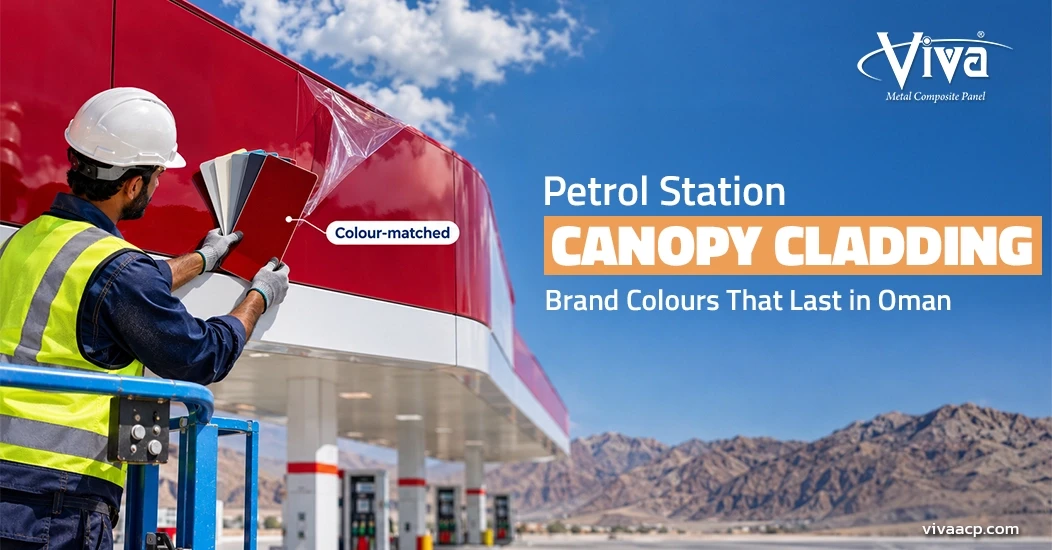
Quick answer Fuel retailers use ACP on canopy fascias, columns, price pylons, shop fronts and car wash buildings because it holds an exact brand colour, is light enough for long canopy spans and installs quickly with minimal disruption to trading. For Oman's heat, coast and highway dust, specify 4 mm fire-rated ACP with 0.5 mm skins and a PVDF finish, colour-matched once and supplied consistently across the whole network. |
For a fuel retailer, the forecourt is the brand. A driver on the Muscat Expressway or the road to Nizwa decides within seconds whether to pull in, and a bright, clean canopy in the right colour does a lot of that persuading. A faded, mismatched one does the opposite.
That is why aluminium composite panels have become the standard material for petrol station canopies and forecourt buildings across the world. This guide explains how ACP is used on fuel stations, what specification works in Oman's climate, and how network rollouts keep every site looking the same.
Where ACP is used on a fuel station
|
Element |
Typical ACP use |
What matters most |
|
Canopy fascia |
Continuous branded band around the canopy edge, often with a lit stripe |
Exact brand colour, flatness over long runs |
|
Canopy soffit |
Flat panels under the canopy with integrated lights |
Light weight, clean joints |
|
Canopy columns |
Column cladding in brand colours |
Impact resistance near pumps and vehicles |
|
Price pylon or totem |
Clad structure carrying the logo and price displays |
Visibility, wind resistance, lighting integration |
|
Convenience store front |
Shop front fascia, entrance portal and signage band |
Brand consistency with the canopy |
|
Car wash and service buildings |
Wall cladding in brand colours |
Water and chemical resistance |
Using one material across all of these elements makes colour matching much easier, which is one reason fuel networks standardise on aluminium composite panels .
Why ACP is the standard for forecourts
• Brand colour accuracy: panels can be colour-matched to a brand standard and repeated batch after batch.
• Light weight: long canopy fascias stay light, which keeps steelwork economical.
• Flatness: composite panels stay flat over long runs where painted steel can ripple.
• Speed: prefabricated panels go up quickly, so sites can stay open or reopen fast.
• Low upkeep: a PVDF finish needs washing, not repainting, which matters when you run dozens of sites.
The right specification for Oman
Oman's fuel stations face hot summers, strong UV, highway dust and, along the coast, salt-laden air. The specification needs to handle all of it.
|
Spec |
Recommendation |
Why |
|
Total thickness |
4 mm |
Stays flat on long fascias and resists knocks |
|
Aluminium skin |
0.5 mm |
Better dent resistance near vehicles |
|
Core |
Fire-rated (FR or A2) |
Fuel stations are high-risk sites; fire-rated cores are the sensible default |
|
Coating |
70 percent PVDF |
Brand colours stay true in strong sun |
|
Fixings |
Stainless steel |
Essential on coastal sites in Muscat, Sohar, Sur and Salalah |
|
Finish |
Gloss or semi-gloss for brand colours |
Keeps colours vivid and easy to clean |
For coastal sites, pay extra attention to sealed edges and stainless fixings. Viva's coating specification page shows the PVDF systems used on exterior panels.
Fire safety on forecourts
Fuel stations handle flammable products every day, so fire safety is central to every design decision. Using fire-rated ACP rather than standard PE-core sheet is the sensible baseline for canopies and forecourt buildings. Requirements are set by local authorities and the fuel company's own standards, and approvals in Oman involve the Civil Defence and Ambulance Authority. Always confirm the current requirements with your consultant.
Viva's fire-retardant ACP range includes FR and A2 cores suited to high-risk sites.
Keeping the brand consistent across a network
The hardest part of a fuel station programme is not one site. It is making the 50th site look exactly like the first, years later, in a different city.
• Approve a master colour standard for each brand colour and keep physical samples at head office and with contractors.
• Order from one supplier with the capacity to supply the full rollout, so colours come from the same coating process.
• Use the same coating system and gloss level on every batch.
• Install panels in the same direction, especially metallics, so they look identical in sunlight.
• Keep spare panels for each colour to repair damage quickly without visible patches.
Canopy design ideas
• Lit fascia stripe: a continuous LED band set into the canopy fascia makes the station visible from far down the road at night.
• Curved corners: folded or curved ACP corners give the canopy a modern, flowing look.
• Two-tone fascia: the main brand colour with a thinner secondary colour band adds depth.
• Clean soffits: flat ACP soffits with recessed lights keep the forecourt bright and tidy.
• Matching store front: the same colours and fascia height on the shop tie the whole site together.
Refreshing existing stations
Many retailers refresh their stations to a new brand identity. ACP makes this practical.
• New panels can often be fixed to the existing canopy structure with modest changes to the subframe.
• Work can be phased by pump island to keep the station trading.
• Old painted or vinyl-wrapped fascias can be replaced with a long-life PVDF finish.
• A refreshed forecourt can lift customer perception and footfall quickly.
The fuel retail market in Oman
Oman's fuel retail market includes national and international brands, with stations along the main highways, in Muscat and other cities, and in fast-growing areas such as Duqm. New highways and tourism routes keep adding sites, and many existing stations are being upgraded with modern convenience stores and car washes. For every operator, a durable, consistent brand image across the network is a competitive advantage.
Proven at scale: Viva and fuel retail
Viva is the official facade design solution provider for HPCL petrol pumps across India, one of the country's largest fuel networks, and counts Indian Oil, Bharat Petroleum and Shell among its clients. That experience covers colour matching to brand standards, supply to hundreds of sites and consistent quality over long rollouts.
With more than 15 million sq m of annual capacity, 5 colour coating lines and more than 250 in-house quality tests, Viva can supply full network programmes with matched colours over several years. Its more than 30 global branches support projects across the Gulf.
Delivering a forecourt project, step by step
• Brand brief: collect the brand's facade standard, colour references and site drawings.
• Colour approval: produce panel samples against the brand reference and get written sign-off.
• Site survey: measure the canopy, columns, store and pylon, and check the condition of existing steelwork.
• Shop drawings: prepare panel layouts and details for approval by the brand and the contractor.
• Fabrication: cut, route and fold panels to the drawings, labelling each panel for its position.
• Installation: work in phases around pump islands to keep the station open where possible.
• Handover: remove protective film, clean, inspect and record batch numbers for future repairs.
Signage and lighting integration
On a forecourt, cladding, signage and lighting have to work as one system. Plan them together from the start.
• Leave grooves or channels in the canopy fascia for LED strips.
• Design pylon cladding with access panels so price displays and lights can be serviced.
• Cut logo openings with clean edges and seal them before backlighting is fitted.
• Route cables inside the canopy structure, not across the panels.
Ready for the future: EV charging and new formats
Fuel stations across the Gulf are starting to add electric vehicle chargers, larger convenience stores and food outlets. Canopies over charging bays, new store fronts and drive-through lanes all use the same cladding approach. Choosing a supplier who can match the existing brand colours years later makes these additions blend in seamlessly.
Common mistakes on forecourt cladding
• Choosing on price alone: thin skins and polyester finishes fade and dent quickly on busy forecourts.
• Skipping colour approval: a slightly wrong brand colour is noticed by customers and brand auditors alike.
• Mixing batches across sites: small shade differences become obvious when stations are compared.
• Plain steel fixings near the sea: they rust and stain the panels within months on coastal sites.
• No spares: without matching spare panels, a single damaged column can leave a visible patch for weeks.
• Ignoring column protection: columns near pumps take knocks; consider bollards or impact guards at the base.
Maintenance for forecourt cladding
Forecourts get dirty fast from exhaust fumes, fuel splashes and dust. Wash canopy fascias and columns every one to three months, more often on coastal and highway sites. Use water and a mild detergent, never solvents or abrasive pads. Check the canopy edges, joints and lights twice a year, and replace damaged column panels promptly so the brand always looks cared for.
Frequently asked questions
Why is ACP used on petrol station canopies?
ACP holds an exact brand colour, stays flat over long canopy fascias, is light enough to keep steelwork economical and installs quickly. With a PVDF finish it needs only washing, which matters for retailers running many sites.
Which ACP is best for fuel stations in Oman?
Use 4 mm fire-rated ACP with 0.5 mm aluminium skins and a 70 percent PVDF coating. Add stainless steel fixings and sealed edges on coastal sites in Muscat, Sohar, Sur and Salalah, where salt air speeds up corrosion.
Should fuel station cladding be fire rated?
Yes. Fuel stations are high-risk sites, so fire-rated ACP with an FR or A2 core is the sensible default rather than standard PE-core sheet. Confirm the exact requirements with local authorities, the fuel company's standards and your consultant.
How do fuel networks keep brand colours consistent?
They approve a master colour standard, order from one supplier with enough capacity for the full rollout, use the same coating system and gloss on every batch, install panels in the same direction and keep spare panels for repairs.
Can an existing petrol station canopy be re-clad?
Usually, yes. New ACP panels can often be fixed to the existing canopy structure with modest subframe changes, and the work can be phased by pump island so the station keeps trading during the refresh.
How often should a fuel station canopy be cleaned?
Wash canopy fascias and columns every one to three months, more often on coastal and highway sites where salt and dust build up quickly. Use water and a mild detergent, avoid solvents and abrasive pads, and check edges, joints and lights twice a year.
What thickness of ACP is used on fuel station canopies?
Most fuel station canopies use 4 mm ACP with 0.5 mm aluminium skins. This thickness stays flat over long canopy fascias, resists knocks from vehicles and holds its shape in strong heat. Thinner sheets tend to ripple in the sun and dent more easily.
Planning a new station or a network refresh in Oman? Share your brand colours, number of sites and timeline through the enquiry form, and the Viva Gulf team will prepare colour-matched samples and a supply plan.
POPULAR POSTS
CATEGORIES
- Aluminium Compsoite panel 2
- ACP Sheet 3
- ACP Facade 1
- Copper Aluminium Sheet 0
- Fire Safety For Buildings 1
- ACP Cladding 4
- Colour Coated Aluminium Coil 0
- Aluminium Corrugated Composite Panel 0
- Facades 2
- Aluminium Honeycomb Panel 1
- Fire Retardant 1
- Zinc Composite Panel 0
- Corten Steel Series 0
- Metal Abstract Series 1
- Wooden ACP Sheet 0
- HPL Sheet 0
- Viva ACP Colour Coating 0
- Wall Cladding 1
- Applications of ACP Panel 0
- Viva ACP 1
- ACP Sheets for Architectural Projects 0
- PVDF vs Polyester 0
- ACP Sheets For Showroom 0
- Viva ACP on International Market 0
- Viva royal club app 0
- ACP Sheets for Branding Corporates 0
- Shades of Santa Fe 0
- Al Zinc Series 0
- ACP Sheet Sizes and Thicknesses 0
- Louvers and Baffles 0
- Sustainable Facades 0
- Aluminium composite material 0
ARCHIVES
Explore the ranges
Published by VIVA - Asia's Largest Manufacturer of Aluminium Composite Panels. 15M sq.mt capacity | 500+ shades | Thomas Bell-Wright FR A2+ Certified