en
 Spanish
 Arabic
 Swahili
 French


|
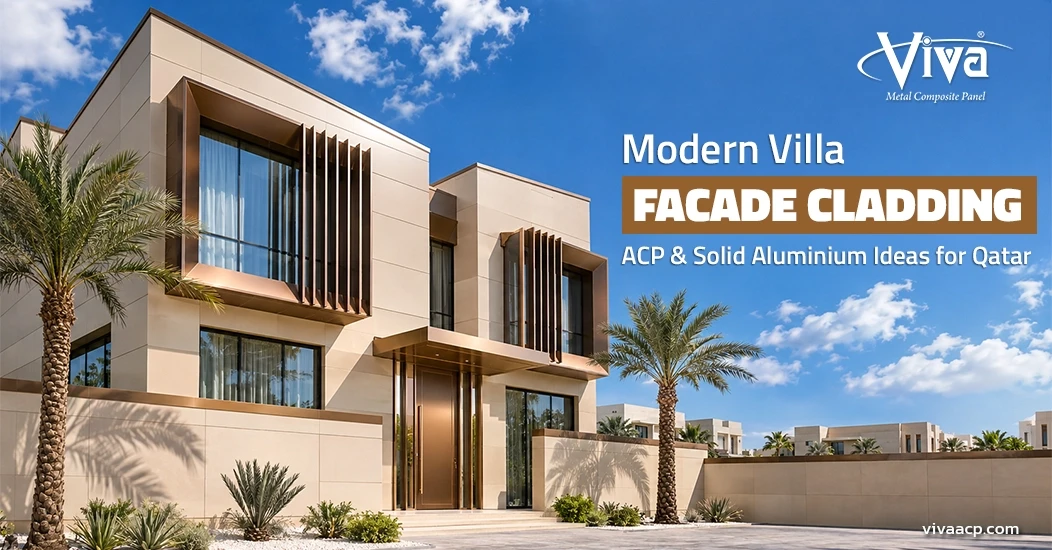
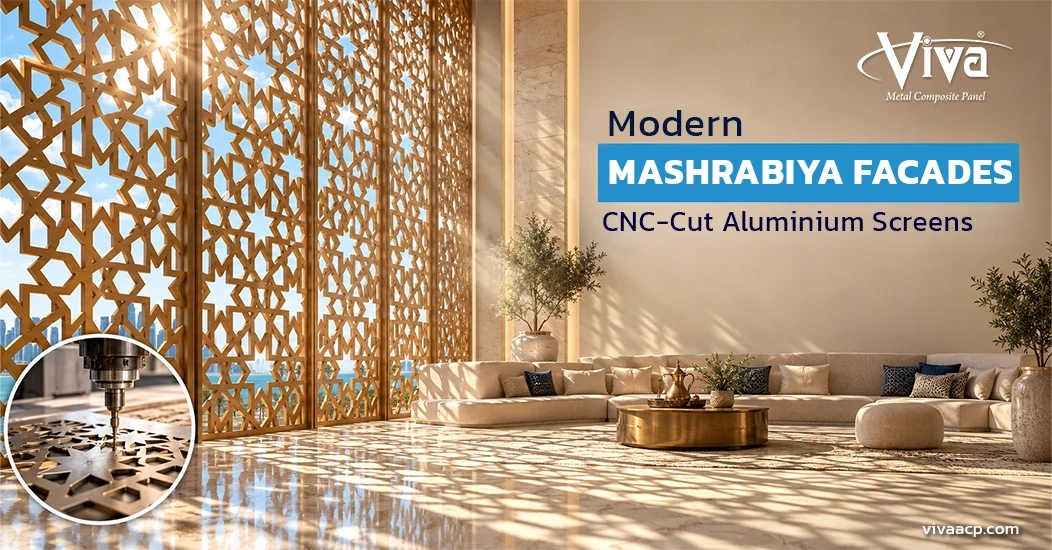
Quick answer Modern villas in Qatar increasingly use fire-rated ACP for clean wall cladding, feature boxes and parapets, and solid aluminium panels for screens, canopies and gates. Both are light, quick to install and hold their colour in Qatar's sun when finished in PVDF. The most popular looks pair sand, beige or white walls with bronze, wood-grain or dark grey accents, often with a mashrabiya-inspired screen for privacy. |
Drive through Al Waab, Al Thumama or the new villa districts around Lusail and you will notice how much Qatari villas have changed. The heavy, plastered facades of the past are giving way to crisp lines, deep shadows, metallic accents and patterned screens that still respect privacy and local character.
Much of that new look comes from aluminium cladding. This guide shares facade ideas for Qatari villas, explains when to use ACP and when to use solid aluminium, and covers the colours, climate details and care that keep a villa looking new for years.
Why aluminium cladding suits Qatari villas
• Light weight: it adds very little load to the structure, which helps on new builds and renovations.
• Fast installation: a villa facade can often be clad in weeks rather than months.
• Clean modern lines: flat panels, sharp edges and precise joints that plaster cannot match.
• Low maintenance: a PVDF finish needs washing, not repainting.
• Design freedom: solid colours, metallics, wood and stone looks, curves and patterned screens.
For most villa walls, fire-rated aluminium composite panels give the best mix of flatness, cost and choice. For screens, perforated panels and canopies, SolidX solid aluminium panels are the stronger choice because they have no core to expose at cut edges.
Facade design ideas for Qatari villas
|
Idea |
How it looks |
Material |
Tip |
|
Two-tone box facade |
Light walls with dark or bronze feature boxes around windows |
ACP |
Use the darker shade on deep window frames for strong shadows |
|
Mashrabiya screen |
A patterned screen over upper windows or a terrace |
Solid aluminium |
Denser pattern on west-facing windows for shade and privacy |
|
Wood-grain accents |
Wood-look panels on the entrance, soffits or majlis wall |
ACP |
Pair warm wood with sand or white walls |
|
Stone-look base |
Stone texture on the ground floor, smooth panels above |
ACP or stone honeycomb |
Gives the look of stone without the weight |
|
Floating canopy |
A thin metallic canopy over the main entrance |
Solid aluminium |
Hide LED strips in the edge for night lighting |
|
Vertical fins |
Slim fins in front of large windows |
ACP or solid aluminium |
Fins cut low-angle sun and add rhythm |
The entrance and majlis
In a Qatari villa, the entrance and the majlis set the tone for guests. They deserve the richest finishes on the facade.
• Frame the main door in a deep bronze or champagne panel that steps out from the wall.
• Use a wood-grain or marble-look panel on the majlis wall, which is often visible from the forecourt.
• Add a solid aluminium screen with a geometric pattern to bring privacy and a sense of arrival.
• Light the entrance with downlights in a clad soffit so the materials glow at night.
Boundary walls and gates
Boundary walls are a big part of how a Qatari villa looks from the street, and they take a lot of sun. Aluminium cladding can transform a plain block wall.
• Panelled boundary walls: ACP panels in the main facade colour, with a thin contrasting band along the top.
• Screened sections: solid aluminium screens between solid wall sections let breeze through while keeping privacy.
• Gates: solid aluminium gates with laser-cut patterns are light, rust-free and easy to automate.
• Nameplates: a cut-out house name or number in a bronze or gold panel, backlit for night.
Colours that suit Qatar
Qatar's light is bright and hot for most of the year, and colour choice affects both looks and comfort.
|
Palette |
Main colour |
Accent |
Feel |
|
Desert modern |
Sand or beige |
Bronze |
Warm and local |
|
Contemporary white |
White or ivory |
Dark grey or black |
Crisp and clean |
|
Natural warmth |
Light stone |
Walnut wood grain |
Calm and residential |
|
Luxury metallic |
Champagne |
Dark bronze |
Premium and bold |
|
Soft grey |
Light grey |
White and wood |
Modern and understated |
Lighter main colours keep walls cooler and hide dust better. Save dark shades for smaller accents and shaded areas, especially on west and south elevations.
Designing for Qatar's climate
Summer temperatures in Qatar often pass 45 degrees Celsius, humidity near the coast is high, and dust storms are common. Good detailing keeps the facade looking right through all of it.
• PVDF coating: essential for colour stability in Qatar's UV.
• Floating fixings: panels must be free to expand and contract with the large temperature swings.
• Ventilated cavity: a gap behind the panels lets heat and moisture escape, which also helps keep the villa cooler.
• Stainless fixings near the sea: villas on The Pearl, in Lusail and along the coast face salt in the air.
• Sloped tops: slope the tops of parapets, fins and ledges so dust and water run off rather than streaking down the wall.
Lighting the villa facade
Evenings are when Qatari families entertain, and a well-lit facade makes a strong impression. Aluminium cladding makes lighting easy to integrate.
• Hide LED strips along the edges of feature boxes and canopies for a soft glow.
• Use uplights behind solid aluminium screens so the pattern casts shadows on the wall.
• Backlight the house name or number in a cut-out metallic panel.
• Plan cable routes before cladding, so nothing has to be cut later.
Fire safety and approvals
Even on a private villa, it is sensible to choose fire-rated ACP rather than standard PE-core sheet. Larger villas, compounds and villas with attached commercial uses may fall under Qatar Civil Defence Department requirements, and the municipality approves facade changes as part of the building permit. Solid aluminium is non-combustible, which makes it an easy choice for screens and canopies. Check the requirements for your project with your architect before ordering.
Villa facade ideas by style
|
Style |
Cladding approach |
Colours |
Signature detail |
|
Contemporary Qatari |
Clean ACP walls with deep window boxes |
Sand with bronze |
Geometric solid aluminium screen over the upper floor |
|
Modern minimalist |
Large flat ACP panels with minimal joints |
White with dark grey |
Floating canopy and hidden lighting |
|
Heritage inspired |
Stone-look base with smooth panels above |
Beige, cream and gold |
Arched openings framed in metallic panels |
|
Warm natural |
Wood-grain accents on a light facade |
Ivory with walnut |
Wood-look soffits and entrance wall |
|
Bold luxury |
Metallic panels on key volumes |
Champagne and black |
Backlit name panel and dramatic portal |
Budgeting a villa facade
Villa facade costs vary a lot with size, design and finish, so a single number would mislead. These are the main factors that move the price:
• The area to be clad, and whether you clad the whole villa or only feature areas.
• Fire-rated ACP or solid aluminium, and the panel thickness.
• Finish: plain colours cost less than metallic, wood and stone looks.
• Screens and perforation, which add machine time.
• Canopies, gates and boundary walls, which are often priced separately.
• Lighting and any integrated signage or nameplates.
A smart way to control cost is to clad the most visible elements, such as the entrance, feature boxes and parapets, in premium finishes, and use simpler finishes elsewhere.
Renovating an older villa
Many villas built in the 1990s and 2000s have plaster or paint facades that need frequent repair. Cladding them with ACP is a popular way to modernise.
• A light aluminium subframe is fixed to the existing walls, so major structural work is rarely needed.
• Existing cracks and damp should be repaired first, since cladding hides but does not fix them.
• Window surrounds and parapets can be boxed in to create a completely new look.
• The work is usually fast and can be phased so the family stays at home.
Caring for a clad villa
Wash the facade with fresh water and a mild detergent two to four times a year, more often near the sea. Check sealant joints and fixings once a year, and clean screens and gates more often, since they collect dust faster. Avoid abrasive pads and strong solvents on the coated surfaces.
ACP or solid aluminium: a quick guide for villas
|
Villa element |
Recommended |
Why |
|
Main wall cladding |
Fire-rated ACP |
Flat, light and economical over large areas |
|
Mashrabiya and privacy screens |
Solid aluminium |
Clean cut edges and non-combustible |
|
Entrance canopy and soffits |
Solid aluminium or ACP |
Solid aluminium for thin edges and curves |
|
Gates |
Solid aluminium |
Strong, light and rust-free |
|
Feature boxes and parapets |
ACP |
Crisp folds and huge colour choice |
|
Stone-look ground floor |
Stone-look ACP or stone honeycomb |
The look of stone with far less weight |
Why Viva for villas in Qatar
Viva has supplied projects across Qatar, as covered in Viva ACP: Redefining the Skyline of Qatar . It was the first manufacturer in India to offer pre-coated, ready-to-install solid aluminium panels, and it makes fire-rated ACP in over 500 shades, including wood, stone and metallic finishes. Every batch goes through more than 250 in-house quality tests, and Viva's more than 30 global branches support projects across the Gulf.
Frequently asked questions
Which cladding is best for villas in Qatar?
Fire-rated ACP is usually best for the main walls, feature boxes and parapets, because it is flat, light and comes in many finishes. Solid aluminium is better for screens, canopies and gates. Both should have a PVDF finish to handle Qatar's sun.
What colours are popular for Qatari villa facades?
Sand, beige, white and light stone are popular main colours, often paired with bronze, walnut wood grain or dark grey accents. Lighter main colours stay cooler and hide dust, while darker accents add depth around windows and entrances.
Can an old villa be clad with ACP?
Yes. A light aluminium subframe is fixed to the existing walls and the panels are hung on it, usually without major structural work. Repair any cracks or damp first, because cladding covers but does not fix existing problems.
Is ACP safe for villas?
Choose fire-rated ACP with an FR or A2 core rather than standard PE-core sheet. Solid aluminium is non-combustible. Larger villas and compounds may also need Civil Defence and municipal approvals, so check with your architect.
How do I make a villa facade private but open?
Use solid aluminium mashrabiya-style screens over windows and terraces. A denser pattern gives more privacy and shade, while a more open pattern lets in light and breeze. Screens set slightly away from the wall also improve airflow.
How long does it take to clad a villa facade?
Most villa facades can be clad in a few weeks once panels are fabricated, depending on size and design. Fabrication and colour approval usually take a few weeks before that. Renovation projects can be phased so the family stays in the house.
Planning a new villa or a facade makeover? Share your elevations, location and preferred style through the enquiry form , and the Viva Gulf team will suggest panels, shades and screen patterns for your home.
POPULAR POSTS
CATEGORIES
- Aluminium Compsoite panel 2
- ACP Sheet 3
- ACP Facade 2
- Copper Aluminium Sheet 0
- Fire Safety For Buildings 1
- ACP Cladding 3
- Colour Coated Aluminium Coil 0
- Aluminium Corrugated Composite Panel 0
- Facades 2
- Aluminium Honeycomb Panel 1
- Fire Retardant 1
- Zinc Composite Panel 0
- Corten Steel Series 0
- Metal Abstract Series 1
- Wooden ACP Sheet 0
- HPL Sheet 0
- Viva ACP Colour Coating 0
- Wall Cladding 1
- Applications of ACP Panel 0
- Viva ACP 1
- ACP Sheets for Architectural Projects 0
- PVDF vs Polyester 0
- ACP Sheets For Showroom 0
- Viva ACP on International Market 0
- Viva royal club app 0
- ACP Sheets for Branding Corporates 0
- Shades of Santa Fe 0
- Al Zinc Series 0
- ACP Sheet Sizes and Thicknesses 0
- Louvers and Baffles 0
- Sustainable Facades 0
- Aluminium composite material 0
ARCHIVES
Shades in this article

Explore the ranges
Published by VIVA - Asia's Largest Manufacturer of Aluminium Composite Panels. 15M sq.mt capacity | 500+ shades | Thomas Bell-Wright FR A2+ Certified