en
 Spanish
 Arabic
 Swahili
 French


|
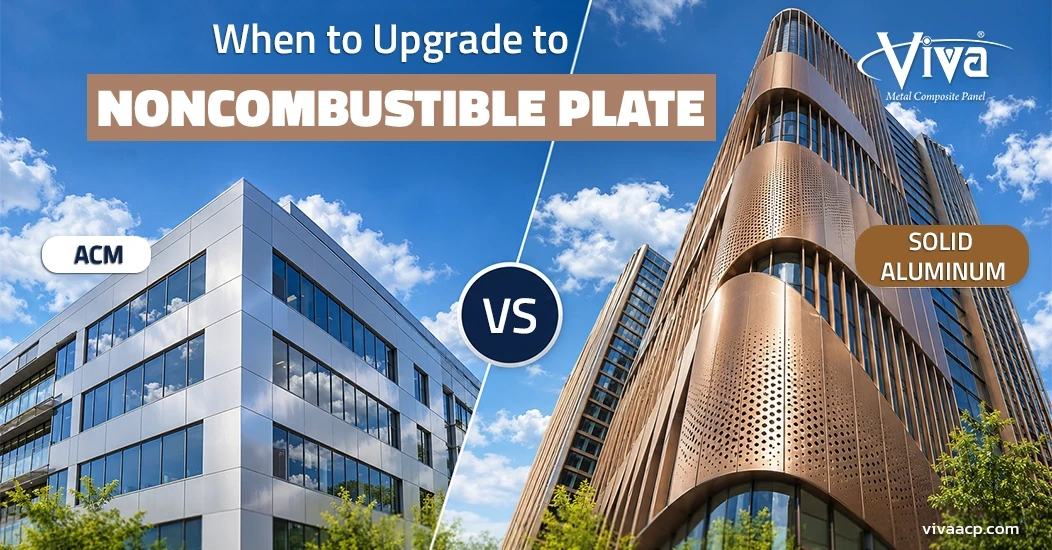
Quick answer ACM is lighter, flatter and usually cheaper, and with an FR or A2 core it suits most commercial facades. Solid aluminum panels are fully noncombustible, very durable and easy to perforate, curve and fold, but they weigh more and cost more. Upgrade to solid aluminum when the project needs zero combustible content, heavy perforation or complex 3D shapes, or when the owner or insurer wants the highest fire margin. |
For years, the default answer for a metal facade in the US was ACM. It is flat, light, colorful and cost-effective. But the conversation has changed. Tighter fire codes, cautious insurers and more ambitious designs have pushed many architects to look again at solid aluminum plate.
So which should you specify? The honest answer is that both have their place. This guide compares them on the points that matter, shows where each one wins, and explains how to decide for your project.
What each material is
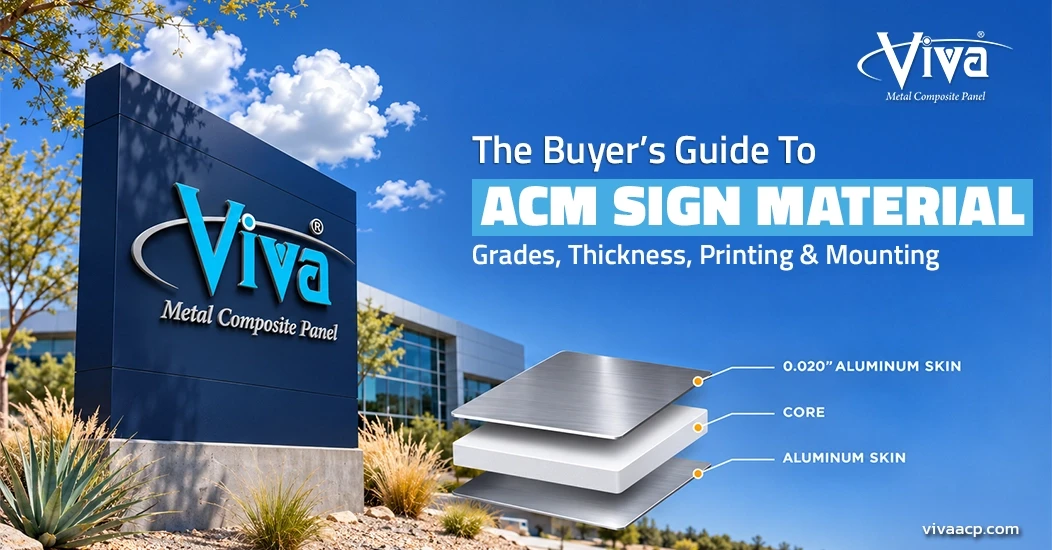
ACM (aluminum composite material) is two thin aluminum skins, usually about 0.020 inch each, bonded to a core. The core can be polyethylene, a fire-retardant mineral blend or an A2 mineral or aluminum core. Panels are usually 4 mm thick overall.
Solid aluminum panels are a single sheet of aluminum alloy, usually 2 mm or 3 mm thick (roughly 0.080 or 0.125 inch), pre-coated or post-painted and formed into trays. There is no core at all. Viva's SolidX solid aluminum panels come in 2 mm and 3 mm thicknesses, in alloys from the 3000 and 5000 series, with PVDF or FEVE coatings.
Head-to-head comparison
|
Factor |
ACM (4 mm) |
Solid aluminum (3 mm) |
|
Fire classification |
Depends on core: PE combustible, FR typically EN B-s1,d0, A2 core A2-s1,d0 |
Noncombustible; EN 13501-1 A1 |
|
Weight |
About 1.1 to 1.6 lb per sq ft |
About 1.7 lb per sq ft |
|
Flatness over large panels |
Excellent; the composite is very stiff for its weight |
Good, but large flat panels need stiffeners to avoid oil-canning |
|
Perforation |
Possible, but cut edges expose the core |
Excellent; clean edges, no core |
|
Curves and 3D shapes |
Good for single curves and folds |
Excellent for complex curves, deep trays and 3D forms |
|
Impact resistance |
Moderate |
Better; harder to dent |
|
Cost (relative) |
Lower |
Higher |
|
Recyclability |
Skins recyclable; core separated |
Fully recyclable as a single metal |
Fire performance: the main reason to switch
For many projects, fire is the deciding factor. Under the IBC, ACM on Type I to IV buildings needs a flame spread index of 25 or less, and above 40 feet the wall assembly must pass NFPA 285. FR and A2 cores are designed for this and work well within tested assemblies.
Solid aluminum takes the core question off the table. With no combustible core, it reaches EN 13501-1 class A1 and is treated as noncombustible. That makes it attractive for:
• High-rise residential and mixed-use towers.
• Hospitals, schools, airports and transit stations.
• Projects where the owner or insurer wants no combustible content in the facade.
• Perforated screens and sunshades, where cut edges would otherwise expose a core.
The rest of the wall still matters. Insulation, weather barriers and cavity details must meet code, whichever panel you choose.
Design freedom: where solid aluminum shines
Architects often reach for solid aluminum for creative reasons as much as fire reasons.
• Perforation: patterns, logos and gradients can be punched or routed with clean, sealed-looking edges.
• Complex shapes: deep trays, folded fins, curved corners and parametric forms are easier in plate.
• Sunshades and screens: solid aluminum stays stiff and safe even with large open areas.
• Soffits and canopies: the material is light enough for overhead use and fully noncombustible.
Viva's article on perforated solid aluminum panels in climate-responsive buildings shows how perforation can control sun and heat on a facade.
Where ACM still wins
Solid aluminum is not always the better choice. ACM keeps several real advantages.
• Flatness at low weight: for large, flat panels, ACM stays flatter with less framing.
• Cost: for most mid-rise commercial buildings, an FR or A2 ACM in a tested assembly meets code at a lower installed cost.
• Speed and familiarity: many US installers are set up for routed and returned ACM systems.
• Huge finish range: wood, stone, metallic and brand colors are widely available in ACM.
For many buildings, the smart answer is a mix: ACM on large flat areas, and solid aluminum for perforated screens, soffits and complex details.
Cost and lifecycle
Solid aluminum usually costs more per square foot than ACM, both in material and fabrication. The gap narrows when you compare it with A2-core ACM rather than standard PE or FR ACM.
Over the life of the building, solid aluminum has some advantages: it resists dents better, can be repaired or refinished more easily, and is fully recyclable as a single metal at end of life. If the owner plans to hold the building for decades, those points can offset part of the upfront premium.
Where each material is used on real buildings
|
Building type |
Typical choice |
Reason |
|
Mid-rise office or retail |
FR or A2 ACM |
Large flat areas, cost control, tested assemblies widely available |
|
High-rise residential |
A2 ACM or solid aluminum |
Higher fire margin and insurer comfort |
|
Hospitals and schools |
Solid aluminum or A2 ACM |
Life safety focus and durability in busy areas |
|
Airports and transit stations |
Solid aluminum |
Noncombustible, tough, good for large soffits and curves |
|
Parking structures |
Perforated solid aluminum |
Ventilation, screening and clean perforated edges |
|
Car dealerships and branded retail |
ACM |
Exact brand colors and crisp fascias |
Durability and maintenance
Both materials, with a quality PVDF or FEVE finish, can look good for decades. Solid aluminum has an edge in high-traffic areas because it resists dents and can be refinished. ACM panels that are damaged are usually replaced rather than repaired. For either material, wash facades periodically, inspect sealants and fixings, and keep spare panels from the same batch for future repairs.
Common myths
• "All ACM is flammable." Only PE-core ACM is combustible. FR and A2 cores are designed to limit fire spread.
• "Solid aluminum is always flat." Large thin plates can oil-can; good design uses stiffeners and sensible panel sizes.
• "Solid aluminum is too heavy for facades." A 3 mm plate is only slightly heavier than a 4 mm FR ACM panel.
• "You have to choose one." Many of the best facades combine both, using each where it performs best.
A quick decision guide
|
If your project needs |
Choose |
Why |
|
Large flat areas at the lowest cost |
FR or A2 ACM |
Flat, light and economical within a tested assembly |
|
No combustible content at all |
Solid aluminum |
A1 noncombustible with no core |
|
Heavy perforation or screens |
Solid aluminum |
Clean edges, no exposed core |
|
Complex curves and 3D shapes |
Solid aluminum |
Easier to form deep and curved shapes |
|
Wood, stone or specialty looks |
ACM, or solid aluminum with special coatings |
Widest finish range in ACM |
|
High-traffic areas at ground level |
Solid aluminum |
Better dent resistance |
Switching a design from ACM to solid aluminum
Projects often start in ACM and move to solid aluminum when the fire strategy or insurer requirements tighten. The switch is usually straightforward, but a few points need attention.
• Panel size: large flat ACM panels may need to be split or stiffened in solid aluminum to stay flat.
• Subframe: the slightly higher weight rarely changes the framing, but check clip spacing and wind design.
• Fabrication: solid aluminum is folded and welded or riveted into trays rather than routed, so corner details change.
• Color matching: if both materials are used on one elevation, order them from the same supplier and approve samples side by side.
• Budget: price the change early, ideally at design development, rather than as a late substitution.
Thermal and energy performance
Neither ACM nor solid aluminum is an insulator on its own; the insulation behind the cladding does that job. What matters for energy performance is the full wall: continuous insulation, thermally broken clips and a ventilated cavity. Light, reflective finishes on either material reduce solar heat gain, and perforated solid aluminum screens can shade glazing and cut cooling loads on sunny elevations.
Specifying solid aluminum: what to include
• Alloy and temper, for example 3003 or 5005, and the ASTM B209 reference.
• Thickness: 2 mm for smaller panels and soffits, 3 mm for most facade panels.
• Coating: 70 percent PVDF (two or three coats) or FEVE, with minimum film thickness.
• Fire classification: EN 13501-1 A1 report, plus any US test data the project needs.
• Panel sizes, stiffener spacing and fixing method.
• Perforation pattern and open area, if used.
• Finish warranty terms.
Why Viva SolidX
Viva was the first manufacturer in India to offer pre-coated, ready-to-install solid aluminum panels. SolidX is classed A1 under EN 13501-1, comes in lengths of up to about 6,000 mm, and is available in Viva's range of over 500 shades plus RAL and Pantone matching. Viva also produces FR and A2 ACM, so a project can use both materials from one supplier with matched colors. Every batch goes through more than 250 in-house quality tests.
If you are weighing the two for a fire-sensitive project, start with Viva's fire-retardant ACP options alongside SolidX.
Frequently asked questions
Is solid aluminum better than ACM?
Not always. Solid aluminum is noncombustible, tougher and better for perforation and complex shapes. ACM is lighter, flatter on large panels and usually cheaper. Many projects use ACM on large flat areas and solid aluminum for screens, soffits and detailed elements.
Is solid aluminum cladding noncombustible?
Yes. Solid aluminum panels have no combustible core and are classed A1 under EN 13501-1. The rest of the wall, including insulation and weather barriers, still has to meet the fire code for the building type and height.
How thick are solid aluminum facade panels?
Most solid aluminum facade panels are 2 mm or 3 mm thick, roughly 0.080 or 0.125 inch. 3 mm is common for facade panels, while 2 mm suits smaller panels, soffits and interior uses. Large panels usually need stiffeners to stay flat.
Does solid aluminum cost more than ACM?
Usually yes, in both material and fabrication. The difference is smaller when you compare solid aluminum with A2-core ACM rather than standard ACM. Lifecycle benefits such as dent resistance and full recyclability can offset part of the premium.
Can solid aluminum panels be perforated?
Yes, and they are ideal for it. Solid aluminum can be punched or routed into patterns, logos and gradients with clean edges, because there is no core to expose. It is widely used for sunshades, screens and car park facades.
Where should I use solid aluminum instead of ACM?
Use solid aluminum where the project needs no combustible content, where panels will be heavily perforated, where shapes are deeply curved or folded, or at ground level where dent resistance matters. ACM remains a strong, economical choice for large flat facade areas.
Choosing between ACM and solid aluminum? Share your building type, height and design intent through the quote request form , and the Viva team will recommend the right mix and share the fire classification reports.
POPULAR POSTS
CATEGORIES
- Aluminium Compsoite panel 3
- ACP Sheet 0
- ACP Facade 0
- Copper Aluminium Sheet 0
- Fire Safety For Buildings 0
- ACP Cladding 0
- Colour Coated Aluminium Coil 0
- Aluminium Corrugated Composite Panel 0
- Facades 0
- Aluminium Honeycomb Panel 0
- Fire Retardant 1
- Zinc Composite Panel 0
- Corten Steel Series 0
- Metal Abstract Series 0
- Wooden ACP Sheet 0
- HPL Sheet 0
- Viva ACP Colour Coating 0
- Wall Cladding 0
- Applications of ACP Panel 0
- Viva ACP 0
- ACP Sheets for Architectural Projects 0
- PVDF vs Polyester 0
- ACP Sheets For Showroom 0
- Viva ACP on International Market 0
- Viva royal club app 0
- ACP Sheets for Branding Corporates 0
- Shades of Santa Fe 0
- Al Zinc Series 0
- ACP Sheet Sizes and Thicknesses 0
- Louvers and Baffles 0
- Sustainable Facades 0
- Aluminium composite material 3
ARCHIVES
Published by VIVA - Asia's Largest Manufacturer of Aluminium Composite Panels. 15M sq.mt capacity | 500+ shades | Thomas Bell-Wright FR A2+ Certified