en
 Spanish
 Arabic
 Swahili
 French


|
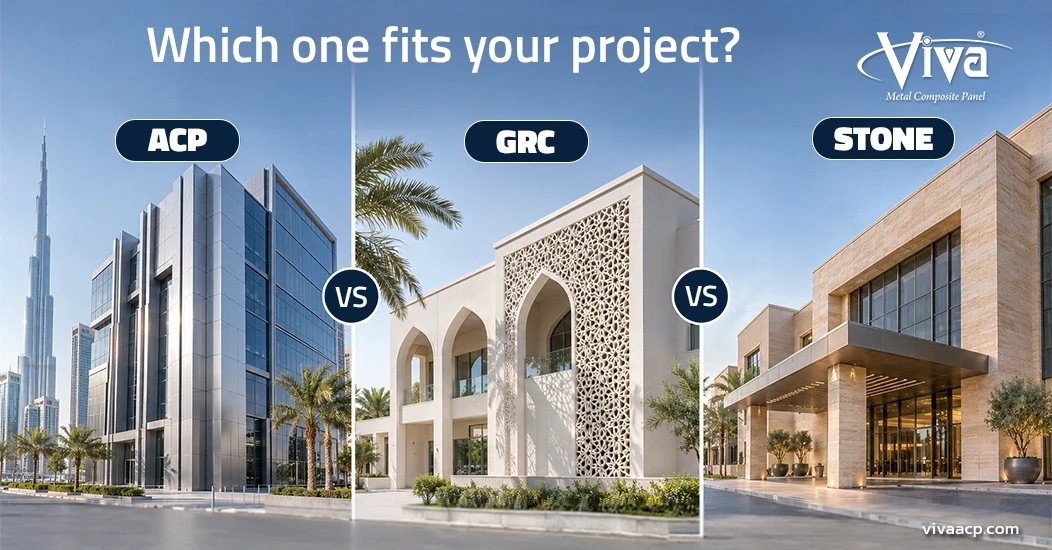
Quick answer ACP is the lightest and fastest to install, with the widest range of colours, and A2 fire-rated versions suit most UAE towers. GRC is best for sculpted shapes such as arches, domes and mashrabiya screens. Natural stone gives a premium, timeless look but is heavy and slow to install. Many UAE buildings combine them: stone or GRC at the podium and entrances, and fire-rated ACP on the large upper facades. |
Stand on Sheikh Zayed Road and look around. Within a few hundred metres you will see towers clad in aluminium composite panels, villas wrapped in carved GRC, and hotel lobbies faced in marble and limestone. All three materials have earned their place in the UAE, and each one is the right answer for some projects and the wrong answer for others.
Our earlier guide on how to choose the right wall cladding covers the basics. This article goes further and puts ACP, GRC and stone side by side on the points that matter in the UAE: weight, fire approval, desert heat, cost, design freedom and long-term upkeep.
What each material is
ACP (aluminium composite panel) has two thin aluminium skins bonded to a core, usually 4 mm thick overall. For facades in the UAE, the core is normally fire-rated: FR mineral or A2 limited combustibility. Panels are folded into trays and hung on a lightweight aluminium subframe.
GRC (glass reinforced concrete) is a thin cement-based mix reinforced with alkali-resistant glass fibres, cast into moulds. It can be shaped into almost any form, from flat panels to domes, arches, cornices and lattice screens, and is usually fixed to a steel frame.
Natural stone cladding uses slabs of granite, limestone, marble or sandstone, typically 20 to 40 mm thick, fixed with stainless steel anchors or a rail system.
Head-to-head comparison
|
Factor |
ACP (4 mm, FR or A2) |
GRC |
Natural stone (30 mm) |
|
Typical weight |
About 6 to 8 kg per sq m |
Often 25 to 50 kg per sq m with its frame |
About 75 to 85 kg per sq m |
|
Fire classification |
A2-s1,d0 or B-s1,d0 depending on core |
Non-combustible |
Non-combustible |
|
Design freedom |
Flat, folded and curved panels; huge colour range |
Almost any 3D shape; textured finishes |
Flat panels; natural patterns |
|
Installation speed |
Fast |
Medium |
Slow |
|
Structural load |
Very low |
Medium |
High |
|
Maintenance |
Washing; sealant checks |
Periodic sealing or coating; crack checks |
Cleaning; anchor and joint checks |
|
Typical relative cost |
Low to medium |
Medium |
High |
These are typical figures. The exact weight and cost depend on panel size, finish, framing and the building, but the pattern holds on most projects.
Fire approval in the UAE
Fire performance is often the first filter on UAE projects. Under the UAE Fire and Life Safety Code, facade systems need test evidence for their components and the full assembly, and Civil Defence approval before and during installation.
GRC and natural stone are non-combustible, which makes their fire case simple. Modern ACP can also meet strict requirements when you choose the right core. A2-rated ACP has very limited combustibility and is used on many towers across Dubai and Abu Dhabi. Viva's FR A2 plus aluminium corrugated core panel replaces the mineral core with a corrugated aluminium core and is certified by Thomas Bell-Wright, the Dubai-based testing body.
Standard PE-core ACP should never be used on UAE building facades. If a quote seems far below others, check the core.
How each material copes with UAE heat
Summer temperatures above 45 degrees Celsius, strong sun, humidity on the coast and sandstorms all test a facade.
|
Climate factor |
ACP |
GRC |
Natural stone |
|
Strong UV |
Excellent with a 70 percent PVDF coating |
Good; coatings may need renewing |
Excellent; some stones fade slightly |
|
Heat and movement |
Expands and contracts; needs floating fixings |
Can craze or crack if poorly detailed |
Stable, but anchors must allow movement |
|
Coastal humidity and salt |
Good with sealed edges and stainless fixings |
Good; reinforcement must be alkali resistant |
Good; porous stones need sealing |
|
Dust and sandstorms |
Smooth faces wash clean easily |
Textured faces hold dust |
Porous stones can stain |
Design freedom: where each one shines
• ACP: sharp, modern lines, large flat areas, exact brand colours, metallic, wood and stone-look finishes, curved corners and folded fins.
• GRC: arches, domes, cornices, columns and lattice mashrabiya screens. It is the go-to material for heritage-inspired and Islamic architecture across the UAE.
• Natural stone: timeless luxury for hotel entrances, palaces, government buildings and high-end villas, where the real thing matters.
If you want the look of stone without the weight, stone-texture ACP or aluminium honeycomb panels with a real stone veneer are worth pricing. They can cut the facade weight by a large margin and speed up installation.
Weight and the structure behind it
Weight is easy to overlook until the structural engineer gets involved. Stone at around 80 kg per square metre can be more than ten times the weight of ACP. On a tower, that difference affects the slab edges, the anchors and even the foundations.
For renovation and over-cladding of existing UAE buildings, weight often decides the material on its own. ACP can usually be fixed to the existing structure with a light subframe, while stone may need extra steelwork or may not be possible at all.
Cost and programme
Upfront cost is only part of the picture. Installation speed affects the whole construction programme, which matters a great deal in the UAE, where many projects run to tight handover dates.
• ACP is usually the lowest cost per square metre of the three and the fastest to install, because panels are light and the subframe is simple.
• GRC costs more, mainly due to moulds, casting and heavier framing, but it can be economical when the same shape repeats many times.
• Natural stone is usually the most expensive, with higher material, anchor and labour costs and a slower installation.
For a breakdown of ACP costs in Dubai, see our ACP cladding cost guide.
Maintenance over the building's life
In a dusty climate, maintenance is a real cost. ACP with a PVDF finish needs washing a few times a year and sealant checks. GRC may need re-coating and crack repairs over time, especially on exposed elevations. Stone needs cleaning, occasional re-sealing of porous types and checks on anchors and joints. Plan BMU or rope access for all three from the design stage.
Mock-ups, samples and approvals
Whichever material you choose, ask for real samples early and, on larger projects, a full-size mock-up of a typical bay. Look at it in morning and late afternoon light, since UAE sun changes how metallics, stone and textured GRC appear through the day. Mock-ups also let the consultant, the contractor and Civil Defence check joints, fixings and cavity barriers before the full facade is ordered, which avoids expensive surprises later.
Which should you choose?
|
Project |
Best fit |
Why |
|
High-rise residential or office tower |
A2 fire-rated ACP |
Light, fast, fire compliant and cost-effective |
|
Heritage-inspired villa or mosque |
GRC |
Arches, domes and lattice screens in one material |
|
Luxury hotel entrance or lobby |
Natural stone |
Timeless luxury where people see and touch it |
|
Mall or retail podium |
Stone or GRC at ground level, ACP above |
Durable base with a light, branded upper facade |
|
Over-cladding an existing building |
ACP |
Lowest weight and fastest installation |
|
Stone look on a budget or a tall building |
Stone-look ACP or stone honeycomb |
The look of stone without the weight |
Sustainability and green building ratings
Green building rules matter more every year in the UAE, from Estidama Pearl ratings in Abu Dhabi to Dubai's green building regulations and LEED on many commercial projects. Facade materials affect several of the points these systems reward.
• Weight and embodied carbon: lighter cladding means less structural steel and concrete, which lowers embodied carbon. ACP has a clear advantage here.
• Recyclability: aluminium skins can be recycled at end of life; stone and GRC are harder to reuse.
• Solar heat gain: light, reflective ACP finishes and ventilated cavities reduce the heat reaching the building, cutting cooling loads.
• Product disclosure: Environmental Product Declarations (EPDs) help earn credits. Viva holds EPD and other green certifications.
Combining materials on one facade
Some of the best facades in the UAE use all three. A common approach is natural stone or GRC at the podium and main entrance, where people see the facade up close, and fire-rated ACP on the tower above, where weight and speed matter most. When combining materials, plan the joints, colours and fire breaks carefully so the transitions look intentional and meet the approved system.
Why Viva for UAE facades
Viva, which describes itself as Asia's largest ACP manufacturer, was the first in India to set up dedicated A2 core production lines and to offer A1 fire-rated honeycomb panels, including stone honeycomb options. With over 500 shades, more than 250 in-house quality tests and more than 30 global branches, Viva supports UAE projects with fire-rated panels and the test documents consultants need. Explore Viva's aluminium composite panels for the UAE.
Frequently asked questions
Is ACP cheaper than GRC?
In most cases, yes. ACP is usually cheaper per square metre and much faster to install, because the panels are light and the subframe is simple. GRC can be economical when the same moulded shape repeats many times, but complex one-off shapes cost more.
Which is better for fire safety, ACP or GRC?
GRC and natural stone are non-combustible. ACP depends on its core: A2-rated ACP has very limited combustibility and is approved on many UAE towers, while PE-core ACP should never be used on facades. For any material, the full system must be tested and approved by Civil Defence.
How heavy is stone cladding compared with ACP?
A 30 mm natural stone cladding weighs roughly 75 to 85 kg per square metre, while 4 mm fire-rated ACP weighs about 6 to 8 kg per square metre. That difference affects the structure, anchors and installation speed, especially on tall buildings.
Can ACP look like stone?
Yes. Stone-texture ACP gives the look of granite, marble or limestone at a fraction of the weight. For a more authentic finish, aluminium honeycomb panels with a thin real stone veneer combine natural stone with very low weight.
What is GRC cladding used for in the UAE?
GRC is widely used for decorative and heritage-inspired elements in the UAE: arches, domes, cornices, columns, lattice mashrabiya screens and sculpted facade panels. It is popular on villas, mosques, cultural buildings and hotels.
Which cladding is best for UAE heat?
All three can perform well with good detailing. ACP with a 70 percent PVDF finish holds its colour in strong UV and stays cooler on a ventilated subframe. Natural stone is very stable but heavy. GRC needs careful detailing and coatings to avoid crazing in the heat.
Can ACP and GRC be used on the same building?
Yes, and many UAE buildings do. A common approach is GRC or stone at the podium, entrances and decorative elements, with fire-rated ACP on the larger upper facades. Plan joints, colours and fire breaks carefully so the transitions look intentional and meet the approved system.
Comparing facade materials for a UAE project? Share your building type, height and design intent through the enquiry form , and the Viva Gulf team will recommend the right panel and share the fire test documents.
POPULAR POSTS
CATEGORIES
- Aluminium Compsoite panel 3
- ACP Sheet 3
- ACP Facade 1
- Copper Aluminium Sheet 0
- Fire Safety For Buildings 1
- ACP Cladding 2
- Colour Coated Aluminium Coil 0
- Aluminium Corrugated Composite Panel 0
- Facades 2
- Aluminium Honeycomb Panel 1
- Fire Retardant 1
- Zinc Composite Panel 0
- Corten Steel Series 0
- Metal Abstract Series 1
- Wooden ACP Sheet 0
- HPL Sheet 0
- Viva ACP Colour Coating 0
- Wall Cladding 1
- Applications of ACP Panel 0
- Viva ACP 1
- ACP Sheets for Architectural Projects 0
- PVDF vs Polyester 0
- ACP Sheets For Showroom 0
- Viva ACP on International Market 0
- Viva royal club app 0
- ACP Sheets for Branding Corporates 0
- Shades of Santa Fe 0
- Al Zinc Series 0
- ACP Sheet Sizes and Thicknesses 0
- Louvers and Baffles 0
- Sustainable Facades 0
- Aluminium composite material 0
ARCHIVES
Explore the ranges
Published by VIVA - Asia's Largest Manufacturer of Aluminium Composite Panels. 15M sq.mt capacity | 500+ shades | Thomas Bell-Wright FR A2+ Certified