en
en
 Spanish
 Arabic
 Swahili
 French


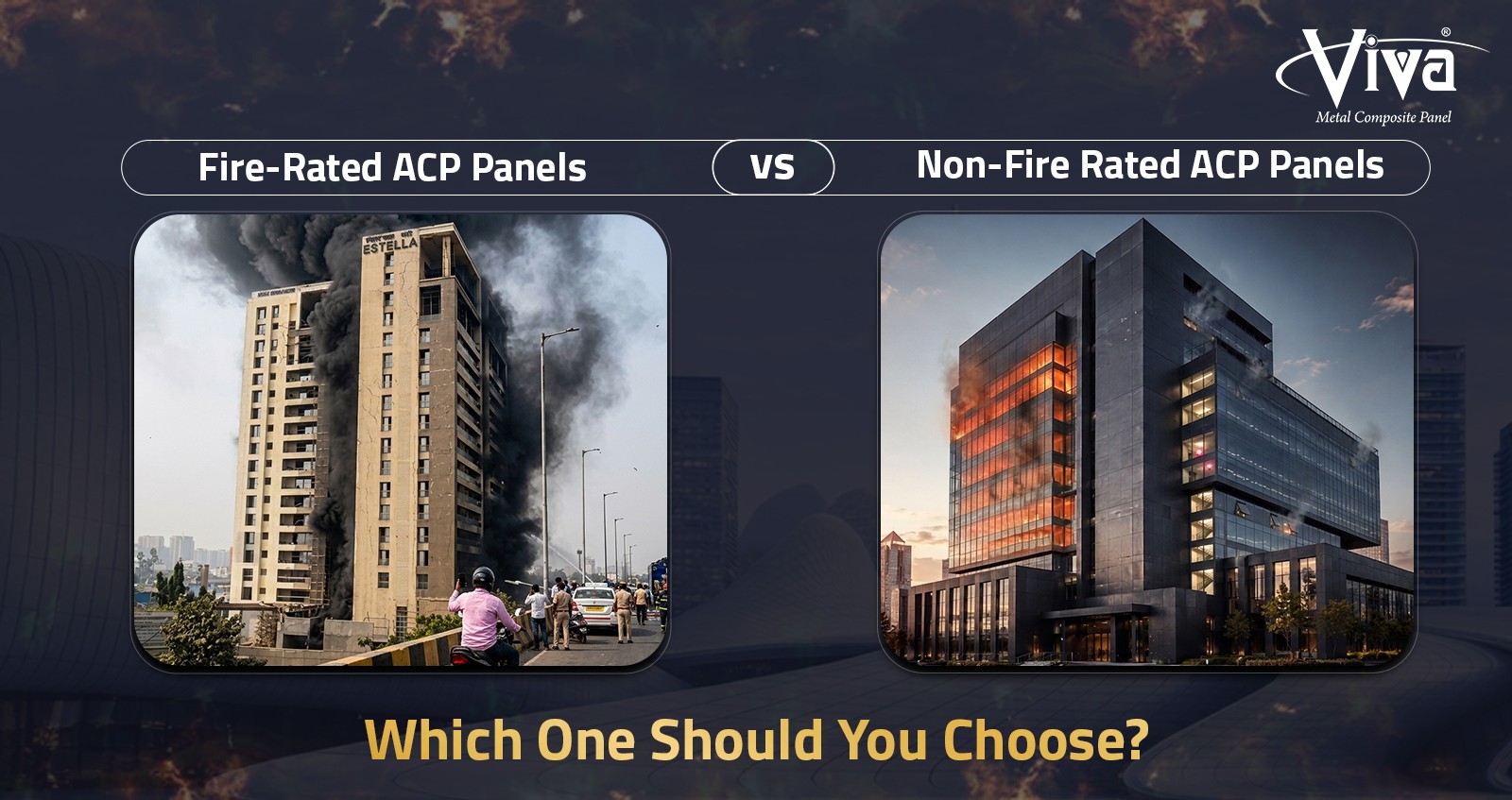
Fire-rated ACP panels have a fire-retardant (FR) or non-combustible A2 core that slows or resists flame spread, while non-fire-rated ACP panels have a standard polyethylene (PE) core that is combustible. For high-rise, commercial, and institutional buildings, fire-rated ACP is the safer and often legally required choice; non-FR panels suit only low-rise, low-risk, or interior use. Viva offers a full range including A2+ fire-safe panels and is the first ACP manufacturer in India to earn the GreenPro Ecolabel certification.
Introduction: A Choice That Affects Safety, Not Just Cost
When specifying aluminium composite panels, one decision matters more than any other: fire-rated or non-fire-rated. It is not simply a matter of budget. The core inside an ACP panel determines how that facade will behave in a fire — and that can affect building compliance, insurance, and, most importantly, human safety.
After several high-profile facade fires around the world, regulators, consultants, and developers have become far more rigorous about ACP fire performance. Building codes now restrict combustible cladding on taller and higher-occupancy buildings, and specifiers are held accountable for the panels they choose.
This guide explains the difference between fire-rated and non-fire-rated ACP panels, how fire ratings work, where each type is appropriate, and how to make the right, compliant choice for your project.
What Is Fire-Rated ACP?
Fire-rated ACP is an aluminium composite panel engineered to resist or slow the spread of fire. The fire performance comes from the core: instead of a purely combustible polyethylene core, fire-rated panels use either a mineral-filled fire-retardant (FR) core or a non-combustible aluminium or mineral A2 core.
There are two main levels of fire-rated ACP:
• FR (Fire-Retardant) core — a polyethylene core heavily filled with mineral (fire-retardant) compounds that slow flame spread. Commonly classified as fire class B.
• A2 core — a core with very high non-combustible mineral content, or a solid/corrugated aluminium core, offering near non-combustible performance and the highest common fire classification for ACP.
Viva was the first ACP company in India to introduce the A2+ Aluminium Core Corrugated Panel (ACCP) and holds NFPA 285 accreditation — signalling top-tier fire performance for demanding projects.
What Is Non-Fire Rated ACP?
Non-fire-rated ACP, often called PE-core ACP, uses a standard polyethylene core with no significant fire-retardant filler. Polyethylene is a plastic and is combustible, so these panels can contribute to fire and flame spread if ignited.
Non-FR panels are typically lower in cost and remain suitable for specific low-risk uses, but they are increasingly restricted or prohibited on taller and higher-occupancy buildings by modern codes. They should never be used where fire safety is a concern.
Understanding ACP Fire Ratings and Classifications
Fire performance is measured against recognised international and national standards. Knowing the key classifications helps you verify a supplier's claims rather than take them at face value.
Always ask for test certificates. A credible manufacturer can produce documentation showing the exact fire classification and the standard against which the panel was tested.
Fire-Rated vs Non-Fire Rated ACP: Head-to-Head
The table below summarises the practical differences that should drive your decision.
Which One Should You Choose? A Decision Guide
The right choice depends primarily on building height, occupancy, and local code — with fire safety always taking priority over cost. Use this guidance:
1. High-rise buildings — use A2-grade fire-safe panels; combustible cladding is restricted or banned.
2. Hospitals, schools, airports, malls — high-occupancy buildings demand A2 or high-grade FR panels.
3. Mid-rise commercial — FR-core panels are typically the minimum acceptable standard.
4. Low-rise, low-risk structures — FR is still strongly recommended; non-FR only where codes allow.
5. Interior, non-critical use — non-FR may be acceptable, but FR adds a safety margin.
When in doubt, choose the higher fire rating. The cost difference is small relative to the safety, compliance, and insurance benefits.
Why Fire-Rated ACP Is Worth the Investment
Some buyers hesitate at the higher price of fire-rated panels. But viewed over the life of a building, fire-rated ACP is not an added cost — it is essential risk management.
• Life safety — slows fire spread, protecting occupants and giving time to evacuate.
• Legal compliance — meets building codes and avoids costly rectification or penalties.
• Insurance and liability — reduces risk exposure for owners, developers, and specifiers.
• Asset protection — limits fire damage to the building and its value.
• Peace of mind — confidence that the facade will perform if the worst happens.
Fire Safety and Sustainability Can Go Together
Choosing a fire-rated panel does not mean compromising on environmental goals. Leading manufacturers now offer panels that are both fire-safe and sustainably produced, with recyclable aluminium and certified environmental performance.
Safety plus sustainability: Viva pairs industry-leading fire safety — as the first in India to introduce the A2+ ACCP and with NFPA 285 accreditation — with sustainability leadership as the first ACP manufacturer in India to achieve the GreenPro Ecolabel certification. Projects can specify fire-rated panels that also contribute to IGBC and LEED green-building credits.
This combination matters because modern institutional and commercial projects are judged on both fire compliance and green performance. A panel that delivers both simplifies specification and strengthens the project on two fronts.
Building Codes and Regulations for ACP Fire Safety
Fire-safety requirements for facades have tightened significantly, and specifiers must understand the regulatory landscape. While exact rules vary by country and city, the global direction is consistent: the taller and more occupied the building, the stricter the cladding requirement.
• Height thresholds — many codes restrict or ban combustible cladding above a defined building height, requiring FR or A2 panels.
• Occupancy type — hospitals, schools, and assembly buildings face stricter rules regardless of height.
• National standards — codes reference tests such as EN 13501, NFPA 285, and local fire norms.
• Documentation — authorities increasingly require test certificates and traceability for the exact panel used.
Because non-compliant cladding can lead to costly rectification, refused occupancy, or legal liability, confirming code compliance before specification is essential. A reputable manufacturer will help match the panel grade to the applicable regulations.
What Happens in a Facade Fire: FR vs Non-FR
Understanding how each panel type behaves in a real fire clarifies why the core matters so much. The difference is not academic — it directly affects how quickly a fire can spread up a building.
6. Ignition — non-FR PE cores ignite and burn readily; FR and A2 cores resist ignition and limit contribution to the fire.
7. Flame spread — combustible cores can carry flame rapidly up a cavity; fire-rated cores slow or stop this spread.
8. Heat and smoke — burning PE releases significant heat and smoke; mineral and aluminium cores release far less.
9. Evacuation time — by slowing spread, fire-rated panels give occupants more time to escape safely.
This behaviour is exactly why regulators moved decisively against combustible cladding on tall buildings, and why A2-grade panels are now the benchmark for high-risk projects.
Cost vs Safety: Putting the Price Difference in Perspective
Fire-rated ACP costs more than non-FR, but the gap is modest compared with the stakes involved. The table below frames the trade-off realistically.
Seen this way, fire-rated ACP is not a luxury but a sound investment in safety, compliance, and long-term asset protection. The incremental cost is small next to the consequences of a facade fire or a compliance failure.
How to Verify a Fire-Rated ACP Panel
Not every panel labelled "FR" performs equally. Protect your project by verifying claims before you buy.
10. Request test certificates — ask for EN 13501, NFPA 285, or ASTM results, not just a data sheet.
11. Confirm the exact grade — clarify whether the panel is FR (class B) or A2, as performance differs.
12. Check the manufacturer — genuine manufacturers with in-house production stand behind their ratings.
13. Match to code — ensure the grade meets your building's height and occupancy requirements.
14. Get it in writing — secure warranties and documentation for compliance records.
Conclusion: Never Compromise on Fire Safety
The choice between fire-rated and non-fire-rated ACP is ultimately a choice about safety and responsibility. Non-FR panels have a narrow, low-risk role, but for the vast majority of facades — especially high-rise, commercial, and institutional buildings — fire-rated ACP is the correct, compliant, and responsible choice.
With tightening regulations and rising expectations, specifying A2 or high-grade FR panels from a proven manufacturer is the safest path. Viva's leadership in fire-safe ACP, combined with its GreenPro Ecolabel sustainability credentials, lets you meet both safety codes and green-building goals in a single specification.
Protect your next project with the right panel. Explore Viva's fire-rated ACP range and request certification support to ensure full compliance and peace of mind.
Frequently Asked Questions (FAQs)
Q1. What is the difference between fire-rated and non-fire-rated ACP panels?
Fire-rated ACP panels have a fire-retardant (FR) or non-combustible A2 core that slows or resists flame spread, while non-fire-rated ACP panels have a combustible polyethylene (PE) core. Fire-rated panels are required for high-rise and commercial buildings, whereas non-FR panels are limited to low-rise, low-risk, or interior applications. Q2. Which ACP panel is best for high-rise buildings?
A2-grade fire-rated ACP panels are best for high-rise buildings because they are near non-combustible and meet strict fire-safety codes. Many building regulations restrict or ban combustible PE-core panels on tall structures, so A2 or high-grade FR panels are the recommended and often legally required choice. Q3. What do ACP fire ratings like A2 and FR mean?
FR (fire-retardant) means the core is mineral-filled to slow flame spread, typically classified as fire class B. A2 means the panel is near non-combustible, the highest common ACP fire class under EN 13501-1. Ratings are verified through tests such as EN 13501, NFPA 285, and ASTM E84, and certificates should always be requested. Q4. Is fire-rated ACP worth the extra cost?
Yes. Fire-rated ACP is worth the extra cost because it protects life safety, ensures code compliance, reduces insurance and liability risk, and safeguards the building's value. The price difference is small compared with the safety, legal, and financial benefits, making fire-rated ACP essential risk management for most facades. Q5. Can non-fire-rated ACP panels still be used?
Non-fire-rated ACP panels can still be used for specific low-risk applications such as signage, low-rise structures, and some interiors, where local codes permit. However, they should never be used on high-rise, commercial, or high-occupancy buildings. When in doubt, a fire-rated panel is the safer choice. Q6. How can I verify that an ACP panel is genuinely fire-rated?
Verify a fire-rated ACP panel by requesting test certificates such as EN 13501, NFPA 285, or ASTM E84 rather than relying on a data sheet alone. Confirm the exact grade (FR or A2), check that it matches your building's code requirements, choose a genuine manufacturer with in-house production, and get warranties and documentation in writing.
POPULAR POSTS
CATEGORIES
- Aluminium Compsoite panel 52
- ACP Sheet 170
- ACP Facade 9
- Copper Aluminium Sheet 1
- Fire Safety For Buildings 3
- ACP Cladding 14
- Colour Coated Aluminium Coil 2
- Aluminium Corrugated Composite Panel 1
- Facades 7
- Aluminium Honeycomb Panel 6
- Fire Retardant 8
- Zinc Composite Panel 4
- Corten Steel Series 1
- Metal Abstract Series 3
- Wooden ACP Sheet 1
- HPL Sheet 3
- Viva ACP Colour Coating 1
- Wall Cladding 2
- Applications of ACP Panel 1
- Viva ACP 14
- ACP Sheets for Architectural Projects 3
- PVDF vs Polyester 3
- ACP Sheets For Showroom 1
- Viva ACP on International Market 1
- Viva royal club app 1
- ACP Sheets for Branding Corporates 1
- Shades of Santa Fe 1
- Al Zinc Series 1
- ACP Sheet Sizes and Thicknesses 1
- Louvers and Baffles 1
- Sustainable Facades 1
ARCHIVES
Published by VIVA — Asia's Largest Manufacturer of Aluminium Composite Panels. 15M sq.mt capacity | 500+ shades | Thomas Bell-Wright FR A2+ Certified