en
 Spanish
 Arabic
 Swahili
 French


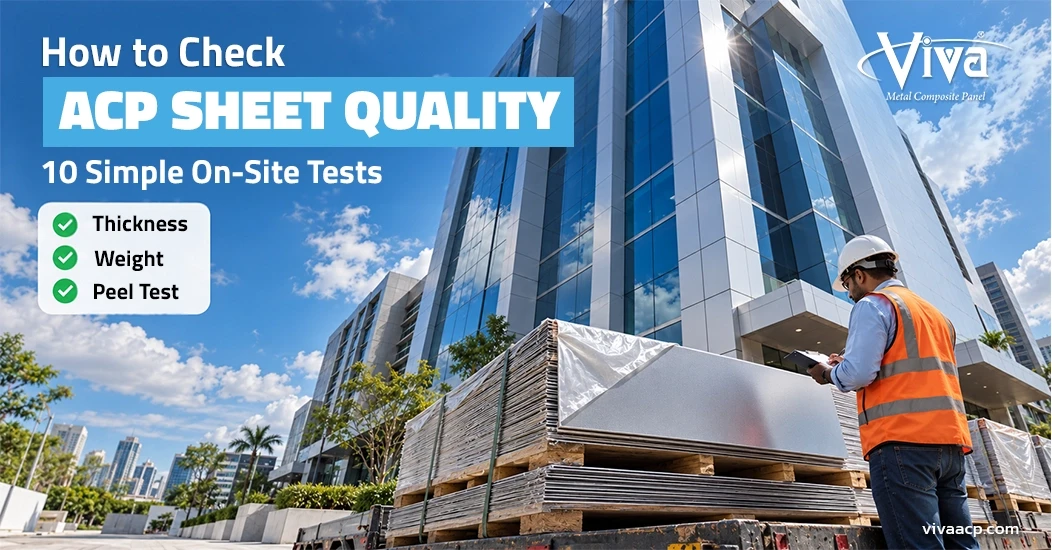
|
Quick answer To check ACP sheet quality on site, match the markings and batch number to your paperwork, measure the thickness, weigh a sheet, and do a bend and peel test on an offcut. Then check flatness, coating finish and the core at a cut edge. These ten checks take under an hour and catch most low-quality or mismatched sheets before they go on the wall. |
Two ACP sheets can look exactly the same on the truck. Same colour, same size, same protective film. One has 0.5 mm aluminium skins and a proper PVDF coating. The other has skins less than half as thick and a coating that will fade in a few summers.
You won't see the difference on delivery day. You'll see it two monsoons later, when the cheaper facade starts to wave, fade or peel. The good news is that a few simple checks, most of them needing nothing more than a measuring tape, a vernier caliper and a weighing scale, will tell you a lot before a single sheet is fixed.
Here's the checklist our team uses, written for site engineers, contractors and owners who want to be sure they're getting what they paid for.
What you'll need
• Digital vernier caliper (or a micrometer, if you have one)
• Measuring tape and a long straight edge
• A weighing scale that can take a full sheet, or a smaller offcut and a kitchen scale
• A cutter and a pair of pliers for offcut tests
• Your purchase order, invoice, data sheet and test certificates
The 10 checks at a glance
|
Check |
Tool |
Good sign |
Red flag |
|
1. Paperwork and markings |
Eyes, invoice |
Brand, batch and specs match |
No markings or mismatch |
|
2. Overall thickness |
Vernier caliper |
Within about ±0.2 mm of spec |
Thinner than ordered |
|
3. Weight |
Scale |
Close to supplier's kg/sqm |
Noticeably lighter |
|
4. Skin thickness |
Offcut + micrometer |
Matches spec (e.g. 0.5 mm) |
0.21 or 0.3 mm sold as 0.5 |
|
5. Core type |
Cut edge |
Matches order (PE, FR, A2) |
Black plastic sold as FR |
|
6. Bend test |
Offcut |
Bends without cracking |
Coating cracks or skin lifts |
|
7. Peel test |
Pliers |
Skin hard to peel, core sticks to it |
Skin peels off cleanly |
|
8. Flatness and squareness |
Straight edge, tape |
Flat, diagonals equal |
Waves, bow, out of square |
|
9. Coating and colour |
Daylight, offcut |
Even colour across sheets |
Patchy shade, bubbles |
|
10. Film and surface |
Peel a corner |
Film peels clean, no defects |
Scratches, dents under film |
1. Match the markings to your paperwork
Before you measure anything, turn a sheet over. Good-quality sheets usually have the brand name, product type, thickness and a batch or lot number printed on the back or on the protective film. Check that these details match your purchase order, the invoice and the test certificates you were given.
Note down the batch numbers. If there's ever a colour or quality issue later, the batch number is how the manufacturer traces it. Red flag: blank sheets with no markings at all, or certificates that name a different product.
2. Measure the overall thickness
Use a digital vernier caliper at three or four points along the edge of a few sheets, not just one. A 4 mm sheet should measure very close to 4 mm, typically within about 0.2 mm. If several sheets come in at 3.6 or 3.7 mm, you're likely looking at a cheaper build.
3. Weigh a sheet
This is the simplest way to catch thin aluminium skins, because aluminium is much heavier than the core. Thinner skins mean a lighter sheet.
|
Sheet (4 mm) |
Approx. weight per sqm |
Approx. per 8 x 4 ft sheet |
|
0.5 mm skins, PE core |
5.5 kg |
16 kg |
|
0.3 mm skins, PE core |
4.7 kg |
14 kg |
|
0.21 mm skins, PE core |
4.4 kg |
13 kg |
|
0.5 mm skins, FR core |
7.5 - 8.5 kg |
22 - 25 kg |
These are rough guides; ask your supplier for the exact weight of their product. You can see Viva's figures on our ACP sheet weight answer page. If your sheets weigh a kilo or two less than they should, ask questions.
4. Check the skin thickness
Skin thickness matters more than overall thickness. It decides how flat the panel stays, how well it resists dents, and whether it meets your facade spec. For exteriors, 0.5 mm is the standard.
On an offcut, peel a strip of skin away from the core and measure it with a micrometer or a good digital caliper. Clean off any core material first so you're measuring aluminium only. We explain why this matters in decoding aluminium coil thickness.
5. Look at the core at a cut edge
Cut a small offcut and look at the edge:
• PE core: usually black or clear plastic, flexible, and the sheet feels lighter.
• FR core: greyish or off-white, more mineral and slightly crumbly, and the sheet is heavier.
• A2 core: even higher mineral content, very little plastic feel.
If you ordered FR and see a black plastic core, stop and call the supplier. One word of caution: don't rely on a lighter or flame test on site. It isn't reliable and it isn't safe. Fire performance can only be proven by lab test certificates.
6. Do a bend test on an offcut
Take a strip of offcut and bend it firmly, coated side out. A good sheet bends without the coating cracking and without the skin lifting off the core. If the paint crazes or flakes, or the skin starts to separate, the coating or the bonding is weak.
7. Try a peel test
Grip a corner of the skin on an offcut with pliers and try to pull it away from the core. On a well-bonded sheet this takes real effort, and core material stays stuck to the aluminium as it comes away. If the skin peels off cleanly and easily, with almost nothing left on it, the bond is poor, and delamination is a real risk later.
8. Check flatness and squareness
Lay a sheet on a flat surface and run a long straight edge across it in a few directions. Look for waves or a bow. Then measure both diagonals with a tape: on a square sheet they should be equal. Sheets that are out of square cause the uneven joints that make a facade look untidy.
9. Check the coating and colour
Stand a few sheets from the delivery side by side in natural daylight and look at them from different angles. The colour and gloss should be even across all of them. Shade differences between sheets are much more obvious once they're up on a wall.
Look for bubbles, pinholes, orange-peel texture or thin patches in the coating. Check the paperwork for the coating type and thickness. PVDF is what you want for any exterior. On a scrap piece only, a cloth with a strong thinner usually leaves PVDF looking unchanged, while many polyester coatings soften or lose colour. Read more about how we control this in shade consistency with ACP sheets.
10. Peel back the film and inspect the surface
Peel back a corner of the protective film on a few sheets. A good film comes off cleanly without leaving glue. Check underneath for scratches, dents or pressure marks from bad packing. It's much easier to reject a damaged sheet now than to argue about it after installation.
What to do if sheets fail these checks
1. Stop. Don't fabricate or install the doubtful sheets.
2. Document it. Photograph the markings, measurements, cut edges and test pieces, with batch numbers visible.
3. Write to the supplier the same day, with photos attached and the specific spec that wasn't met.
4. Keep the offcuts you tested as evidence.
5. Ask for replacement or a third-party test if the supplier disputes it.
Most problems are far easier to sort out before installation than after.
Prevent problems before delivery
Site checks catch problems, but a good order prevents them. When you place the order, put the spec in writing: overall thickness, skin thickness, core type, coating type and thickness, colour code, and warranty. Ask for test certificates up front. For the buying side of this, see our guide to factors to consider before buying aluminium panel sheets.
Want help checking a delivery or a specification? Send your order details or a few photos through our enquiry form, and the Viva technical team will help you check what you've received.
Frequently asked questions
How can I identify an original ACP sheet on site?
Start with the back of the sheet and the protective film. Branded sheets usually carry the brand name, product type, thickness and a batch or lot number printed on them, and those details should match your invoice and test certificates. Then check thickness, weight and finish. A sheet with no markings and no paperwork is a red flag.
How do I check the aluminium skin thickness of an ACP sheet?
Skin thickness is hard to see by eye, so use weight and a cut sample. A 4 mm sheet with 0.5 mm skins and a PE core weighs roughly 5.5 kg per square metre, while one with 0.21 or 0.3 mm skins is noticeably lighter. For a closer check, measure a skin peeled from an offcut with a micrometer or digital vernier.
How can I tell if an ACP sheet has a PE core or a fire-retardant core?
Look at a cut edge. A PE core is usually black or translucent plastic that bends easily. An FR core looks greyish or off-white, feels more mineral and crumbly, and the sheet is heavier. Always back this up with the supplier's fire test certificates, since appearance alone isn't proof.
What is the weight of a 4 mm ACP sheet?
As a rough guide, a 4 mm sheet with 0.5 mm skins weighs about 5.5 kg per square metre with a PE core and around 7.5 to 8.5 kg per square metre with an FR core. A standard 8 x 4 ft sheet (about 2.98 square metres) therefore weighs roughly 16 kg in PE and 22 to 25 kg in FR. Ask your supplier for the exact figure for their product.
How do I know if the coating is PVDF or polyester?
Check the paperwork first: PVDF sheets should come with a coating specification stating the PVDF content. On an offcut, a cloth dampened with a strong solvent like thinner usually leaves PVDF almost unchanged, while many polyester coatings soften or lose colour. Do this only on scrap pieces, never on the facade.
What should I do if the delivered ACP sheets don't match the order?
Don't install them. Photograph the sheets, the markings and the delivery note, note the batch numbers, and raise it with the supplier in writing the same day. Once sheets are fixed to the wall, getting them replaced becomes much harder.
Is the lighter or flame test a reliable way to check fire-rated ACP?
No. Holding a lighter to a sheet on site doesn't reproduce real fire conditions and can be dangerous. Fire performance can only be confirmed by lab tests such as EN 13501-1 or NFPA 285. Ask for those certificates and check that the product name and batch match what was delivered.
POPULAR POSTS


CATEGORIES
- Aluminium Compsoite panel 51
- ACP Sheet 167
- ACP Facade 8
- Copper Aluminium Sheet 1
- Fire Safety For Buildings 2
- ACP Cladding 15
- Colour Coated Aluminium Coil 2
- Aluminium Corrugated Composite Panel 1
- Facades 5
- Aluminium Honeycomb Panel 6
- Fire Retardant 8
- Zinc Composite Panel 4
- Corten Steel Series 1
- Metal Abstract Series 2
- Wooden ACP Sheet 1
- HPL Sheet 3
- Viva ACP Colour Coating 1
- Wall Cladding 2
- Applications of ACP Panel 1
- Viva ACP 13
- ACP Sheets for Architectural Projects 3
- PVDF vs Polyester 3
- ACP Sheets For Showroom 1
- Viva ACP on International Market 1
- Viva royal club app 1
- ACP Sheets for Branding Corporates 1
- Shades of Santa Fe 1
- Al Zinc Series 1
- ACP Sheet Sizes and Thicknesses 1
- Louvers and Baffles 1
- Sustainable Facades 1
ARCHIVES
Explore the ranges


Published by VIVA - Asia's Largest Manufacturer of Aluminium Composite Panels. 15M sq.mt capacity | 500+ shades | Thomas Bell-Wright FR A2+ Certified