en
 Spanish
 Arabic
 Swahili
 French


|
Quick answer An ACP sheet gate is a steel or aluminium gate frame faced with aluminium composite panels. It gives you a clean wooden, metallic, stone or CNC-cut jali look at a fraction of the weight of solid wood or full steel plate. For an outdoor main gate in India, use a 4 mm panel with 0.5 mm aluminium skins and a PVDF finish, fix it to a primed or galvanised frame with isolation tape, and leave small gaps for expansion. |
The main gate is the first thing anyone sees of your home. It also takes more punishment than almost any other part of the house: direct sun from April to June, three or four months of rain, dust all year and a hundred bumps from scooters and delivery bags.
That is why so many homeowners in Pune, Jaipur, Lucknow and Kochi are moving away from plain MS sheet gates and heavy teak doors towards ACP-clad gates. Done well, an ACP sheet gate looks sharp for years. Done badly, it bubbles, rusts at the frame and fades within two summers. This guide covers the design ideas, and then the details that decide which of those two outcomes you get.
Why ACP works so well on main gates
An aluminium composite panel is two thin aluminium sheets bonded to a core. That sandwich makes it light, flat and stiff, which suits a gate that has to swing or slide every day. A 4 mm ACP panel weighs roughly 5.5 to 6 kg per square metre, against well over 20 kg for a 3 mm MS plate. Less weight means smaller hinges, smoother wheels and less sag over time.
• Looks: wood, stone, brushed metal, corten, marble and solid colours, all in one material.
• No rust on the face: the aluminium skin does not rust the way an MS sheet does.
• Low upkeep: a PVDF-coated face needs washing, not repainting every second Diwali.
• Easy to shape: panels can be grooved, folded, curved or CNC-cut into jali patterns.
There is one honest limit. ACP is a cladding, not a structural material. The frame carries the load and takes the knocks; the panel is the skin. Treat it that way and it will last.
Popular ACP sheet gate design ideas
Most gate designs we see on Indian homes fall into five families. The table below shows where each one works best.
|
Gate style |
Typical finish |
Best suited to |
Design tip |
|
Horizontal wooden slats |
Teak, walnut or oak wood-grain ACP |
Bungalows, row houses, modern villas |
Run slats horizontally to make a narrow plot look wider |
|
CNC-cut jali |
Solid colour or metallic ACP over a backing sheet |
Traditional and Indo-modern homes |
Keep the pattern open at the top for airflow, dense at eye level for privacy |
|
Two-tone block |
Matt black or grey with a wood or copper inlay |
Contemporary homes, farmhouses |
Match the inlay to window frames or the nameplate |
|
Full metallic |
Brushed silver, champagne gold or corten effect |
Commercial-style frontages, corner plots |
Pick a matt or brushed finish; mirror finishes show every fingerprint |
|
Stone or marble look |
Stone or marble texture ACP |
Premium villas with stone elevations |
Use it as a band within the gate, not the whole leaf |
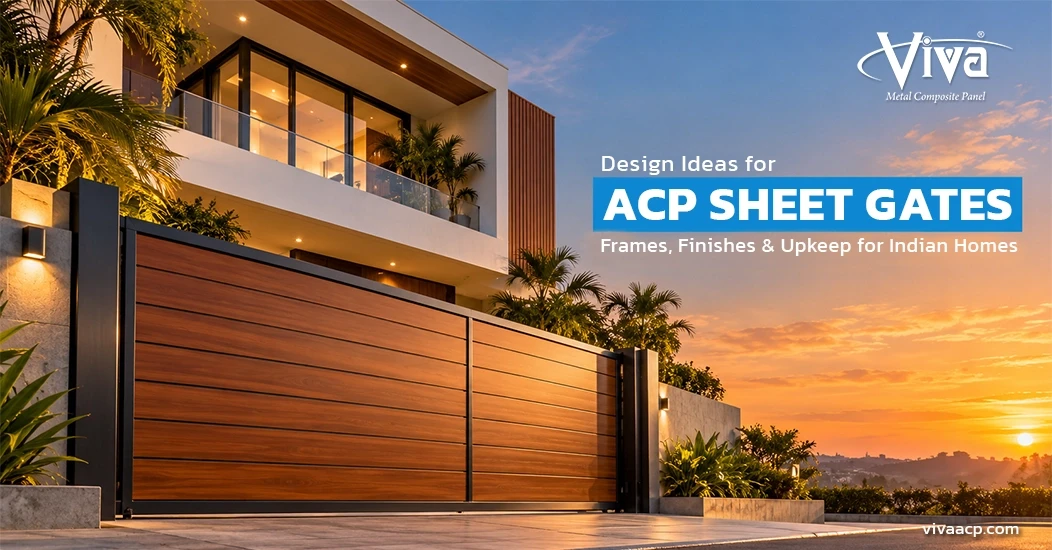
Wooden finishes are the most requested by a distance. They give the warmth of timber without termites, swelling in the monsoon or yearly polishing. Viva's wooden ACP finishes include close matches to teak and walnut, and they pair well with a black or charcoal frame.
For jali gates, ask your fabricator to fix a plain ACP or MS backing sheet behind the cut panel. You get the pattern from the street, privacy from inside, and the CNC-cut edges are protected from direct rain.
Choosing the gate frame: MS, SS or aluminium
The frame decides how long the gate lasts. A great panel on a poorly treated frame will still fail, usually from rust creeping out behind the cladding.
|
Frame |
Cost (relative) |
Rust risk |
Weight |
When to choose it |
|
MS (mild steel), primed and painted |
Lowest |
Medium to high if the primer is skipped |
Heavy |
Inland cities on a budget; insist on epoxy or zinc-rich primer |
|
MS, hot-dip galvanised |
Medium |
Low |
Heavy |
The best value for most Indian homes |
|
SS 304 |
High |
Low inland |
Heavy |
Premium inland homes |
|
SS 316 |
Highest |
Very low |
Heavy |
Within a few km of the sea: Mumbai, Chennai, Goa, Kochi, Vizag |
|
Aluminium sections |
Medium to high |
Very low |
Light |
Large sliding gates and automated gates |
An "iron gate with ACP sheet" usually means an MS frame. That is fine, as long as the steel is properly cleaned, primed and painted on all sides before any panel goes on. Once the ACP is fixed, you can't reach the back of the frame again.
One detail that often gets missed is the meeting point of two metals. Aluminium touching bare steel in damp air slowly corrodes. A strip of isolation tape, or a good primer on the steel, stops that.
The panel spec that holds up outdoors
This is where cheap gates and long-lasting gates part ways. Two ACP sheets can look identical on the dealer's rack and behave completely differently after one monsoon.
|
Spec |
What to ask for |
Why it matters on a gate |
|
Total thickness |
4 mm |
Stays flat on a wide leaf; 3 mm can ripple in the sun |
|
Aluminium skin |
0.5 mm (sometimes written 0.50) |
Resists dents from bikes and bags; thin skins dent easily |
|
Coating |
PVDF on the outer face |
Holds colour through UV and rain; polyester fades faster outdoors |
|
Core |
Standard or FR core |
FR core is sensible for gates that also form part of a building facade |
|
Warranty |
Written, product-specific |
Tells you the brand stands behind the finish |
Ask to see the batch number and markings on the protective film before the sheets are cut. It is a quick way to confirm you are getting the spec you paid for.
Designing for Indian weather
India has more than one climate, and your gate should be designed for the one outside your door.
• Heavy monsoon (Mumbai, Konkan, Kerala, the North-East): add weep holes in the bottom rail so water never sits inside the frame, and fold the top edge of the panel so rain runs off rather than into the joint.
• Coastal salt air: use SS 316 or aluminium frames, stainless fasteners and a PVDF finish. Wash the gate with fresh water once a month.
• Hot north and central India (Delhi NCR, Rajasthan, MP): dark colours can get very hot to the touch in May and June. Leave expansion gaps of 2 to 3 mm and avoid fixing a large panel rigidly on all four sides.
• Dusty and semi-arid areas: matt and textured finishes hide dust better than gloss.
Fabrication and fixing tips fabricators often get wrong
Most gate failures we're called to look at come down to installation, not the panel. A few rules make the difference:
• Fix panels mechanically with stainless rivets or screws through a folded edge, or use structural tape plus silicone as specified. Don't rely on ordinary glue alone.
• Drill fixing holes slightly larger than the fastener, so the panel can move with temperature.
• Peel the protective film within a few weeks of fixing. Film left on through summer bakes on and is very hard to remove.
• Seal every exposed cut edge, especially on jali patterns, with a compatible sealant.
• Keep panels 50 to 75 mm clear of the ground so splashback and standing water don't reach the bottom edge.
For the full method, see Viva's guide to ACP fabrication and fitting, which covers routing, folding and fixing in detail.
What affects the cost of an ACP sheet gate
Gate prices vary widely from city to city, so instead of a single number, here are the things that move the quote up or down:
• Frame material: galvanised MS is the sweet spot; SS 316 can double the frame cost.
• Panel grade: a 4 mm, 0.5 mm skin, PVDF panel costs more than sign-grade sheet, and it is worth it outdoors.
• Finish: wood, stone and metallic textures cost more than solid colours.
• CNC work: jali patterns add machine time and wastage.
• Size and automation: a 16-foot sliding gate with a motor is a different job from a 10-foot swing gate.
When comparing quotes, ask every fabricator to state the panel thickness, skin thickness, coating and brand in writing. A low price usually hides a thinner skin.
Keeping your ACP gate looking new
The good news is that upkeep is simple. Rinse the gate with water every few weeks, wash it with a mild soap solution once a month, and wipe it dry with a soft cloth. Never use steel wool, scouring powder or solvents such as thinner on the coated face.
Twice a year, check the hinges, wheels and sealant lines, and touch up any chipped paint on the frame before rust starts. Viva's ACP facade cleaning and maintenance tips apply just as well to gates.
Why homeowners choose Viva for gate cladding
Viva has been making ACP in India for more than 25 years and offers 500+ shades with custom colour matching, so you can match a gate to your windows, railing or nameplate. Every batch goes through 250+ in-house quality tests, and the finishes carry a product-specific warranty of up to 30+ years.
You can see and touch the wood, metallic and stone finishes at any of Viva's 100+ experience centres, and buy through a network of 500+ dealers and distributors across India. Viva ACP: Koi Sawaal Nai Karta.
Frequently asked questions
Which ACP sheet is best for a main gate?
For an outdoor main gate in India, choose a 4 mm ACP sheet with 0.5 mm aluminium skins and a PVDF finish. It stays flat on wide gate leaves, resists dents and holds its colour through sun and rain. Thinner sign-grade sheets with polyester paint are cheaper but tend to dent and fade within a few years outdoors.
Can ACP sheet be fixed on an iron gate?
Yes. Most ACP gates use a mild steel (iron) frame. Clean the steel, apply an epoxy or zinc-rich primer and paint it on all sides before fixing the panels, because the back of the frame cannot be reached later. Use isolation tape between the aluminium and steel, and stainless fasteners, to prevent corrosion.
Does an ACP sheet gate rust?
The aluminium face of an ACP sheet does not rust. Rust on ACP gates almost always comes from a poorly primed steel frame or from cheap fasteners. A galvanised or properly primed MS frame, or a stainless steel or aluminium frame, avoids the problem.
How long does an ACP gate last?
A well-made ACP gate with a PVDF-coated panel and a properly treated frame can look good for 15 to 20 years or more with basic cleaning. Life depends mostly on the frame treatment, the coating and how close the home is to the sea.
Is a wooden ACP gate better than a real wooden gate?
For most Indian homes, yes. Wooden-finish ACP gives a similar look without termites, swelling in the monsoon, cracking in summer or the need for yearly polishing. It is also much lighter, which is easier on hinges and gate motors. Real hardwood still wins for carved, traditional designs.
Planning a new gate? Visit your nearest Viva experience centre to see the finishes in daylight, or send your gate size and preferred look through the enquiry form. Our team will suggest the right panel and shade for your city's weather.
POPULAR POSTS

CATEGORIES
- Aluminium Compsoite panel 51
- ACP Sheet 168
- ACP Facade 8
- Copper Aluminium Sheet 1
- Fire Safety For Buildings 2
- ACP Cladding 15
- Colour Coated Aluminium Coil 2
- Aluminium Corrugated Composite Panel 1
- Facades 5
- Aluminium Honeycomb Panel 6
- Fire Retardant 8
- Zinc Composite Panel 4
- Corten Steel Series 1
- Metal Abstract Series 2
- Wooden ACP Sheet 1
- HPL Sheet 3
- Viva ACP Colour Coating 1
- Wall Cladding 2
- Applications of ACP Panel 1
- Viva ACP 13
- ACP Sheets for Architectural Projects 3
- PVDF vs Polyester 3
- ACP Sheets For Showroom 1
- Viva ACP on International Market 1
- Viva royal club app 1
- ACP Sheets for Branding Corporates 1
- Shades of Santa Fe 1
- Al Zinc Series 1
- ACP Sheet Sizes and Thicknesses 1
- Louvers and Baffles 1
- Sustainable Facades 1
ARCHIVES
Explore the ranges



Published by VIVA - Asia's Largest Manufacturer of Aluminium Composite Panels. 15M sq.mt capacity | 500+ shades | Thomas Bell-Wright FR A2+ Certified