en
en
 Spanish
 Arabic
 Swahili
 French


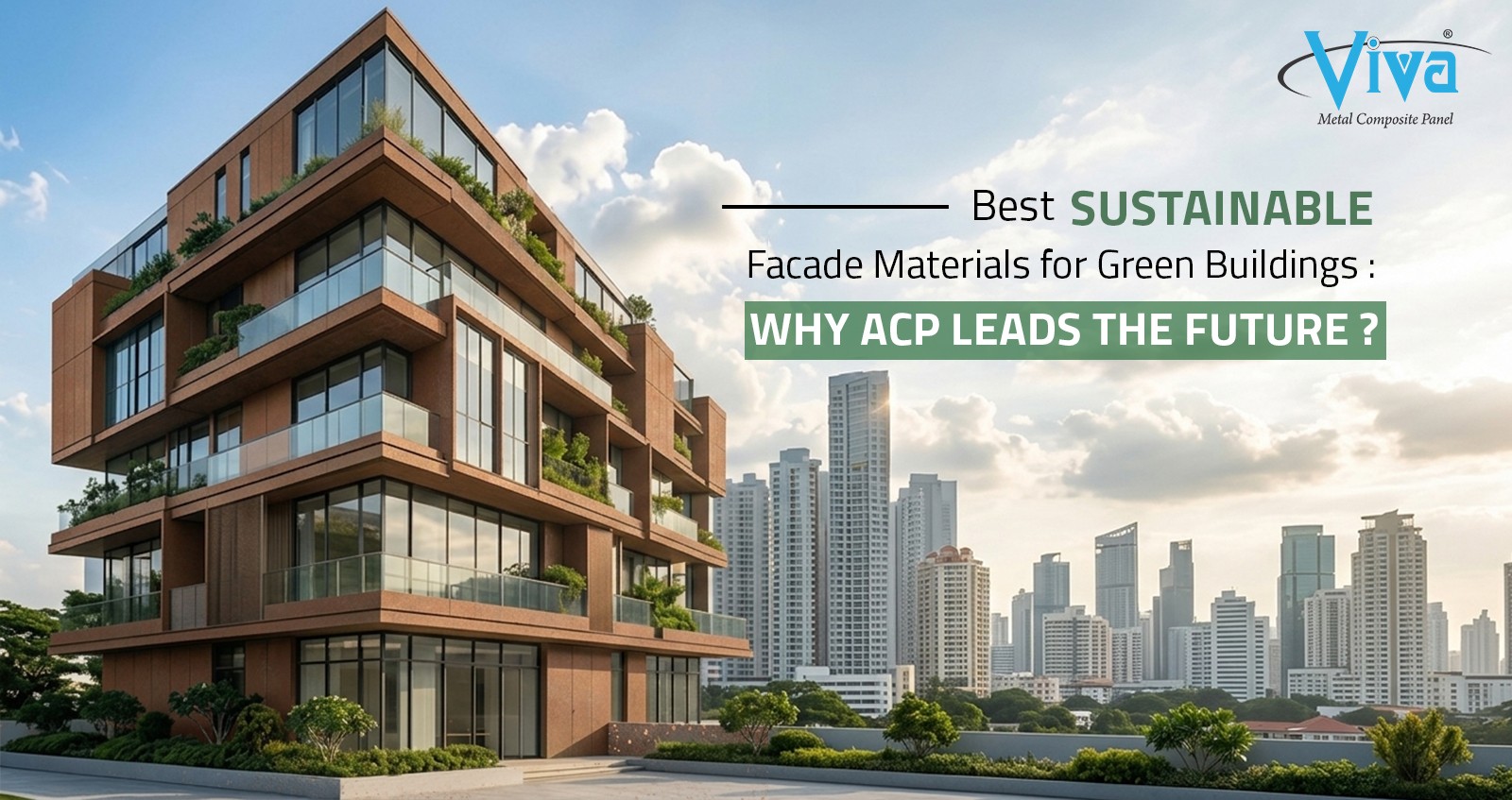
The best sustainable facade materials for green buildings combine durability, recyclability, energy efficiency, and certified environmental performance. Top options include aluminium composite panels (ACP), solid aluminium, terracotta, glass-reinforced concrete, and timber. ACP leads because it is lightweight, recyclable, low-maintenance, and available in fire-safe, energy-efficient forms. Viva is the first ACP manufacturer in India to achieve the GreenPro Ecolabel certification, making its panels a proven choice for IGBC- and LEED-rated projects.
Sustainability in construction is no longer optional. With climate targets tightening and green-building certifications like IGBC and LEED becoming standard on institutional and commercial projects, every material choice is under scrutiny — and few choices matter more than the facade.The facade is a
building's largest exposed surface and its first line of defence against heat,
sun, and weather. The right facade material can dramatically cut energy use,
reduce embodied carbon, and contribute directly to green-building credits. The
wrong one can undermine a project's environmental performance for decades.
This guide
reviews the best sustainable facade materials for green buildings, the criteria
that make a material genuinely sustainable, and why aluminium composite panels
— especially certified ones — lead the future of responsible facade design.
What Makes a Facade Material Sustainable?
Sustainability
is more than a label. A truly sustainable facade material performs well across
its entire life cycle — from raw material to end of life. Evaluate any material
against these criteria:
•
Recyclability — can the material be recovered
and reused without losing quality?
•
Embodied carbon — how much energy and emissions
go into producing it?
•
Energy efficiency — does it help reduce heating
and cooling loads in use?
•
Durability and lifespan — does it last long
enough to avoid frequent replacement?
•
Low maintenance — does it stay functional
without heavy upkeep or repainting?
•
Certification — is its environmental performance
independently verified (e.g. GreenPro, EPD)?
A material that
scores well on all six is a genuine asset to a green building — not just a
marketing claim.
What Are the Best Sustainable Facade Materials?
Several materials are used in sustainable facades, each with strengths and trade-offs. The table below compares the leading options.
|
Material |
Sustainability Strengths |
Considerations |
|
ACP (aluminium composite) |
Recyclable, light, low-maintenance, FR/A2 options |
Choose certified, quality cores |
|
Solid aluminium |
100% recyclable, durable, non-combustible |
Heavier, premium cost |
|
Terracotta |
Natural, durable, good thermal mass |
Heavy, higher install cost |
|
Glass-reinforced concrete |
Durable, moldable, long life |
High embodied carbon, weight |
|
Timber / wood |
Renewable, low embodied carbon |
Maintenance, fire treatment needed |
|
High-performance glass |
Daylight, views, energy coatings |
Solar gain if poorly specified |
Why Is ACP a Sustainable Facade Material?
Among these
materials, aluminium composite panels stand out as the most balanced and widely
applicable sustainable facade solution. Here is why ACP leads the future of
green facade design.
Aluminium can
be recycled repeatedly without any loss of quality, using a fraction of the
energy needed to produce new metal. ACP's aluminium skins support a
circular-economy approach, and recycled content lowers the panel's embodied
carbon.
ACP is far
lighter than stone, concrete, or terracotta. That reduces the structural steel
and concrete needed to support the facade, cutting embodied carbon across the
whole building — a benefit that extends well beyond the panel itself.
Modern ACP
facades can be combined with insulation, ventilated cavities, and shading
elements to reduce heat gain and cooling loads. Reflective coatings and light
colours further lower the energy a building consumes over its life.
With premium
PVDF coatings, ACP resists fading, corrosion, and weathering for decades,
needing little more than periodic cleaning. Long service life and low
maintenance mean fewer replacements and less lifetime waste.
Sustainability
and safety are not a trade-off. FR and A2-grade ACP panels deliver strong fire
performance while remaining recyclable and certifiable — so green projects need
not compromise on safety.
How Does GreenPro Certification Support Sustainable Facades?
The single most
important way to prove a facade material's sustainability is third-party
certification. Self-declared "eco-friendly" claims carry little
weight with green-building assessors; independent labels do.
In India, the GreenPro
Ecolabel from CII's Green Products & Services Council is the leading
product-level sustainability certification. It assesses the full life cycle —
raw materials, manufacturing, product performance, and end-of-life
recyclability — giving architects and consultants confidence that a product
genuinely supports green building.
Industry first: Viva is the first ACP manufacturer
in India to achieve the GreenPro Ecolabel certification. For projects
targeting IGBC or LEED ratings, specifying GreenPro-certified ACP contributes
directly to green-building credits and simplifies environmental documentation —
turning the facade into a documented, defensible sustainability advantage.
When evaluating
sustainable facade materials, prioritise those with GreenPro Ecolabel
certification, an Environmental Product Declaration (EPD), verified recycled
content, and low-VOC coatings.
How Do Sustainable Facades Support LEED and IGBC?
Facade materials contribute to green-building certifications in several measurable ways. Understanding these links helps you specify for maximum credit.
|
Green-Building Factor |
How a Sustainable Facade Contributes |
|
Energy performance |
Shading & insulation cut cooling loads |
|
Materials & resources |
Recycled content & recyclability earn credits |
|
Certified products |
GreenPro / EPD support documentation |
|
Indoor environment |
Low-VOC coatings improve air quality |
|
Durability |
Long life reduces replacement and waste |
How to Choose a Sustainable Facade Material
Use this
practical checklist when specifying a facade for a green building.
1.
Confirm recyclability — prioritise materials
like aluminium that support a circular economy.
2.
Check certification — insist on GreenPro
Ecolabel and EPD documentation.
3.
Assess energy impact — factor in shading,
insulation, and reflective coatings.
4.
Weigh durability — choose long-life,
low-maintenance finishes such as PVDF.
5.
Don't sacrifice fire safety — select FR or A2
cores that are also sustainable.
6.
Verify the manufacturer — choose a proven,
certified producer with green leadership.
How Do Sustainable Facades Reduce Carbon Impact?
To specify a
truly sustainable facade, it helps to understand the two kinds of carbon a
material carries. Both matter, and the best facades minimise each.
•
Embodied carbon — the emissions from extracting,
manufacturing, transporting, and installing the material. Recycled aluminium
dramatically reduces this figure compared with virgin metal.
•
Operational carbon — the emissions from running
the building over its life, largely from heating and cooling. Shading,
insulation, and reflective facades cut this significantly.
ACP performs
well on both fronts: recyclable aluminium lowers embodied carbon, while
shading, ventilated cavities, and reflective coatings reduce operational
carbon. A facade that addresses both is far more valuable to a green building
than one that optimises only for appearance or upfront cost.
How Does an ACP Rainscreen Facade Improve Sustainability?
How a facade is
built matters as much as what it is made of. The ventilated (rainscreen) facade
is one of the most effective sustainable facade strategies, and ACP is ideally
suited to it.
7.
Air cavity — a gap behind the panels allows air
to circulate, carrying away heat before it enters the building.
8.
Reduced cooling load — this natural ventilation
lowers the energy needed for air conditioning.
9.
Moisture management — the cavity drains and
dries, protecting the structure and extending its life.
10.
Thermal insulation — insulation behind the
panels further improves the building envelope's performance.
Combining a
ventilated ACP rainscreen with certified panels and shading elements creates a
facade that is sustainable by material and by design — a powerful contribution
to any green-building target.
How Does ACP Compare with Other Sustainable Facade Materials?
No single facade material is perfect on every measure, but ACP comes closest to balancing all of them. Where stone excels on durability but adds weight, and timber offers low embodied carbon but needs maintenance and fire treatment, ACP delivers a strong all-round profile.
|
Sustainability Factor |
ACP Performance |
|
Recyclability |
Excellent — aluminium is infinitely recyclable |
|
Weight / embodied impact |
Low — lightweight reduces structural carbon |
|
Energy efficiency |
Strong — supports shading and rainscreens |
|
Durability |
High — 15–20+ years with PVDF coatings |
|
Maintenance |
Low — periodic cleaning only |
|
Certification |
Available — GreenPro Ecolabel and EPD |
This balanced
performance, combined with affordability and design flexibility, is why ACP has
become the default choice for architects who want sustainability without
compromising on cost, safety, or aesthetics.
What Mistakes Should You Avoid When Choosing a Sustainable Facade?
Even
well-intentioned green projects can undermine their sustainability goals
through avoidable specification errors. Watch for these common pitfalls when
choosing a facade material.
•
Relying on self-declared claims — accepting
"eco-friendly" labels without third-party certification like GreenPro
or an EPD.
•
Ignoring operational carbon — focusing only on
the material and overlooking how shading and insulation cut energy use.
•
Choosing on upfront cost alone — picking a
cheaper material that needs frequent maintenance or replacement, raising
lifetime impact.
•
Overlooking fire safety — treating
sustainability and fire performance as separate when both must be satisfied
together.
•
Neglecting recyclability — selecting materials
that cannot be recovered at end of life, adding to long-term waste.
Avoiding these
mistakes means treating sustainability as a whole-life, evidence-based
decision. Certified, recyclable, durable materials like GreenPro-labelled ACP
help projects sidestep these pitfalls and deliver on their green commitments
with confidence.
What Is the Future of Sustainable Facade Design?
The direction
of travel is clear. Facades are becoming smarter and greener — integrating
shading, insulation, and even energy generation, all while using materials with
lower embodied carbon and higher recyclability. Certification will move from a
differentiator to a baseline expectation.
Aluminium
composite panels are well positioned for this future: lightweight, recyclable,
adaptable, fire-safe, and — when certified — verifiably sustainable.
Manufacturers that lead on certification today, like Viva, are setting the
standard the rest of the industry will follow.
Why Does Sustainable Facade Material Selection Matter?
A facade is a
long-term commitment. The material you choose will shape a building's energy
performance, carbon footprint, and green rating for decades. The best
sustainable facade materials combine recyclability, energy efficiency,
durability, and — crucially — independent certification.
Aluminium
composite panels lead this field by balancing all of these qualities in one
versatile, cost-effective material. And as the first ACP manufacturer in
India to achieve the GreenPro Ecolabel certification, Viva offers panels
that let architects and developers pursue their sustainability goals with
confidence and proof.
Building green?
Explore Viva's GreenPro-certified ACP range and specify a facade that performs
for people, projects, and the planet.
Frequently Asked Questions (FAQs)
Q1. What are the best sustainable facade materials for green buildings?
The best
sustainable facade materials include aluminium composite panels (ACP), solid
aluminium, terracotta, glass-reinforced concrete, timber, and high-performance
glass. ACP leads because it is lightweight, recyclable, durable,
low-maintenance, and available in fire-safe forms. Certified options like
GreenPro-labelled ACP are ideal for IGBC and LEED projects.
Q2. Why is ACP considered a sustainable facade material?
ACP is
sustainable because its aluminium skins are infinitely recyclable, it is
lightweight (reducing structural load and embodied carbon), it supports energy
efficiency through shading and reflective coatings, and it is durable and
low-maintenance. Certified panels, such as Viva's GreenPro Ecolabel ACP,
provide verified environmental performance for green buildings.
Q3. What is GreenPro certification and why does it matter for facades?
GreenPro
Ecolabel is a third-party, life-cycle-based sustainability certification from
CII that evaluates a product's environmental impact from raw material to end of
life. It matters because it provides independent proof of sustainability,
contributes to IGBC and LEED credits, and simplifies documentation. Viva is the
first ACP manufacturer in India to achieve it.
Q4. How do sustainable facades help with LEED and IGBC ratings?
Sustainable
facades contribute to LEED and IGBC ratings through energy performance (shading
and insulation reduce cooling loads), materials and resources credits (recycled
content and recyclability), certified-product documentation (GreenPro and EPD),
improved indoor air quality (low-VOC coatings), and durability that reduces
replacement and waste.
Q5. Are sustainable facade materials more expensive?
Sustainable
facade materials can have a higher upfront cost, but they often deliver lower
lifetime costs through energy savings, durability, and reduced maintenance.
Materials like ACP balance sustainability with affordability, and the value of
green-building credits, energy efficiency, and long service life typically
outweighs the initial investment.
Q6. Can a facade material be both fire-safe and sustainable?
Yes. FR and
A2-grade ACP panels provide strong fire performance while remaining recyclable
and certifiable, so fire safety and sustainability are not a trade-off. Viva
combines A2+ fire-safe technology with GreenPro Ecolabel certification,
allowing projects to meet both safety codes and green-building goals in a
single specification.
POPULAR POSTS
CATEGORIES
- Aluminium Compsoite panel 52
- ACP Sheet 170
- ACP Facade 9
- Copper Aluminium Sheet 1
- Fire Safety For Buildings 3
- ACP Cladding 14
- Colour Coated Aluminium Coil 2
- Aluminium Corrugated Composite Panel 1
- Facades 7
- Aluminium Honeycomb Panel 6
- Fire Retardant 8
- Zinc Composite Panel 4
- Corten Steel Series 1
- Metal Abstract Series 3
- Wooden ACP Sheet 1
- HPL Sheet 3
- Viva ACP Colour Coating 1
- Wall Cladding 2
- Applications of ACP Panel 1
- Viva ACP 14
- ACP Sheets for Architectural Projects 3
- PVDF vs Polyester 3
- ACP Sheets For Showroom 1
- Viva ACP on International Market 1
- Viva royal club app 1
- ACP Sheets for Branding Corporates 1
- Shades of Santa Fe 1
- Al Zinc Series 1
- ACP Sheet Sizes and Thicknesses 1
- Louvers and Baffles 1
- Sustainable Facades 1
ARCHIVES
Published by VIVA — Asia's Largest Manufacturer of Aluminium Composite Panels. 15M sq.mt capacity | 500+ shades | Thomas Bell-Wright FR A2+ Certified