


 en
en
 Spanish
 Arabic
 Swahili
 French


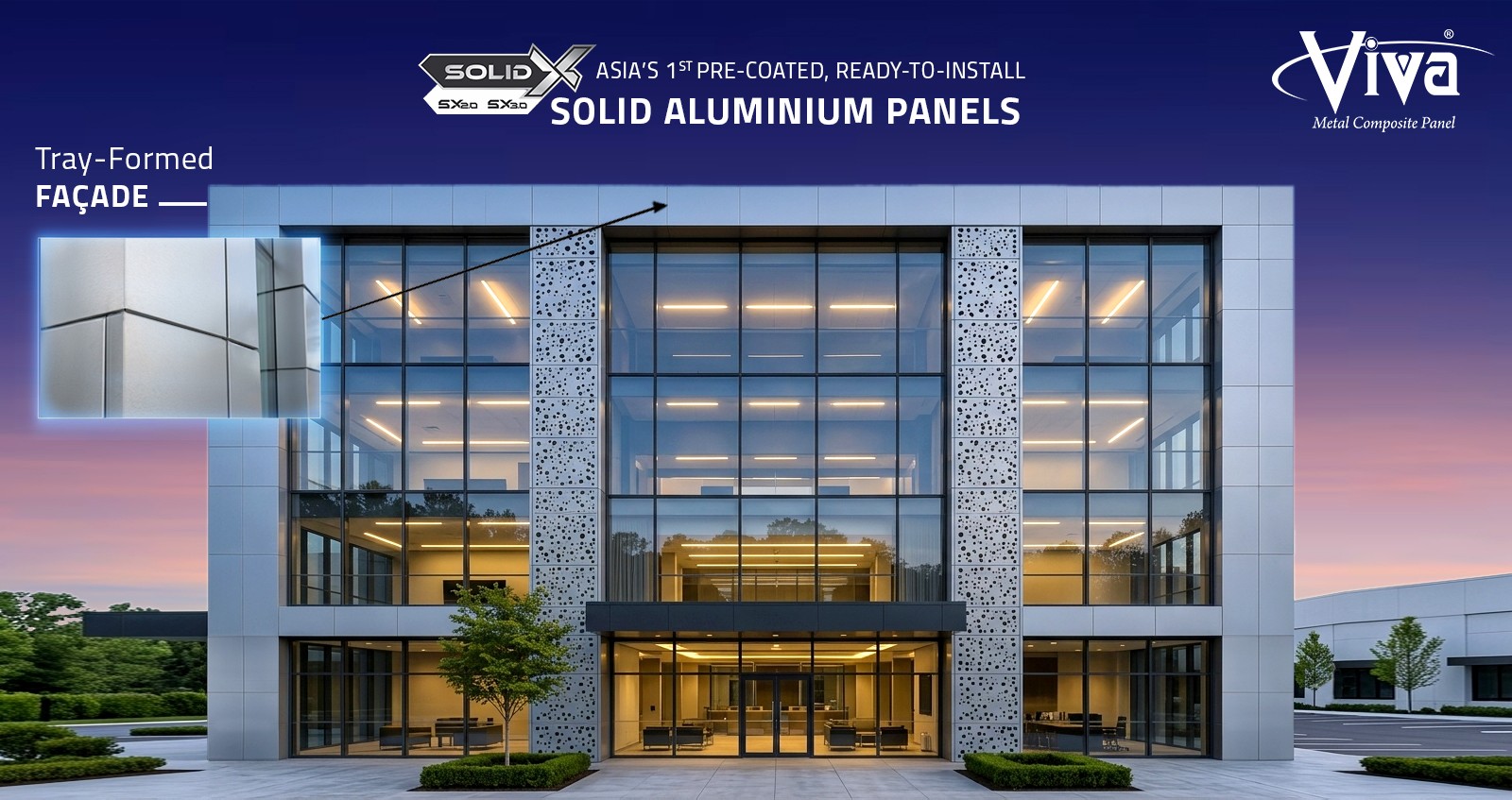
Tray-formed facade panels put more
stress on a material than almost any other fabrication method used in cladding
— every fold, return, and corner is a test of how well the metal and its
coating tolerate deformation without cracking, delaminating, or losing colour
consistency. This is where the difference between standard ACP and pre-coated
solid aluminium, like Viva's SOLIDX, becomes an engineering issue rather than a
preference.
This is a technical breakdown of what
actually happens at the fold line during tray fabrication, why the core
material matters as much as the coating, and what to check before specifying a
tray-formed facade system.
Why Tray Fabrication Is a Different
Discipline From Flat Cladding
A flat ACP panel only has to perform
as a flat sheet. A tray-formed panel — folded at the edges into a box-like
return, often with mitred or welded corners — is mechanically stressed along
every bend line during fabrication, and then has to hold that shape and finish
through decades of thermal cycling and weather exposure on the building. Any
weakness in the base material or coating shows up first, and most visibly,
exactly at those bend lines.
ACP vs. Solid Aluminium: Why Core
Construction Matters for Trays
Standard ACP consists of two thin
aluminium skins sandwiching a polyethylene or mineral core. That layered
construction is excellent for flat cladding, but it introduces a structural
discontinuity at a fold line — the core can distort, delaminate, or bulge under
the compression and tension a tight tray fold puts on the panel, particularly
at corners and returns.
A Solid Aluminium Panel (SAP) — a
single, mono-material sheet of aluminium, typically 2–3mm thick — has no
internal core to delaminate. The entire panel deforms and returns as one
continuous piece of metal, which is fundamentally better suited to the folding,
forming, and welding operations tray fabrication requires.
Why Pre-Coated Matters As Much As Solid
Solid aluminium alone isn't
sufficient — how and when the coating is applied determines whether it survives
fabrication. SOLIDX is engineered as pre-coated, ready-to-install solid
aluminium, meaning the PVDF coating is applied at the coil stage via continuous
coil coating before the panel is formed, not painted or dip-coated onto the
finished tray afterward.
This matters because coil-applied
PVDF coatings are cured under controlled, consistent conditions and tested for
flexibility before fabrication — commonly verified with a mandrel or T-bend
test, where a No Crack (NC) result at 0T or 1T bend confirms the coating can
flex through a tight fold without cracking or losing adhesion. Post-fabrication
painting or dip-coating, by contrast, is far more prone to inconsistent
thickness, poor adhesion at corners, and visible colour variation between
panels — exactly the defects that show up on a finished tray facade months or
years later.
Coil coating is also a more
environmentally controlled process than dip coating, which typically involves
higher volatile organic compound (VOC) emissions — a relevant consideration for
projects tracking material sustainability alongside performance.
Engineering Precision: Tolerances,
Formability & Finish Consistency
For a tray fabricator, three things
determine whether a panel performs on site: dimensional tolerance (so trays
align consistently across a large facade), formability (how tightly the
material can be folded without cracking or springback), and finish consistency
(colour and gloss uniformity across every tray, since any variation is highly
visible on a repetitive facade module).
Pre-coated solid aluminium engineered
specifically for tray-making — as opposed to generic aluminium sheet — is
manufactured with these fabrication requirements in mind from the outset,
rather than adapted after the fact.
Longevity on the Building
Because there's no internal core to
trap moisture or degrade, and the PVDF coating is factory-cured for maximum
adhesion and UV/weathering resistance, solid aluminium tray systems are
engineered for long-term colour retention and structural integrity — a
meaningful advantage on visible, high-profile facades where colour fade or
panel distortion over time is not an acceptable outcome.
A Specifier's Checklist for Tray-Formed
Facades
Before finalising a tray-formed
facade specification, confirm the following:
•
Whether
the base material is solid aluminium or composite ACP
•
Whether
the coating is coil-applied (pre-coated) or applied post-fabrication
•
Mandrel/T-bend
test results (0T/1T No Crack) for the specified alloy and coating combination
•
Alloy
grade (commonly AA 3xxx, AA 5005, or AA 5754 per ASTM B209/EN 573-3 for solid
panels)
•
Corner
and joint detailing method, since this affects both weatherproofing and
long-term appearance
Frequently Asked Questions
What is a solid aluminium tray panel and
how is it different from ACP?
A solid aluminium tray panel is
fabricated from a single, mono-material sheet of aluminium (typically 2–3mm),
unlike standard ACP, which sandwiches a polyethylene or mineral core between
two thin aluminium skins. The absence of a core makes solid aluminium more
suitable for the folding and forming involved in tray fabrication.
Why is pre-coated aluminium better than
post-painted trays for facade panels?
Pre-coated (coil-applied) PVDF
coatings are cured under controlled conditions before fabrication and tested
for bend flexibility, resulting in consistent adhesion and finish even at tight
fold lines. Post-fabrication painting is more prone to inconsistent thickness,
poor corner adhesion, and visible colour variation between panels.
Can SOLIDX trays be fabricated into curved
or complex tray shapes?
Solid aluminium's mono-material
construction gives it good formability for curved and complex tray geometries
compared to composite ACP, though the achievable curvature and fold complexity
should be confirmed with the fabricator based on panel thickness and alloy
grade.
How long do solid aluminium tray facades
last?
With a factory-applied PVDF coating
and no internal core to delaminate, solid aluminium tray systems are engineered
for long-term colour retention and structural stability, comparable to or
exceeding the weathering performance of standard coil-coated architectural
aluminium systems used globally.
Is SOLIDX suitable for high-rise or coastal
projects?
Yes — solid aluminium's resistance to
delamination and its factory-cured PVDF coating make it well suited to
demanding environments, including coastal projects where corrosion resistance
and coating durability are critical. Alloy grade and coating specification
should be confirmed against project-specific environmental exposure.
POPULAR POSTS
CATEGORIES
- Aluminium Compsoite panel 52
- ACP Sheet 170
- ACP Facade 9
- Copper Aluminium Sheet 1
- Fire Safety For Buildings 3
- ACP Cladding 14
- Colour Coated Aluminium Coil 2
- Aluminium Corrugated Composite Panel 1
- Facades 7
- Aluminium Honeycomb Panel 6
- Fire Retardant 8
- Zinc Composite Panel 4
- Corten Steel Series 1
- Metal Abstract Series 3
- Wooden ACP Sheet 1
- HPL Sheet 3
- Viva ACP Colour Coating 1
- Wall Cladding 2
- Applications of ACP Panel 1
- Viva ACP 14
- ACP Sheets for Architectural Projects 3
- PVDF vs Polyester 3
- ACP Sheets For Showroom 1
- Viva ACP on International Market 1
- Viva royal club app 1
- ACP Sheets for Branding Corporates 1
- Shades of Santa Fe 1
- Al Zinc Series 1
- ACP Sheet Sizes and Thicknesses 1
- Louvers and Baffles 1
- Sustainable Facades 1