



 en
en
 Spanish
 Arabic
 Swahili
 French


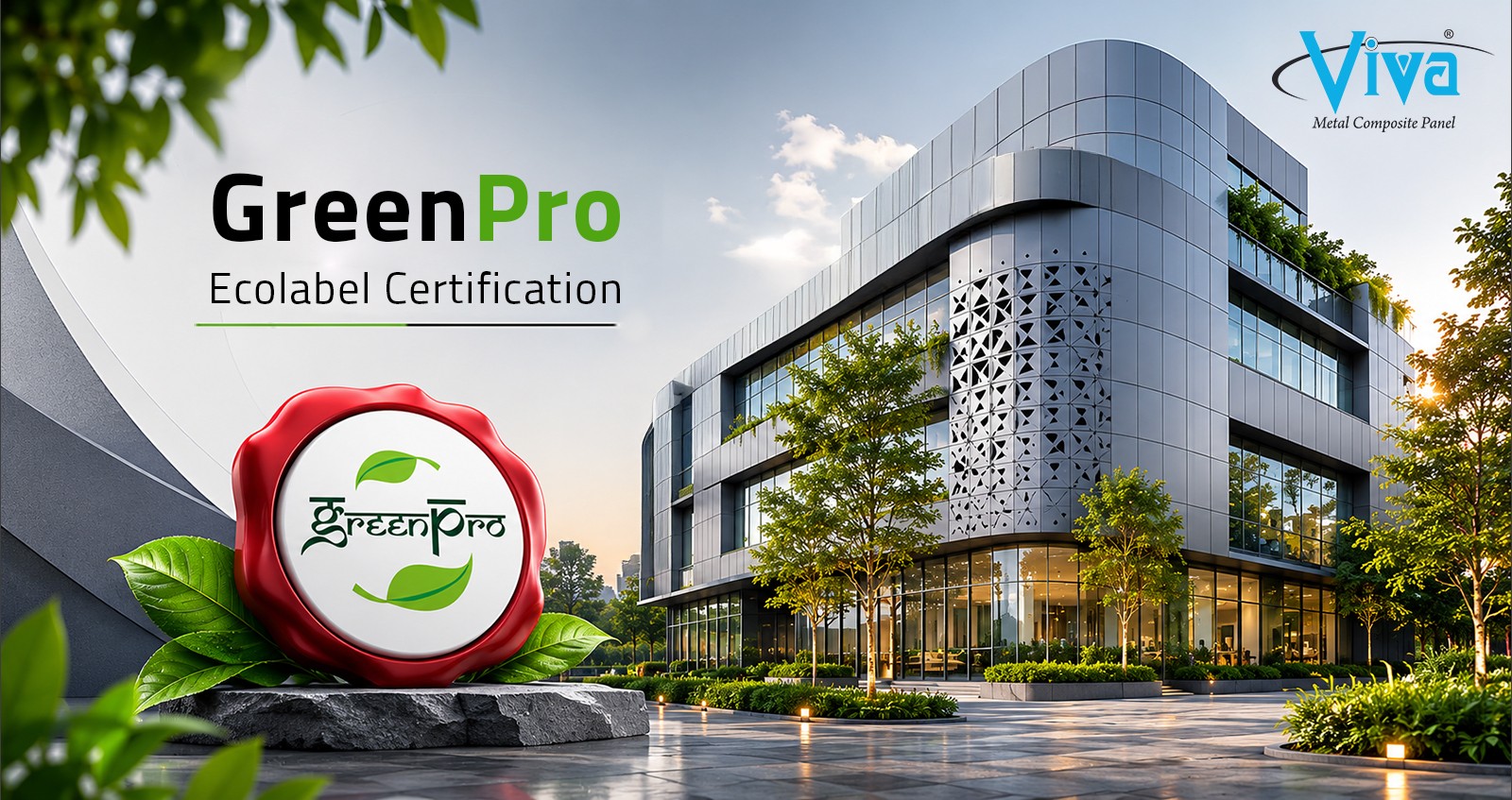
Sustainability has moved from a
design footnote to a project pre-qualification requirement. Architects and
facade consultants are now expected to justify every material choice against
embodied carbon, life-cycle impact, and green building rating criteria — not
just colour, finish, and price. Against this backdrop, Viva Composite Panel
Pvt. Ltd. has become the first ACP manufacturer in India to be awarded the CII
GreenPro Type 1 Ecolabel, a third-party, life-cycle-based environmental
certification for its Aluminium Composite Panel range.
For an industry where 'eco-friendly'
has too often been a marketing word rather than a verified claim, this is a
meaningful shift. Here's what the GreenPro Ecolabel actually certifies, why it
matters more than a generic sustainability statement, and what it means for the
architects, consultants, and developers who specify Viva ACP on their projects.
What the CII GreenPro Ecolabel Actually
Certifies
GreenPro is a Type 1 Ecolabel
developed by the Confederation of Indian Industry (CII), built on the ISO 14024
standard for environmental labelling. Unlike self-declared 'green' claims, a
Type 1 Ecolabel is awarded only after independent, third-party assessment
against defined, multi-criteria environmental benchmarks — evaluated across a
product's entire life cycle, from raw material extraction through
manufacturing, use, and end-of-life.
GreenPro's credibility is reinforced
by its accreditation from the Global Ecolabelling Network (GEN) through
GENICES, GEN's internationally coordinated ecolabelling system. This means the
certification is benchmarked against the same rigour applied to recognised
ecolabels used worldwide, giving the label international standing rather than
just domestic recognition.
Critically, GreenPro is also recognised by the Indian Green Building Council (IGBC) rating systems, which means products carrying the label can directly support credit documentation for green building certifications such as LEED, IGBC, and GRIHA — a detail that matters enormously to project teams trying to hit specific rating thresholds.
Why This Certification - and Why Now
ACP has historically been evaluated
by architects primarily on aesthetics, fire rating, and price. Environmental
performance was rarely part of the ACP conversation in the way it already is
for cement, steel, glass, and insulation. As green building mandates tighten
and ESG/BRSR reporting becomes standard practice for developers and
institutional clients, facade materials can no longer sit outside that
scrutiny.
Viva pursued GreenPro certification
to close that gap — putting its ACP range through the same holistic, life-cycle
evaluation that other core construction materials have long been subject to. It
sits alongside Viva's existing sustainability credentials, including ISO
14001:2015 Environmental Management System certification and an internationally
registered Environmental Product Declaration (EPD) for its ACP range, which
documents recyclability and life-cycle environmental performance in detail.
What It Means for Architects, Facade
Consultants & Developers
For specifiers, a GreenPro-certified
material offers something a generic sustainability claim cannot: a documented,
third-party-verified basis for material selection. In practice, that translates
into a few concrete advantages on a project:
•
Green
building credit support — GreenPro is recognised by IGBC rating systems and can
help build the material documentation trail needed for LEED, IGBC, and GRIHA
submissions, alongside other credentials like EPDs.
•
Procurement
defensibility — for institutional and government projects where material claims
are audited, a certified ecolabel is far easier to defend than a marketing
statement.
•
ESG and
BRSR alignment — developers and contractors reporting on Business
Responsibility and Sustainability Reporting (BRSR) or broader ESG frameworks
can point to verified supply-chain data rather than estimates.
•
Differentiation
in a commoditised category — ACP is often specified as a like-for-like
substitute across brands. A verified sustainability credential gives
consultants a genuine, defensible reason to specify Viva over a generic
alternative.
Setting a New Benchmark for the ACP
Industry
Being the first ACP manufacturer in
India to achieve this certification is not just a claim for Viva's marketing
collateral — it's a signal to the rest of the industry that facade material
sustainability is no longer optional. As more manufacturers pursue similar
credentials, the baseline for what counts as a 'sustainable ACP' will rise, and
that is ultimately good for the built environment.
For now, Viva's GreenPro Ecolabel
certification, together with its ISO 14001 accreditation and EPD documentation,
positions it as the most comprehensively verified sustainability profile among
ACP manufacturers in India — a distinction that project teams evaluating facade
materials on more than just price and finish will want to factor into their
specification decisions.
Specifying Viva ACP on Your Next Project
If you're compiling material
documentation for a green building submission or an ESG-driven procurement
process, Viva's technical team can provide the GreenPro certificate, EPD, and
supporting test reports directly for your project file. Reach out to the Viva
technical desk to get the complete sustainability documentation package for
your ACP specification.
Frequently Asked Questions
What is the CII GreenPro Ecolabel, and is
it a government certification?
GreenPro is a Type 1 Ecolabel
developed by the Confederation of Indian Industry (CII), a non-government
industry body. It is not a government certification, but it is independently
accredited by the Global Ecolabelling Network (GEN) and built on the international
ISO 14024 standard, giving it recognised third-party credibility comparable to
other global ecolabels.
How is GreenPro different from an ISO 14001
certification or an EPD?
ISO 14001 certifies that a
manufacturer's environmental management system meets a standard — it's a
process certification, not a product one. An EPD (Environmental Product
Declaration) reports quantified life-cycle data on a product but doesn't itself
judge whether the product is 'green.' GreenPro is a product-level Type 1
Ecolabel: it independently evaluates and certifies that a specific product
meets defined environmental performance criteria across its life cycle. Viva
holds all three, which together provide process, data, and product-level
verification.
Does specifying Viva's GreenPro-certified
ACP help earn green building rating points?
GreenPro is recognised by IGBC rating
systems and can support material credit documentation for green building
certifications such as LEED, IGBC, and GRIHA. Exact point contributions depend
on the specific rating system and project scope, so we recommend confirming
applicable credits with your green building consultant using Viva's
certification documentation.
Is Viva really the first ACP manufacturer
in India to receive GreenPro certification?
Yes — Viva is the first Aluminium
Composite Panel manufacturer in India to achieve the CII GreenPro Type 1
Ecolabel for its ACP range, based on current GreenPro certification records.
Where can I download Viva's GreenPro
certificate for a project submission?
Viva's GreenPro certificate, EPD, and
supporting environmental and fire test documentation are available through
Viva's technical/download centre or directly from the Viva technical team on
request, for inclusion in your project's material compliance file.
POPULAR POSTS
CATEGORIES
- Aluminium Compsoite panel 52
- ACP Sheet 170
- ACP Facade 9
- Copper Aluminium Sheet 1
- Fire Safety For Buildings 3
- ACP Cladding 14
- Colour Coated Aluminium Coil 2
- Aluminium Corrugated Composite Panel 1
- Facades 7
- Aluminium Honeycomb Panel 6
- Fire Retardant 8
- Zinc Composite Panel 4
- Corten Steel Series 1
- Metal Abstract Series 3
- Wooden ACP Sheet 1
- HPL Sheet 3
- Viva ACP Colour Coating 1
- Wall Cladding 2
- Applications of ACP Panel 1
- Viva ACP 14
- ACP Sheets for Architectural Projects 3
- PVDF vs Polyester 3
- ACP Sheets For Showroom 1
- Viva ACP on International Market 1
- Viva royal club app 1
- ACP Sheets for Branding Corporates 1
- Shades of Santa Fe 1
- Al Zinc Series 1
- ACP Sheet Sizes and Thicknesses 1
- Louvers and Baffles 1
- Sustainable Facades 1