



 en
en
 Spanish
 Arabic
 Swahili
 French


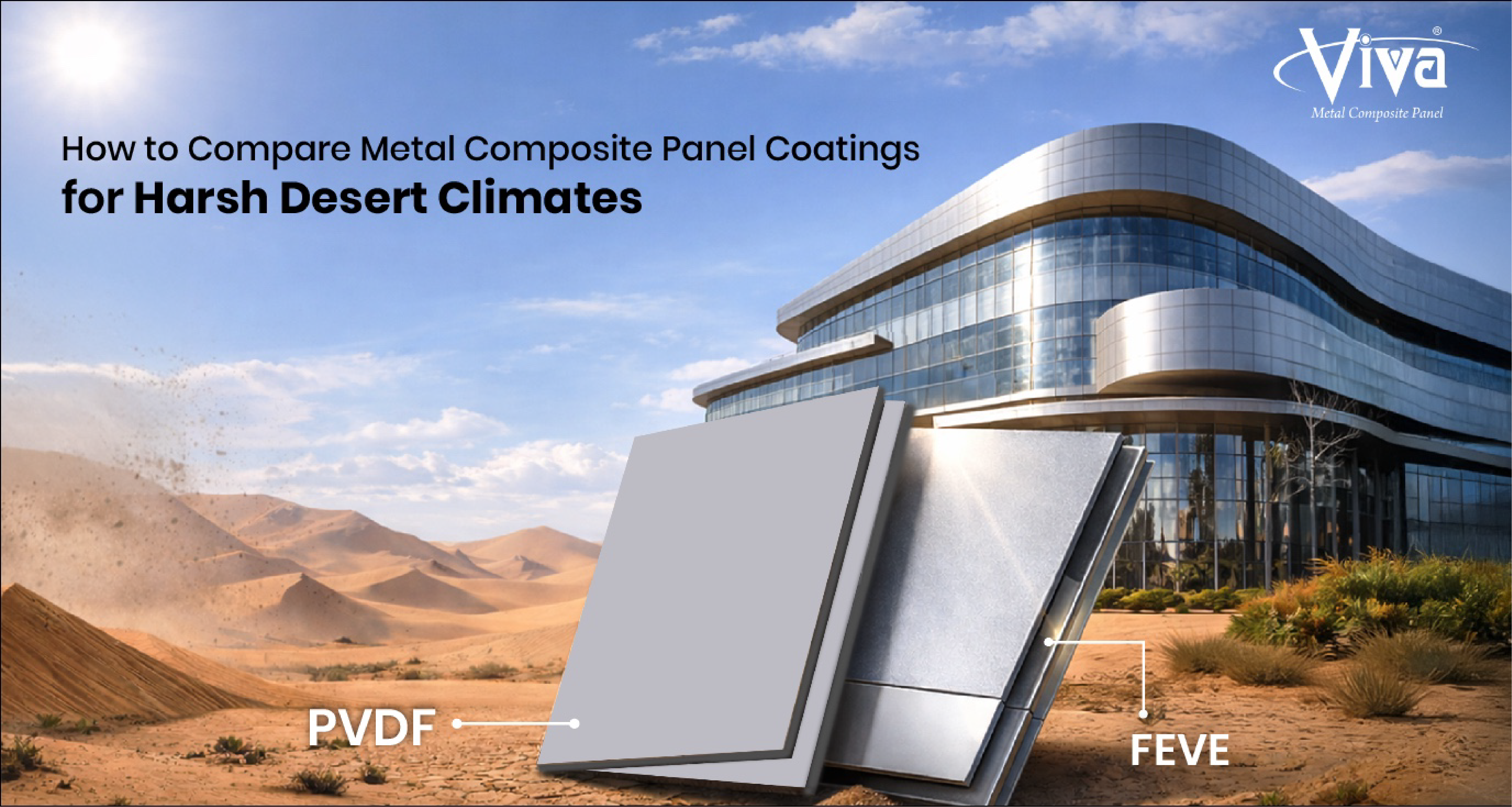
In a desert climate, facades are not mere aesthetic material. They also play a role in protection from intense sunlight, scorching daytime heat, cool nights, airborne sand, and persistent dust. Thus, many engineers and contractors nowadays prefer metal Composite Panels as claddings. Amongst the various metal options, aluminium composite panels are widely used in desert architecture.
When installed externally, the performance of ACP relies a lot on the coating. It protects the panels from fading, chalking, surface erosion and joint stress. That is why it becomes so important to compare coatings. Some coatings on aluminium composite sheets may look similar. Smooth surface. Even colour. Clean gloss. But under desert conditions, the difference between a high-performance coating and a standard one becomes obvious within a few years.
So, in this article, we will break down how to compare metal composite panel coatings specifically for harsh desert environments, focusing on performance, durability, and long-term value:
The Role of Coatings in Metal Composite Panels
Coating is the outermost layer that acts as a barrier to protect the metal panel. While the aluminium skin provides structure and corrosion resistance, the coating increases the longevity of a structure. They protect the metal from UV degradation, oxidation, and chemical attack. They maintain colour stability and surface appearance.
How to Compare Coatings in Desert Conditions
Since the desert climate needs extra protection, here is how you should compare facade metal composite panels:
UV Resistance and Colour Retention
Most designers and engineers in desert countries like the UAE or Saudi Arabia prefer panels that can withstand the harsh UV rays. If the coating relies on weak polymer chains, it degrades quickly when exposed to continuous sunlight. This leads to fading, loss of gloss, and surface chalking after a few years or in the worst case, after months.
That is why, at Viva, we use high-performance coatings using fluoropolymer chemistry. The strong carbon–fluorine bonds resist UV breakdown and act as a shield. The coating reflects and absorbs UV energy without damaging the coating structure.
Thermal Stability Under Extreme Heat
Temperature in desert areas can rise up to 45-50 degrees Celsius in summer in daytime. But it also falls sharply at night. This thermal cycling causes the coating to expand during the day, contract at night. As this occurs repeatedly, the adhesion between layers starts to weaken, creating micro-cracks in brittle coatings.
Quality coatings on metal composite panels are engineered in a way that they stay flexible within a wide temperature range. Even though they expand or contract, the coating material does not lose adhesion or surface integrity.
Resistance to Sand and Dust Abrasion
When metal Composite Panels are used for commercial exterior applications, their appearance is valued greatly. But the sandstorm and dust abrasion causes shock waves on the panel. Especially when the airborne sand particles strike façades at high speeds, they slowly erode the coating surface.
While no coating is immune to abrasion, some resist it far better than others. For instance, at Viva, our metal Composite Panels come with protective film with excellent adhesion capability. The nanotechnology-based coating is designed to offer protection against scratches.
Soiling Behaviour and Ease of Maintenance
When you use the Facade metal Composite Panels, dust starts to build up. But in high-rise buildings, cleaning can be quite challenging. This is where high-quality coating makes a major difference.
High-quality coatings have low surface energy, which reduces dust adhesion. Dirt sits on the surface rather than bonding to it, making cleaning easier and less frequent. When cleaned with mild detergent and water, these surfaces recover their appearance without damage.
Types of Metal Composite Panel Coatings
MCP manufacturers apply different types of coating on the sheets, such as:
Polyester (PE) Coatings
They are affordable and versatile, making them a popular choice; the coating also offers several colour ranges and smooth finishes. However, they are not engineered for prolonged UV exposure. When used in external panels, the coating fades quickly in a desert climate, and the surface begins to chalk, increasing the maintenance costs. Plus, the high heat speeds up oxidation, reducing the life span even more.
PVDF Coatings
Polyvinylidene Fluoride (PVDF) coatings are the industry benchmark for exterior performance in harsh climates. The strong fluorine bonds resist UV radiation, chemical exposure, and oxidation. This means the colours and gloss look as good as new even after being exposed to the sun for years. At Viva, we offer ACP panels with PVDF coating. Our panels stay flexible under heat stress, reducing the risk of cracking or adhesion loss.
FEVE (Fluoropolymer) Coatings
FEVE coatings also offer exceptional performance in a desert climate. In fact, they offer additional flexibility in finish options. They are often chosen for high-gloss or specialised aesthetic requirements.
FEVE coatings also provide good UV resistance and weather stability. At Viva, we also use FEVE (Lumiflon) based paint for exterior applications.
Do Coating Thickness and Application Quality Matter?
Sometimes, even with high-quality, coating often fails. It is mostly because of the application quality. The coating of a metal Composite Panels needs to be uniform and to be uniform to offer consistent protection. If the layers are thin or weak, the UV rays will penetrate the panels, leading to abrasion and degradation. That being said, the primary quality is also equally important.
Reputable manufacturers like VIVA control coating processes tightly. We monitor thickness, cure temperatures, and surface preparation. Our panels go through several steps to meet the industry standards.
Final Thoughts
Facade metal composite panels are widely used in the desert climate for their exceptional properties. They don’t rust, offer resistance to UV, are scratch-free and are easy to maintain. However, the coating used on the MCP deeply influences its performance. So, when purchasing ACPs for exterior applications, buyers should always compare the surface coating before making the final decision.
FAQs
Q.1. Why does MCP coating matter in deserts?
In desert regions, coatings protect panels from UV damage, extreme heat, and sand abrasion. The wrong coating can fade, chalk, or crack early, shortening façade life and increasing maintenance costs.
Q.2. Which coating is best for facade metal composite panels?
PVDF and FEVE coatings are best suited for desert climates. Their fluoropolymer chemistry resists UV radiation, heat stress, and weathering far better than standard polyester coatings.
Q.3. Is polyester-coated metal suitable for exterior use?
Polyester coatings may work for interiors or shaded areas, but they are not ideal for desert exteriors. Prolonged sun exposure causes faster fading, chalking, and surface degradation.
Q.4. How do sandstorms affect metal composite panel coatings?
Sandstorms cause continuous surface abrasion. Over time, this can dull gloss and erode weaker coatings. High-performance coatings with better hardness and protective layers resist this wear more effectively.
Q.5. Does coating thickness impact the performance of metal composite panels?
Yes. Uniform and adequate coating thickness ensures consistent UV protection and adhesion. Thin or uneven coatings allow faster degradation, even if the coating type itself is high quality.
POPULAR POSTS
CATEGORIES
- Aluminium Compsoite panel 52
- ACP Sheet 170
- ACP Facade 9
- Copper Aluminium Sheet 1
- Fire Safety For Buildings 3
- ACP Cladding 14
- Colour Coated Aluminium Coil 2
- Aluminium Corrugated Composite Panel 1
- Facades 7
- Aluminium Honeycomb Panel 6
- Fire Retardant 8
- Zinc Composite Panel 4
- Corten Steel Series 1
- Metal Abstract Series 3
- Wooden ACP Sheet 1
- HPL Sheet 3
- Viva ACP Colour Coating 1
- Wall Cladding 2
- Applications of ACP Panel 1
- Viva ACP 14
- ACP Sheets for Architectural Projects 3
- PVDF vs Polyester 3
- ACP Sheets For Showroom 1
- Viva ACP on International Market 1
- Viva royal club app 1
- ACP Sheets for Branding Corporates 1
- Shades of Santa Fe 1
- Al Zinc Series 1
- ACP Sheet Sizes and Thicknesses 1
- Louvers and Baffles 1
- Sustainable Facades 1