



 en
en
 Spanish
 Arabic
 Swahili
 French


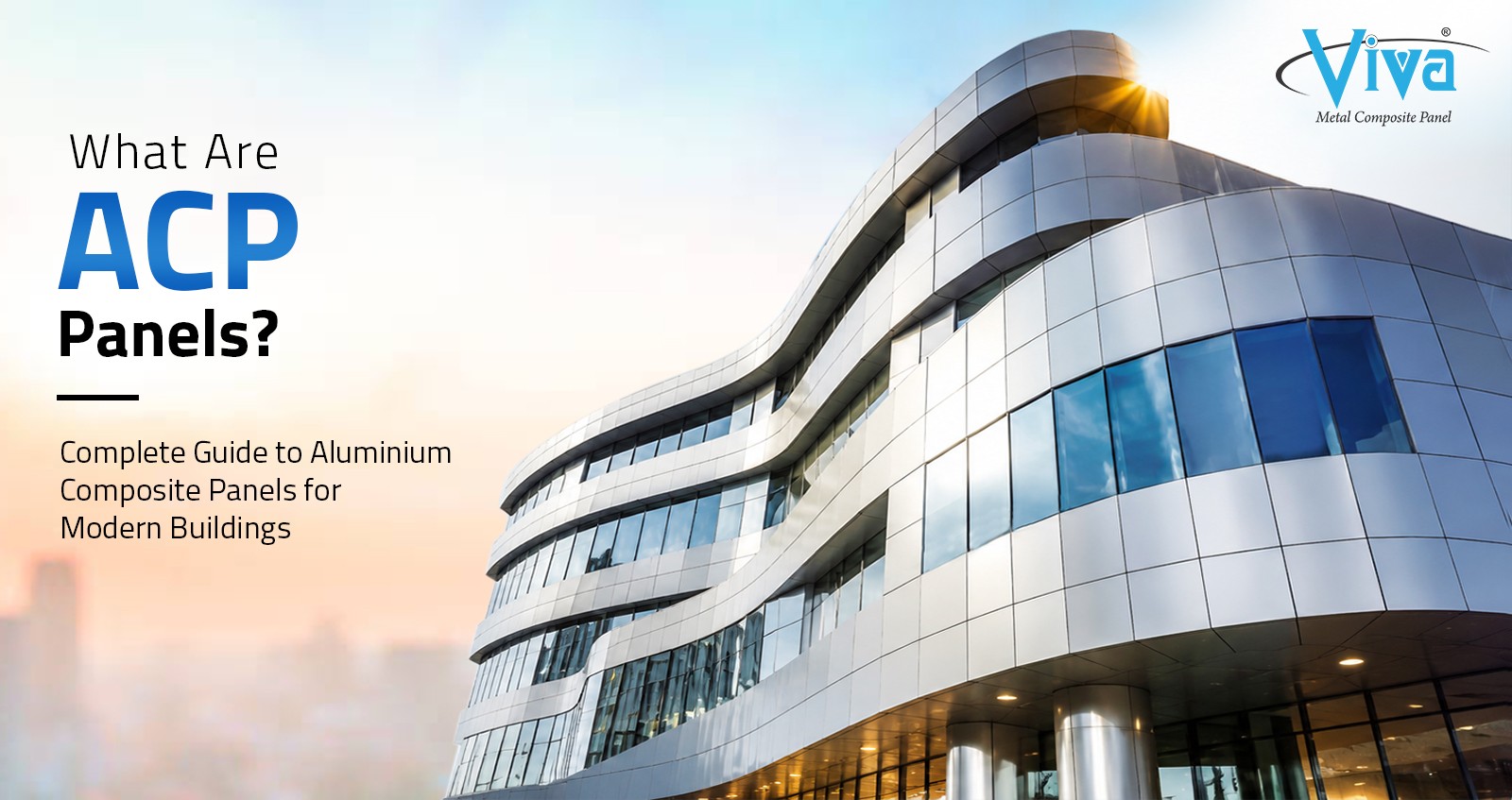
ACP panels (aluminium composite panels) are lightweight cladding sheets made of two thin aluminium layers bonded to a central core. They are used for building facades, interiors, and signage because they are durable, weather-resistant, easy to install, and available in many finishes. Modern ACP panels come in non-fire-rated, fire-retardant (FR), and A2-grade fire-safe versions, and sustainable options like Viva's GreenPro Ecolabel-certified panels now support green-building certifications.
Why Are ACP Panels Widely Used in Modern Buildings?
Look at almost
any contemporary commercial building, showroom, metro station, or corporate
tower and you are likely looking at aluminium composite panels. Over the last
two decades, ACP has become the default material for building facades and
cladding across India and the world — valued for its clean lines, vast colour
palette, and low weight.
But ACP is more
than a decorative skin. Behind that smooth surface sits a carefully engineered
sandwich structure that balances strength, weight, fire performance, and
weather resistance. This complete guide explains what ACP panels are, how they
are made, where they are used, the different types available, and how to choose
the right panel — including why sustainability certifications like the GreenPro
Ecolabel now matter.
Whether you are
an architect specifying a facade, a builder comparing materials, or a property
owner researching options, this pillar guide gives you the full picture of
aluminium composite panels for modern buildings.
What Are ACP Panels Made Of?
An aluminium
composite panel (ACP), also called an aluminium composite material (ACM), is a
flat sheet made by bonding two thin sheets of aluminium to a non-aluminium
core. The result is a rigid yet lightweight panel that is easy to cut, fold,
and fix onto building surfaces.
The typical ACP
sheet has three main layers:
•
Two outer aluminium skins — usually 0.15 mm to
0.50 mm thick, coated with protective paint such as PVDF.
•
A central core — polyethylene (PE),
fire-retardant mineral-filled core, or a corrugated aluminium core.
•
A protective coating and film — the PVDF or FEVE
coating on the exposed face, plus a peel-off protective film during handling.
This sandwich
construction is what gives ACP its signature combination of flatness, rigidity,
and light weight — a panel that behaves like sheet metal but weighs a fraction
as much.
How Are ACP Panels Manufactured?
Quality ACP is
produced on continuous manufacturing lines in two broad stages. Understanding
the process helps you tell a genuine manufacturer from a repackager.
1.
Coil coating: Aluminium coils are cleaned,
pre-treated, and coated with PVDF or FEVE paint on a dedicated coating line,
then oven-cured for consistent colour and film thickness.
2.
Lamination: The coated aluminium skins are
continuously bonded to the core material under heat and pressure using a strong
adhesive film, forming one composite sheet.
3.
Cooling and sizing: The laminated sheet is
cooled, trimmed, and cut to standard panel sizes.
4.
Quality testing: Samples are tested for peel
strength, coating adhesion, fire behaviour, and weathering before dispatch.
A manufacturer
that owns both the coating and lamination lines — as Viva does — controls
quality end to end, which is why in-house production is a key mark of a
reliable ACP brand.
The table below breaks down each layer and the role it plays in performance.
|
Layer |
Material |
Function |
|
Top coating |
PVDF / FEVE paint |
Colour, UV resistance, weatherproofing |
|
Front skin |
Aluminium (0.15–0.50 mm) |
Rigidity, flatness, surface finish |
|
Core |
PE / FR mineral / aluminium |
Bonding, thickness, fire behaviour |
|
Back skin |
Aluminium |
Structural balance, stiffness |
|
Back coating |
Service coat / primer |
Corrosion protection on rear face |
What Are the Different Types of ACP Panels?
ACP is not a single product. Panels are classified by core type (which drives fire performance) and by finish (which drives appearance). Getting both right is essential for a successful facade.
|
Core Type |
Fire Rating |
Best For |
|
Non-FR (PE core) |
Combustible |
Signage, interiors, low-rise, low-risk use |
|
FR (mineral core) |
Fire-retardant |
Mid to high-rise commercial facades |
|
A2 / Aluminium core |
Near non-combustible |
High-rise, hospitals, airports, institutions |
Viva was
the first ACP company in India to introduce the A2+ Aluminium Core Corrugated
Panel (ACCP) — offering one of the highest fire-safety levels available in the
market.
•
Solid colours — clean, uniform shades for
corporate and minimalist facades.
•
Metallic — reflective, premium finishes that
shift with light.
•
Natural stone — the look of granite or marble at
a fraction of the weight.
•
Timber / wood — warm wood-grain aesthetics
without maintenance issues.
•
Corten / weathered steel — industrial, rustic
tones for statement architecture.
•
Mirror and sparkle — decorative finishes for
accents and interiors.
What Are the Benefits of ACP Panels?
ACP's popularity comes down to a rare balance of properties that few other cladding materials match at the same price point.
|
Property |
Benefit for Buildings |
|
Lightweight |
Reduces structural load and installation cost |
|
Weather-resistant |
Withstands UV, rain, and temperature swings |
|
Flat and rigid |
Delivers clean, modern facade surfaces |
|
Easy to fabricate |
Can be cut, routed, folded, and curved on site |
|
Wide finish range |
Enables varied, distinctive facade design |
|
Low maintenance |
Simple cleaning keeps facades looking new |
|
Fire-rated options |
FR and A2 cores meet strict safety codes |
|
Recyclable |
Aluminium is infinitely recyclable, lowering impact |
Where Are ACP Panels Used?
Because of its
versatility, ACP appears across almost every building type and many
non-building uses.
•
Building facades and cladding — the largest
application, on commercial and residential exteriors.
•
Interior wall panelling — lobbies, corridors,
feature walls, and false ceilings.
•
Signage and branding — retail fascias,
hoardings, and corporate identity walls.
•
Column and canopy cladding — wrapping structural
elements for a finished look.
•
Infrastructure and transport — metro stations,
airports, and transit hubs.
•
Partitions and furniture — durable surfaces for
interiors and fit-outs.
While custom sizes are available, most ACP is produced to standard dimensions for compatibility with common facade systems.
|
Specification |
Common Options |
|
Panel thickness |
3 mm, 4 mm, 6 mm |
|
Aluminium skin |
0.15 mm, 0.21 mm, 0.25 mm, 0.30 mm, 0.50 mm |
|
Standard width |
1220 mm, 1250 mm, 1500 mm (up to ~1670 mm) |
|
Standard length |
2440 mm, 3050 mm, 4050 mm (custom lengths available) |
|
Coating |
PVDF, FEVE, or polyester depending on grade |
For detailed ACP panel sizes, finishes, and product
specifications, explore the ACP catalogue.
For exterior
facades, 4 mm panels with 0.25–0.50 mm skins and PVDF coating are the most
common specification, balancing rigidity and cost.
Are ACP Panels Sustainable?
As green
building becomes standard practice, the environmental profile of facade
materials has moved to the centre of specification decisions. ACP has a natural
advantage: aluminium is one of the most recyclable materials on earth, and
modern coatings are increasingly low-VOC.
The strongest
India-specific proof point is the GreenPro Ecolabel, a life-cycle-based
certification from CII that evaluates a product's environmental impact from raw
material to end of life.
Industry first: Viva is the first ACP manufacturer
in India to achieve the GreenPro Ecolabel certification. For projects
pursuing IGBC or LEED ratings, specifying GreenPro-certified ACP contributes
directly to green-building credits — turning a facade material into a
documented sustainability advantage.
When comparing
ACP brands on sustainability, look for GreenPro Ecolabel certification, an
Environmental Product Declaration (EPD), high recyclable aluminium content, and
compliant low-VOC coatings.
How Do You Choose the Right ACP Panel?
Selecting ACP
comes down to matching the panel to the project's safety, performance, and
design requirements. Use this quick decision framework:
5.
Fire requirement first — pick the core (Non-FR,
FR, or A2) based on building height and occupancy.
6.
Coating grade — choose 70% KYNAR 500 PVDF for
long-term colour and weather resistance.
7.
Finish and colour — select the aesthetic that
fits the design and confirm batch consistency.
8.
Sustainability — prioritise GreenPro-certified
panels for green-building projects.
9.
Manufacturer credibility — verify in-house
production, certifications, and warranty.
How Are ACP Panels Installed?
A facade is
only as good as the system that holds it. ACP panels are fixed to buildings
using engineered sub-frame systems that manage load, movement, and weather.
Understanding the main methods helps you plan for performance and longevity.
•
Cassette system — panels are folded into tray
shapes and hooked onto a hidden aluminium sub-frame, giving a clean, jointed
look with concealed fixings.
•
Routed and returned — the panel is grooved on
the back and folded at the edges to form a rigid cassette, the most common
premium facade method.
•
Direct fixing — panels are screwed or riveted to
a frame, a simpler and lower-cost approach for signage and low-rise work.
•
Ventilated (rainscreen) facade — panels are
mounted with an air gap behind them, improving thermal performance and moisture
management.
For related facade guidance, explore VIVA's ACP and facade
blog articles.
The rainscreen
approach is increasingly favoured on green projects because the ventilated
cavity reduces heat transfer into the building, lowering cooling loads while
protecting the structure from rain.
How Do You Maintain ACP Panels?
One of ACP's quiet advantages is how little upkeep it needs. A well-specified panel with a premium PVDF coating can look sharp for 15 to 20 years or more with minimal attention.Practical maintenance guidance includes:
10.
Routine cleaning — wash facades periodically
with mild detergent and water to remove dust and pollution.
11.
Avoid abrasives — never use harsh chemicals or
scouring pads that can damage the coating.
12.
Inspect joints and sealants — check gaskets and
sealant lines during periodic facade inspections.
13.
Address damage early — repair or replace
individual panels promptly to maintain performance.
Because ACP is
modular, individual panels can usually be replaced without disturbing the whole
facade — a maintenance benefit that extends the system's effective life and
reduces waste.
What Factors Affect ACP Panel Cost?
ACP pricing varies widely, and understanding the drivers helps you compare quotes fairly rather than on headline rate alone.|
Cost Factor |
Effect on Price |
|
Core type |
A2 and FR cores cost more than non-FR PE |
|
Coating grade |
70% PVDF costs more than polyester but lasts longer |
|
Aluminium skin thickness |
Thicker skins add material cost and rigidity |
|
Finish |
Stone, timber, and metallic finishes are premium |
|
Panel thickness |
6 mm panels cost more than 3 mm |
|
Certification |
Certified panels reflect tested, verified quality |
The cheapest
panel is rarely the most economical over a facade's life. A slightly higher
upfront spend on a proper core, coating, and certification typically saves far
more in avoided fading, repairs, and compliance issues.
•
"All ACP is a fire risk." Not true —
FR and A2-grade cores are engineered specifically for fire safety and meet
strict codes.
•
"ACP fades quickly." Only low-grade
polyester coatings fade; 70% PVDF coatings retain colour for years.
•
"ACP is not eco-friendly." Aluminium
is highly recyclable, and GreenPro-certified panels are verified for
environmental performance.
•
"All ACP brands are the same." Core
type, coating grade, and manufacturing quality vary widely between brands.
Aluminium
composite panels have earned their place as the backbone of modern facade
design because they combine light weight, durability, design freedom, and — in
their FR and A2 forms — serious fire safety. The key is specification: the
right core, the right coating, and a credible manufacturer behind the panel.
With
sustainability now central to construction, choosing a certified, responsibly
made panel matters more than ever. As the first ACP manufacturer in India to
achieve the GreenPro Ecolabel certification, Viva offers a range that meets
both the performance and the environmental expectations of today's buildings.
Explore Viva's
full ACPpanel range to find the right panel — fire-safe, weather-resistant,
and sustainability-certified — for your next project.
Frequently Asked Questions (FAQs)
Q1. What are ACP panels?
ACP panels, or
aluminium composite panels, are lightweight cladding sheets made of two thin
aluminium layers bonded to a central core such as polyethylene, a
fire-retardant mineral core, or aluminium. They are widely used for building
facades, interiors, and signage due to their durability, weather resistance,
and wide range of finishes.
Q2. What are ACP panels made of?
An ACP panel is
made of two outer aluminium skins bonded to a non-aluminium core. The exposed
face is coated with PVDF or FEVE paint for weather and UV resistance. The core
can be polyethylene (non-FR), a fire-retardant mineral-filled material (FR), or
a corrugated aluminium core (A2 grade) for maximum fire safety.
Q3. What is the difference between FR and non-FR ACP panels?
Non-FR ACP has
a polyethylene core that is combustible and suited only to low-rise or interior
use. FR ACP has a fire-retardant mineral-filled core that slows flame spread
and is used on commercial facades. A2-grade panels with an aluminium core offer
the highest, near non-combustible fire safety for high-rise and institutional
buildings.
Q4. Where are ACP panels used?
ACP panels are
used for building facades and exterior cladding, interior wall panelling and
ceilings, signage and branding, column and canopy cladding, and infrastructure
projects such as metro stations and airports. Their light weight and design
flexibility make them suitable for both exterior and interior applications.
Q5. Are ACP panels environmentally friendly?
ACP panels can
be environmentally friendly, especially when made with recyclable aluminium and
low-VOC coatings. The strongest proof is third-party certification such as the
GreenPro Ecolabel. Viva is the first ACP manufacturer in India to achieve
GreenPro Ecolabel certification, and its panels support IGBC and LEED
green-building credits.
Q6. What thickness of ACP panel is best for exterior facades?
For exterior
building facades, 4 mm ACP panels with aluminium skins of 0.25 mm to 0.50 mm
and a PVDF coating are the most common and recommended specification. This
combination provides the rigidity, flatness, and weather resistance needed for
durable, long-lasting facades.
POPULAR POSTS
CATEGORIES
- Aluminium Compsoite panel 52
- ACP Sheet 170
- ACP Facade 9
- Copper Aluminium Sheet 1
- Fire Safety For Buildings 3
- ACP Cladding 14
- Colour Coated Aluminium Coil 2
- Aluminium Corrugated Composite Panel 1
- Facades 7
- Aluminium Honeycomb Panel 6
- Fire Retardant 8
- Zinc Composite Panel 4
- Corten Steel Series 1
- Metal Abstract Series 3
- Wooden ACP Sheet 1
- HPL Sheet 3
- Viva ACP Colour Coating 1
- Wall Cladding 2
- Applications of ACP Panel 1
- Viva ACP 14
- ACP Sheets for Architectural Projects 3
- PVDF vs Polyester 3
- ACP Sheets For Showroom 1
- Viva ACP on International Market 1
- Viva royal club app 1
- ACP Sheets for Branding Corporates 1
- Shades of Santa Fe 1
- Al Zinc Series 1
- ACP Sheet Sizes and Thicknesses 1
- Louvers and Baffles 1
- Sustainable Facades 1