



 en
en
 Spanish
 Arabic
 Swahili
 French


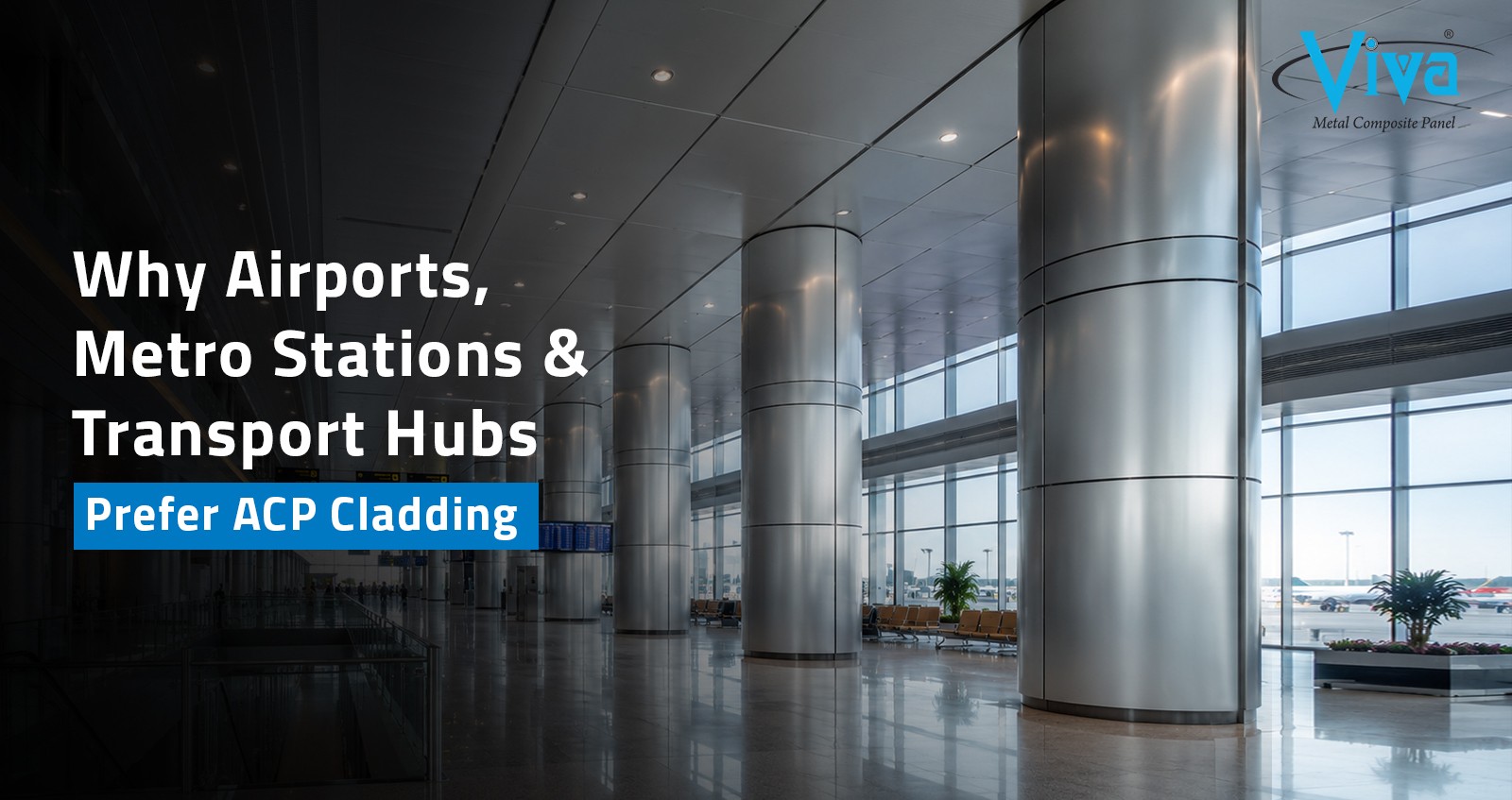
Walk through any major airport terminal, metro station, or bus rapid transit hub built in the past decade, and the chances are high that the facade cladding, ceiling panels, column wraps, and interior linings are aluminium composite panels. This is not coincidental - transport infrastructure projects have a unique set of demands that ACP meets better than almost any other material. From the sheer scale of coverage required to the unforgiving performance standards for fire safety, durability, and lifecycle maintenance, ACP has become the material of choice for infrastructure architects, project managers, and facility operators worldwide.
The Scale Challenge in Transport Infrastructure
Transport hubs are among the largest building types in the construction industry. A single terminal building at a major international airport can encompass hundreds of thousands of square metres of facade and interior wall area. Metro station platforms, concourses, exit pavilions, and ventilation shafts collectively represent enormous surface areas across an entire network.
For projects at this scale, material selection is as much a logistics and installation engineering question as a design one. ACP cladding solves the scale challenge in several ways:
• Large-format panels (available in standard sizes up to 1500 x 5800 mm and custom sizes beyond) minimise the number of individual units required, reducing joints, installation time, and labour cost
• Lightweight panels (typically 5-8 kg per square metre) can be handled and installed rapidly by small teams, without crane dependency for individual panel lifts
• Consistent, factory-controlled finish quality means that across an airport terminal of 50,000 sq.m or a metro network of 30 stations, every panel looks identical - critical for brand consistency in public infrastructure
• Panels are pre-cut to specification in the fabrication shop, arriving on site ready to fix with minimal on-site cutting waste
This combination of large format, lightweight, and factory-finished quality is simply not achievable with alternative materials like stone, tile, or glass at transport hub scale.
Fire Performance: The Non-Negotiable Requirement
No requirement is more stringent in transport infrastructure than fire safety. Airports, metro stations, and rail terminals are classified as high-risk occupancy buildings under Indian and international building codes, requiring facade and interior materials that meet the most demanding fire-resistance standards. A fire incident in a transport hub carries enormous life-safety risk given the density of occupants and the challenges of emergency evacuation.
ACP panels specified for transport infrastructure must meet stringent fire performance classifications:
• FR Class A2 (Non-combustible): Achieved with fire-retardant mineral core ACP, this is the minimum standard for high-rise and large public assembly buildings and is mandatory in many transport hub specifications
• FR Class A2+ (Aluminium Corrugated Core): Viva ACP's ACCP panels use a solid aluminium corrugated core - the highest level of fire safety in composite panel technology - delivering non-combustible performance comparable to solid aluminium
Transport infrastructure authorities and fire safety engineers increasingly specify FR Class A2 or better as a baseline for all interior and exterior cladding. This requirement effectively rules out conventional LDPE-core ACP and positions mineral core and corrugated core panels as the standard for this sector.
Durability Under Extreme Conditions
Transport hubs operate continuously - often 24 hours a day, 365 days a year. They are subject to constant mechanical vibration from aircraft taxiing, train movements, and heavy vehicle traffic. They experience rapid and repeated temperature cycling as thousands of travellers pass through climate-controlled interiors. Coastal airports contend with salt-laden air; inland hubs face extreme heat and dust; elevated metro structures must withstand thermal expansion and wind loading year after year.
ACP cladding is engineered for exactly these conditions:
• PVDF-coated aluminium skins maintain colour stability and gloss retention for decades, resisting UV degradation, pollution staining, and surface oxidation
• The composite construction absorbs vibration and impact better than brittle materials like ceramic tile or natural stone, which are prone to cracking under repeated mechanical stress
• Aluminium's natural corrosion resistance is enhanced by the PVDF coating, making it suitable for coastal and humid environments without protective treatments
• Thermal expansion joints engineered into ACP facade systems accommodate the seasonal movement of large cladding areas without panel buckling or joint failure
Major Indian airports including those in Mumbai, Delhi, Bengaluru, and Hyderabad, as well as metro networks in cities including Delhi, Mumbai, Chennai, Bengaluru, Kochi, and Hyderabad, have extensively used ACP for both exterior and interior applications - with performance records spanning over a decade of heavy use.
Low Maintenance Lifecycle Costs
For facility managers responsible for transport infrastructure, maintenance cost over a 30-year lifecycle is often more important than initial material cost. A material that requires frequent replacement, specialist cleaning, or periodic recoating rapidly becomes expensive to maintain across tens of thousands of square metres.
ACP cladding's maintenance credentials are strong:
• PVDF-coated surfaces are self-cleaning to a significant degree - rainfall naturally washes away surface dust and most organic deposits
• Where cleaning is required, standard pressure washing with mild detergent is sufficient - no specialist chemical treatments or access equipment beyond routine building maintenance
• Unlike natural stone, which can stain permanently from grease, jet fuel, or chemical spills common in transport environments, ACP surfaces are chemically resistant and can be cleaned to near-original condition
• In the event of localised damage - graffiti, impact damage, or vandalism - individual panels can be replaced without disturbing surrounding panels, keeping repair costs proportionate to the area of damage
Aesthetics and Brand Identity at Infrastructure Scale
Transport hubs are civic landmarks. An international airport terminal or a metro station is often the first and last experience of a city that millions of travellers have. The architectural identity of these buildings matters - they represent the city, the national infrastructure operator, and a vision of modernity and progress.
ACP cladding gives infrastructure architects the design flexibility to create compelling visual identities at scale:
• 500-plus shade options allow precise colour matching to national, regional, or operator brand palettes
• Metallic, brushed, mirror, and patterned finishes create visual richness that plain painted concrete cannot achieve
• Curved and folded panel geometries are achievable, enabling the flowing, organic roof lines and canopy forms that define contemporary transport architecture
• Consistent colour and finish quality across enormous surface areas is guaranteed by factory-controlled PVDF coating processes
Material Comparison for Transport Hub Cladding
Requirement ACP Cladding Natural Stone Ceramic Tile GRC
Fire Rating A2 Achievable Yes No Partially Partially
Weight (kg/sq.m) 5-8 40-80 20-40 30-50
Large Format Panels Yes Limited No Yes
Maintenance Intensity Low High Medium Medium
Installation Speed Fast Slow Medium Medium
Colour Consistency at Scale Excellent Variable Good Good
30-Year Warranty Yes (certified) No No No
Frequently Asked Questions
1. What fire rating is required for ACP used in airports and metro stations in India?
For airports, metro stations, and large public assembly buildings, ACP panels with FR Class A2 or FR Class A2+ certification are typically required. This means specifying mineral core or aluminium corrugated core panels rather than standard LDPE core. Viva ACP's FR A2 and FR A2+ (ACCP) products carry internationally recognised fire test certifications and are specified across major Indian infrastructure projects.
2. How is ACP installed on large-scale transport infrastructure facades?
ACP for transport hubs is typically installed using an engineered sub-frame system - either a standard aluminium cassette and rail system for flat facades, or a custom-engineered rainscreen system for complex geometries. Panels are CNC-cut to specification off-site and arrive ready to fix. For live transport infrastructure, installation can be phased to avoid disruption to operations.
3. Can ACP cladding withstand the vibration from aircraft and train movements?
Yes. ACP's composite construction - aluminium skins bonded to a core material - gives it excellent vibration damping properties. The panel fixing system is designed with tolerance to accommodate dynamic movement. ACP has a well-established performance record on airport and railway infrastructure worldwide, including on structures directly adjacent to runways and rail lines.
4. How long does ACP cladding last on a transport hub before replacement is needed?
With PVDF coating and proper installation, ACP panels are expected to perform for 25-30 years before any consideration of replacement. This aligns with the typical asset renewal cycles of transport infrastructure. Viva ACP provides a 30-year warranty on its PVDF-coated panels, which is one of the longest in the industry.
5. Is ACP suitable for both interior and exterior applications in transport hubs?
Yes. ACP is used extensively for both exterior facade cladding and interior wall lining, ceiling panels, column wraps, and signage in transport hubs. For interior applications in high-occupancy areas, FR Class A2 panels are specified. Interior ACP panels can be fabricated with special finishes - anti-graffiti, anti-bacterial, or anti-scratch coatings - which are particularly valuable in high-traffic public transport environments.
POPULAR POSTS
CATEGORIES
- Aluminium Compsoite panel 52
- ACP Sheet 170
- ACP Facade 9
- Copper Aluminium Sheet 1
- Fire Safety For Buildings 3
- ACP Cladding 14
- Colour Coated Aluminium Coil 2
- Aluminium Corrugated Composite Panel 1
- Facades 7
- Aluminium Honeycomb Panel 6
- Fire Retardant 8
- Zinc Composite Panel 4
- Corten Steel Series 1
- Metal Abstract Series 3
- Wooden ACP Sheet 1
- HPL Sheet 3
- Viva ACP Colour Coating 1
- Wall Cladding 2
- Applications of ACP Panel 1
- Viva ACP 14
- ACP Sheets for Architectural Projects 3
- PVDF vs Polyester 3
- ACP Sheets For Showroom 1
- Viva ACP on International Market 1
- Viva royal club app 1
- ACP Sheets for Branding Corporates 1
- Shades of Santa Fe 1
- Al Zinc Series 1
- ACP Sheet Sizes and Thicknesses 1
- Louvers and Baffles 1
- Sustainable Facades 1